
A leasehold service charge is a recurring, variable payment leaseholders make to cover their share of the costs for maintaining, repairing, and insuring a building's shared spaces and services. Under the Landlord and Tenant Act 1985, these charges must be reasonable and lease-authorised to be legally enforceable. If you own a flat in England or Wales, understanding exactly what you are paying for, and what you can challenge, is one of the most practical things you can do as a leaseholder.
What is a leasehold service charge and what does it cover?
A leasehold service charge is defined as any variable amount a leaseholder pays towards the costs of services, repairs, maintenance, improvements, insurance, or management of a building. The charge is not fixed. It rises and falls depending on actual expenditure, which is why leaseholders often find it difficult to budget for.
The typical cost categories covered by service charges include:
- Building insurance: The landlord arranges cover for the structure, and leaseholders fund it through the service charge.
- Utilities for communal areas: Electricity for hallways, lifts, and car parks falls here.
- Cleaning and upkeep: Regular cleaning of communal areas such as stairwells, lobbies, and gardens.
- Repairs and maintenance: Day-to-day fixes and planned maintenance to the building fabric.
- Reserve or sinking funds: Contributions set aside for large future works such as roof replacements or lift overhauls.
- Major works: One-off projects like external redecoration or structural repairs, which can generate significant one-off demands.
- Management fees: Costs charged by a managing agent or Resident Management Company for administering the building.
One point that catches many leaseholders off guard: management fees form part of service charges only if reasonable and lease-authorised. A managing agent cannot simply add a fee that the lease does not permit. These fees are one of the most common triggers for disputes.
Service charges are also legally distinct from ground rent and estate management charges. Ground rent is a separate payment to the freeholder for the land itself. A leasehold estate management charge, sometimes called an estate charge, applies to privately managed estates and covers roads, open spaces, and shared infrastructure outside the building. Knowing which fee is which matters when you are reviewing your annual demands.

Pro Tip: Read your lease's service charge schedule carefully. It lists every category of expenditure the landlord is permitted to recover. Any cost not listed in the schedule cannot legally be charged to you.
How are leasehold service charges calculated and demanded?
Service charges are calculated using a method set out in your lease. The three most common approaches are:
- Proportion by floor area: Your flat's square footage as a percentage of the total building area determines your share.
- Fixed equal shares: Each flat pays an identical proportion regardless of size, common in smaller blocks.
- Lease-specified percentage: Your lease states a fixed percentage, such as 15%, that you pay of total costs.
The billing process follows a standard annual cycle. The landlord or managing agent issues a budget forecast at the start of the year, setting out anticipated expenditure. Leaseholders pay on account against that budget, typically monthly or quarterly. At the year end, actual costs are reconciled against the budget. If spending was lower than forecast, you receive a credit or surplus. If it was higher, you face a deficit demand.
A critical legal protection sits within this process. Under Section 20B of the Landlord and Tenant Act 1985, landlords must demand costs within 18 months of incurring them. If they fail to notify you within that window, they lose the right to recover those costs entirely. This rule is frequently overlooked, yet it is one of the strongest protections leaseholders hold.
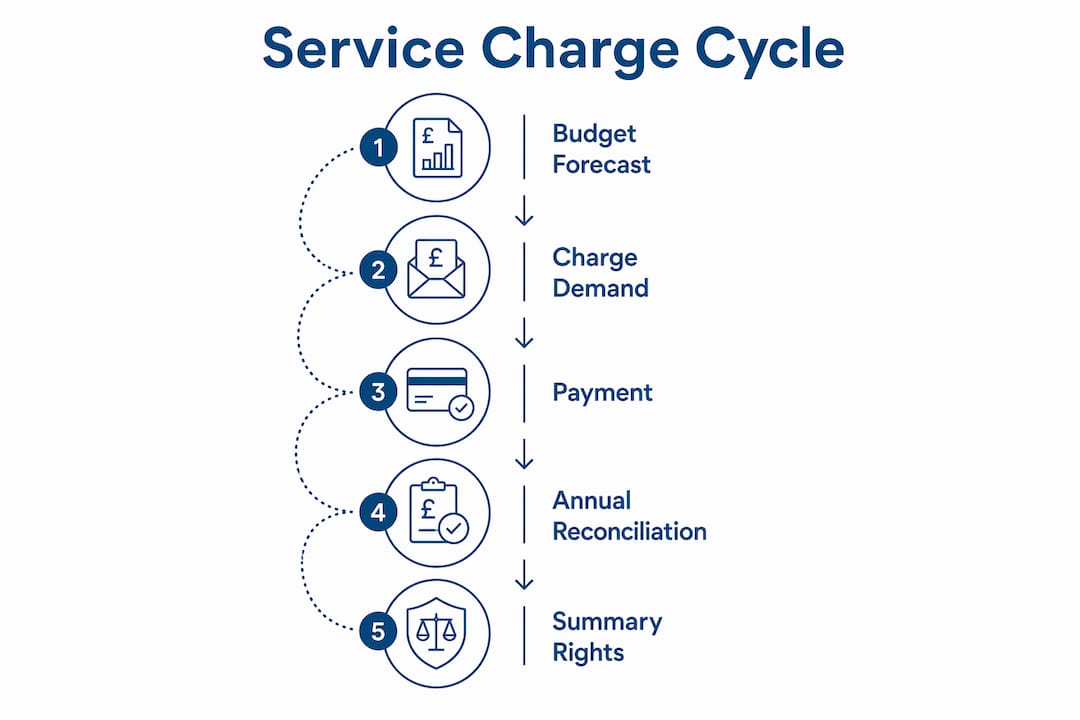
Every valid service charge demand must also include a statutory Summary of Rights and Obligations. A demand without this document is legally invalid. You are entitled to withhold payment until the correct paperwork is supplied, and no arrears accumulate in the meantime.
| Demand Requirement | What Happens If Missing |
|---|---|
| Summary of Rights and Obligations | Demand is invalid; payment can be withheld without penalty |
| Costs demanded within 18 months | Landlord loses the right to recover those costs |
| Lease authorisation for the charge | Charge is unenforceable regardless of amount |
| Reasonableness of the amount | Tribunal can reduce or disallow the charge |
Pro Tip: Keep every service charge demand you receive. If a landlord tries to bill you for costs incurred more than 18 months ago without prior notification, you have a statutory right to refuse payment.
What rights do leaseholders have over service charges?
Leaseholders in England and Wales hold significant statutory rights that many never use. The starting point is the right to inspect. You can request to see the accounts, receipts, and invoices that underpin any service charge demand. The landlord must provide a summary of costs within one month of a written request, and you have the right to inspect supporting documents within six months.
The most powerful protection is the reasonableness requirement. A charge is only payable if:
- The services or works were carried out to a reasonable standard.
- The costs incurred were reasonable in amount.
- The lease permits the landlord to recover that category of expenditure.
If you believe a charge fails any of these tests, you can apply to the First-tier Tribunal (Property Chamber in England, Leasehold Valuation Tribunal in Wales) for a determination. The Tribunal reviews the necessity of works, the proportionality of management fees, and whether the lease supports the charge. Landlords cannot profit from service charges. Any surplus must be held on trust for leaseholders, not retained by the freeholder.
Service charge money must be held on trust by landlords in separate accounts for the benefit of leaseholders, protecting funds even if landlord insolvency occurs.
This trust status is not a technicality. It means that if your freeholder becomes insolvent, your service charge contributions cannot be seized by creditors. The funds remain ringfenced for the building's maintenance.
One area where leaseholders frequently make a costly mistake: withholding payment without a formal challenge. Non-payment of service charges risks forfeiture proceedings, which can ultimately threaten your ownership of the flat. The correct approach is to pay under protest, then challenge the charge through the Tribunal. You can also explore leaseholder dispute resolution options before escalating to a formal application.
What should you do if service charges seem unfair?
Suspecting that your service charges are excessive or mismanaged is common. Acting on that suspicion effectively is what separates leaseholders who recover money from those who simply pay and resent.
Start with documentation. Write formally to your landlord or managing agent requesting:
- A full breakdown of the current year's budget and actual expenditure to date.
- Copies of invoices and contracts for any major works.
- Details of how your proportion of costs is calculated.
- The name and contact details of the managing agent responsible for the building.
If the managing agent is unresponsive or the landlord refuses to provide information, you have statutory rights to compel disclosure. A written request under Section 21 of the Landlord and Tenant Act 1985 requires the landlord to supply a summary of costs within one month.
Where a Resident Management Company (RMC) is involved, the dynamics shift. An RMC is controlled by leaseholders themselves, which should mean greater transparency. If your building has an RMC but you still face unexplained charges, request the company's accounts directly as a shareholder or member.
For persistent problems, the First-tier Tribunal is the formal route. Applications are relatively low cost and do not require a solicitor, though legal advice helps for complex cases. Mediation through the Leasehold Advisory Service (LEASE) is also available and can resolve disputes without a hearing.
Pro Tip: Always put complaints about service charges in writing and keep copies. A paper trail strengthens any Tribunal application and demonstrates you acted in good faith before escalating.
Key takeaways
A leasehold service charge is only enforceable if it is reasonable, lease-authorised, and demanded correctly within the statutory 18-month window.
| Point | Details |
|---|---|
| Definition of service charge | A variable payment covering maintenance, insurance, repairs, and management of shared building areas. |
| 18-month billing rule | Landlords must demand costs within 18 months or lose the legal right to recover them. |
| Demand validity | Every demand must include a Summary of Rights and Obligations or payment can be withheld without penalty. |
| Right to challenge | Leaseholders can apply to the First-tier Tribunal to dispute unreasonable or unauthorised charges. |
| Trust protection | Service charge funds must be held in a separate trust account, protecting leaseholders if the landlord becomes insolvent. |
The uncomfortable truth about service charge disputes
Most leaseholders I speak with have been overpaying for years before they realise it. The system is not designed to make it easy to spot problems. Budgets arrive in dense spreadsheets, invoices are rarely shared proactively, and managing agents rely on the fact that most people will not take the time to scrutinise the figures.
The single biggest mistake I see is leaseholders treating service charges as fixed facts rather than negotiable figures. They are not fixed. Every line item is subject to the reasonableness test, and the Tribunal exists precisely because Parliament recognised that landlords and agents do not always act in leaseholders' interests.
That said, I would caution against treating every charge as a battle. Some managing agents are genuinely competent and transparent. The goal is informed engagement, not reflexive suspicion. Request the accounts, read the lease, and ask specific questions. You will quickly learn whether you are dealing with a well-run building or one where costs are being inflated.
The Leasehold and Freehold Reform Act 2024 has begun to shift the balance further towards leaseholders, with stronger transparency requirements on the horizon. The direction of travel is clear. Leaseholders who understand their rights now are better placed to benefit from those changes as they take effect.
If the managing agent is the root problem, the Right to Manage process gives qualifying leaseholders the legal power to take over building management without buying the freehold. That is a more permanent solution than disputing individual charges year after year.
— Paul
How Righttomanage can help you take control
If excessive or opaque service charges are a recurring problem in your building, the issue may run deeper than a single disputed invoice. Poor managing agents and freeholder indifference are systemic problems that individual challenges rarely fix permanently.

Righttomanage helps leaseholders exercise their Right to Manage legally and efficiently, taking full control of building management without purchasing the freehold. The service covers eligibility checks, RTM company formation, Section 78 and Section 79 notices, counter-notice review, and acquisition-date preparation. If your building qualifies, you can replace the managing agent, appoint your own contractors, and set service charge budgets transparently. Start with a free RTM eligibility check to find out whether your block qualifies.
FAQ
What is a leasehold service charge in simple terms?
A leasehold service charge is a variable payment leaseholders make to fund the maintenance, repair, insurance, and management of their building's shared areas. The amount changes each year based on actual costs.
Can a landlord charge whatever they want for services?
No. Under the Landlord and Tenant Act 1985, all service charges must be reasonable in amount, reflect services actually provided, and be permitted by the lease. The First-tier Tribunal can reduce or disallow any charge that fails these tests.
What happens if i refuse to pay my service charge?
Withholding payment without a formal challenge risks forfeiture proceedings, which can threaten your ownership of the flat. The correct approach is to pay under protest and then apply to the First-tier Tribunal to dispute the charge.
How do i know if my service charge demand is legally valid?
A valid demand must include a statutory Summary of Rights and Obligations. Without this document, the demand is legally invalid and you may withhold payment without accumulating arrears until the correct paperwork is supplied.
What is the 18-month rule for service charges?
Under Section 20B of the Landlord and Tenant Act 1985, landlords must demand costs within 18 months of incurring them. If they miss this deadline without notifying you, they lose the right to recover those costs from you entirely.