
Communal areas in leasehold buildings are shared spaces managed by the freeholder or their appointed managing agent, with leaseholders contributing financially through service charges that cover maintenance, repairs, and statutory compliance. Understanding how communal areas are managed in leasehold buildings is the difference between accepting poor conditions and knowing exactly when you have grounds to push back. Stairwells, lifts, entrance lobbies, gardens, bin stores, and car parks all fall within this shared framework. The costs are real, the legal protections are specific, and the options available to leaseholders have expanded significantly since the Leasehold and Freehold Reform Act 2024 came into force.
Who is responsible for managing communal areas in leasehold buildings?
The freeholder owns the communal areas and appoints the managing agent who handles day-to-day tasks including maintenance, safety checks, and resident communication. This is the foundational structure of leasehold building management, and it explains why leaseholders often feel powerless. You pay for the upkeep of spaces you do not control.
The managing agent acts on behalf of the freeholder. Their duties typically include arranging cleaning contracts, organising repairs, commissioning fire risk assessments, and managing contractor relationships. The quality of this work varies enormously between agents, and there is no universal licensing requirement in England that guarantees a minimum standard of service.

Leaseholders maintain their flats internally but bear no direct responsibility for communal parts. Your lease defines the boundary precisely. The internal walls, floor coverings, and fixtures inside your flat are yours to maintain. Everything beyond that threshold, including the structure, roof, external walls, and all shared spaces, sits with the freeholder.
There are two routes that shift this balance of control toward residents:
- Residents' management company (RMC): Some leases are structured so that leaseholders collectively own a company that holds management responsibilities from the outset. This is common in purpose-built blocks developed with resident control in mind.
- Right to Manage (RTM): Leaseholders can legally acquire management functions from the freeholder without purchasing the freehold and without proving any fault on the freeholder's part. This is a statutory right under the Commonhold and Leasehold Reform Act 2002.
Pro Tip: Check your lease carefully for the term "Residents' Management Company." If one already exists and you are not engaged with it, you may already have more influence over communal space management than you realise.
What do service charges cover for communal area upkeep?
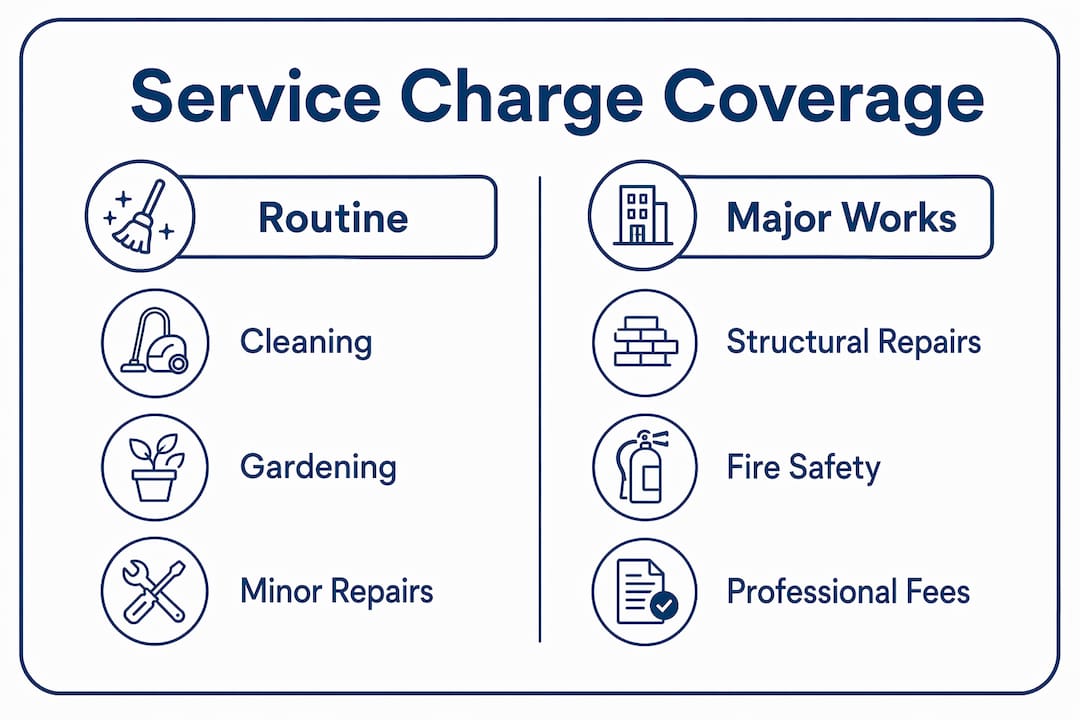
Service charges cover cleaning, lighting, repairs, maintenance of lifts, boilers, alarms, shared facilities, and external grounds. They also include contributions to reserve funds, sometimes called sinking funds, which spread the cost of major future works across leaseholders over time. This is the financial engine behind leasehold building maintenance, and understanding what is legitimately included is your first line of defence against overcharging.
The typical components of a service charge demand include:
- Day-to-day maintenance: Cleaning of communal areas, gardening, window cleaning, and routine repairs to shared fixtures and fittings.
- Utilities: Electricity for communal lighting, water for shared facilities, and heating for any central systems.
- Statutory compliance: Fire alarm testing, lift inspections, asbestos surveys, and electrical installation condition reports.
- Insurance: Buildings insurance for the entire structure, arranged by the freeholder or managing agent.
- Management fees: The agent's fee for administering the building, typically expressed as a percentage of total expenditure or a fixed annual sum.
- Reserve fund contributions: Amounts set aside for future major works such as roof replacement or external redecoration.
| Cost category | What it covers |
|---|---|
| Routine maintenance | Cleaning, gardening, minor repairs to shared areas |
| Statutory compliance | Fire safety, lift certification, electrical checks |
| Insurance | Buildings cover for the whole structure |
| Management fees | Agent's administration and oversight costs |
| Reserve fund | Long-term savings for major structural works |
One distinction that catches many leaseholders off guard involves professional fees versus physical works. Tribunals weigh these differently in disputes. A surveyor's fee for specifying a roof repair is not the same as the cost of the repair itself, and different consultation thresholds can apply. Knowing this distinction matters when you are scrutinising a large demand.
How can leaseholders challenge and monitor communal area costs?
Most leasehold communal area disputes revolve around charge reasonableness and demand timing rather than a desire for higher maintenance standards. This is a revealing insight. Leaseholders are not usually arguing that their building should be maintained to a lower standard. They are arguing that the costs presented to them are unjustified, inflated, or procedurally defective.
The most powerful challenge workflow runs as follows. Obtain a detailed service charge summary from your managing agent. Map each line item against the relevant clause in your lease to confirm the cost is recoverable under the terms you agreed. Then check whether the demand was served within the statutory time limit.
That time limit is critical. Under section 20B of the Landlord and Tenant Act 1985, a landlord has 18 months from the date a cost is incurred to recover it through a service charge demand. Miss that window and the charge becomes unrecoverable. Leaseholders commonly use this rule to resist late demands, and it represents one of the most practical legal protections available to you.
For major works, a separate protection applies. Where works exceed £250 per leaseholder, the freeholder must follow a statutory consultation process under section 20 of the Landlord and Tenant Act 1985. This requires them to notify leaseholders, invite observations, and obtain at least two competitive quotes. Failure to follow this process can lead to the First-tier Tribunal (Property Chamber) capping the recoverable amount at £250 per leaseholder regardless of actual costs.
Pro Tip: Request a written summary of service charge accounts within six months of the end of each accounting period. This is your legal right under section 21 of the Landlord and Tenant Act 1985, and it gives you the documentation needed to mount any challenge.
The First-tier Tribunal is the correct forum for most service charge disputes. It is relatively accessible, does not require legal representation, and can determine whether charges are reasonable. Collective action through a recognised tenants' association also strengthens your position, as it gives residents a formal voice in consultations and increases the pressure on managing agents to justify their costs.
What governance options give leaseholders direct control?
The Right to Manage enables leaseholders to assume building management without proving landlord fault. This is a significant legal right that is still underused. You do not need to demonstrate that your freeholder or managing agent has done anything wrong. You simply need to meet the eligibility criteria and follow the statutory process.
From March 2025, reforms introduced under the Leasehold and Freehold Reform Act 2024 expanded RTM eligibility and removed the requirement for leaseholders to pay the freeholder's legal costs in most cases. This makes RTM a more accessible and financially predictable route than it was previously.
The practical impact of RTM on communal space management is substantial. Once an RTM company acquires management functions, leaseholders appoint their own managing agent or self-manage. They control procurement decisions, set service charge budgets, and choose contractors. Transparency improves because the people paying the bills are also the people approving them.
| Option | Who controls management | Requires freehold purchase | Fault required |
|---|---|---|---|
| Freeholder-appointed agent | Freeholder | No | N/A |
| Residents' management company | Leaseholders (by lease design) | No | No |
| Right to Manage | Leaseholders (by statute) | No | No |
| Collective enfranchisement | Leaseholders (as freeholders) | Yes | No |
Commonhold is a longer-term structural alternative. Under commonhold, each flat owner holds their unit outright and collectively owns the common parts through a commonhold association. There is no freeholder. The Leasehold and Freehold Reform Act 2024 signals a policy direction toward commonhold as the preferred tenure for new builds, though widespread adoption remains years away. For existing leaseholders, RTM remains the most practical near-term route to taking control of building management without the cost of buying the freehold.
You can also compare RTM against a court-appointed manager under section 24 of the Landlord and Tenant Act 1987, which requires proving management failure. RTM requires no such proof, making it the cleaner and more commonly used route.
Key takeaways
Communal area management in leasehold buildings is governed by a clear legal framework, and leaseholders who understand it are far better placed to challenge costs, enforce standards, and take control through RTM.
| Point | Details |
|---|---|
| Freeholder holds responsibility | The freeholder owns and manages communal areas, recovering costs through service charges. |
| Service charges are itemised | Charges cover maintenance, compliance, insurance, management fees, and reserve fund contributions. |
| The 18-month rule protects you | Costs not demanded within 18 months of being incurred cannot be recovered from leaseholders. |
| Section 20 limits major works costs | Works over £250 per leaseholder require statutory consultation or charges may be capped. |
| RTM shifts control without fault | Leaseholders can take over building management through RTM without proving freeholder wrongdoing. |
Why most leaseholders are playing defence when they should be playing offence
I have spoken with hundreds of leaseholders over the years, and the pattern is almost always the same. They receive a service charge demand, feel it is too high, complain informally, get a vague response, and then pay anyway because they do not know what else to do. The frustration is real, but the passivity is a choice.
The legal framework around leasehold building maintenance is genuinely protective if you use it. The 18-month rule, section 20 consultation rights, and the First-tier Tribunal exist precisely because Parliament recognised that leaseholders were structurally disadvantaged. These tools work. The problem is that most residents only discover them after years of overpaying.
My honest view is that RTM is underused not because it is difficult but because leaseholders do not realise they qualify. Many assume their building is too small, too mixed-use, or that their freeholder can simply block the process. The eligibility criteria for RTM are broader than most people think, and the 2025 reforms made the process more accessible still. If you are frustrated with your managing agent, the question is not whether RTM is worth exploring. The question is why you have not started yet.
— Paul
Take control of your building's communal areas with Righttomanage
If poor communal area management is affecting your daily life, whether through neglected maintenance, opaque service charges, or a managing agent that simply does not respond, Righttomanage can help you do something about it.
Righttomanage handles the entire RTM process from start to finish, including eligibility checks, company formation, Section 78 and Section 79 notices, and counter-notice review. You do not need to prove fault. You do not need a solicitor on day one. You need to know whether your building qualifies. Start with a free RTM eligibility check and find out exactly where you stand. If you manage a smaller block, the RTM process for smaller buildings is specifically designed for buildings of two to four flats.
FAQ
Who manages communal areas in a leasehold building?
The freeholder owns and is responsible for communal areas, typically appointing a managing agent to handle day-to-day tasks. Leaseholders contribute to the costs through service charges but do not directly manage these spaces unless an RTM company or residents' management company is in place.
What do service charges for communal areas include?
Service charges cover cleaning, lighting, lift maintenance, fire safety compliance, buildings insurance, management fees, and contributions to a reserve fund for major works. The specific items recoverable depend on the terms of your lease.
Can leaseholders challenge service charge costs?
Yes. Leaseholders can apply to the First-tier Tribunal (Property Chamber) to determine whether service charges are reasonable. Charges not demanded within 18 months of being incurred are unrecoverable under section 20B of the Landlord and Tenant Act 1985.
What is the section 20 consultation requirement?
Where major works exceed £250 per leaseholder, the freeholder must follow a statutory consultation process under section 20 of the Landlord and Tenant Act 1985. Failure to consult can result in the tribunal capping recoverable costs at £250 per leaseholder regardless of actual expenditure.
How does Right to Manage affect communal area management?
RTM transfers management functions from the freeholder to a leaseholder-controlled RTM company, giving residents direct control over contractor appointments, service charge budgets, and maintenance standards. No fault needs to be proved, and from March 2025, leaseholders no longer need to pay the freeholder's legal costs in most RTM cases.