
The First-tier Tribunal (Property Chamber) is the primary judicial body for leasehold dispute resolution in England and Wales, with the authority to make binding decisions on service charges, Right to Manage claims, lease extensions, and management disputes. Established in its current form in 2013, it replaced the Leasehold Valuation Tribunal and operates under the Tribunal Procedure (First-tier Tribunal) (Property Chamber) Rules 2013. If you are a leaseholder facing an unreasonable service charge demand or a freeholder contesting an RTM application, this is the forum where those conflicts are formally resolved.
What disputes fall under the First-tier Tribunal's jurisdiction?
The FTT replaced the Leasehold Valuation Tribunal in 2013, significantly broadening the scope of leasehold dispute resolution in England. Understanding which disputes fall within its jurisdiction is the first practical step for any leaseholder or property owner considering a formal challenge.
The Tribunal handles the following main categories of dispute:
- Service charge reasonableness: Whether charges demanded by a landlord or managing agent are reasonable in amount and properly incurred under the lease.
- Appointment of a manager: Applications under Section 24 of the Landlord and Tenant Act 1987 to appoint an independent manager where the current management is failing.
- Right to Manage: Resolving disputes arising from RTM applications, including freeholder counter-notices and eligibility challenges.
- Leasehold enfranchisement: Disputes over the premium payable when leaseholders seek to extend their lease or collectively purchase the freehold.
- Administration charges: Challenges to fees charged for consents, notices, or other administrative functions under the lease.
- Rent repayment orders: Applications where a landlord has committed a relevant housing offence.
Each category sits within a structured case type. Service charge and management disputes typically fall under the Leasehold 1 or Leasehold 2 classifications, while enfranchisement and lease extension matters are handled under separate RPT forms. The statutory bases include the Landlord and Tenant Act 1985, the Leasehold Reform, Housing and Urban Development Act 1993, and the Commonhold and Leasehold Reform Act 2002. Knowing which legislative framework applies to your dispute shapes how you prepare your application and what evidence the Tribunal will expect.
How does the First-tier Tribunal operate procedurally?
The FTT is managed by HM Courts and Tribunals Service, with dedicated case officers handling application registration and paperwork. Those officers are explicitly prohibited from providing legal advice, so do not expect guidance on the merits of your case from the administration team.
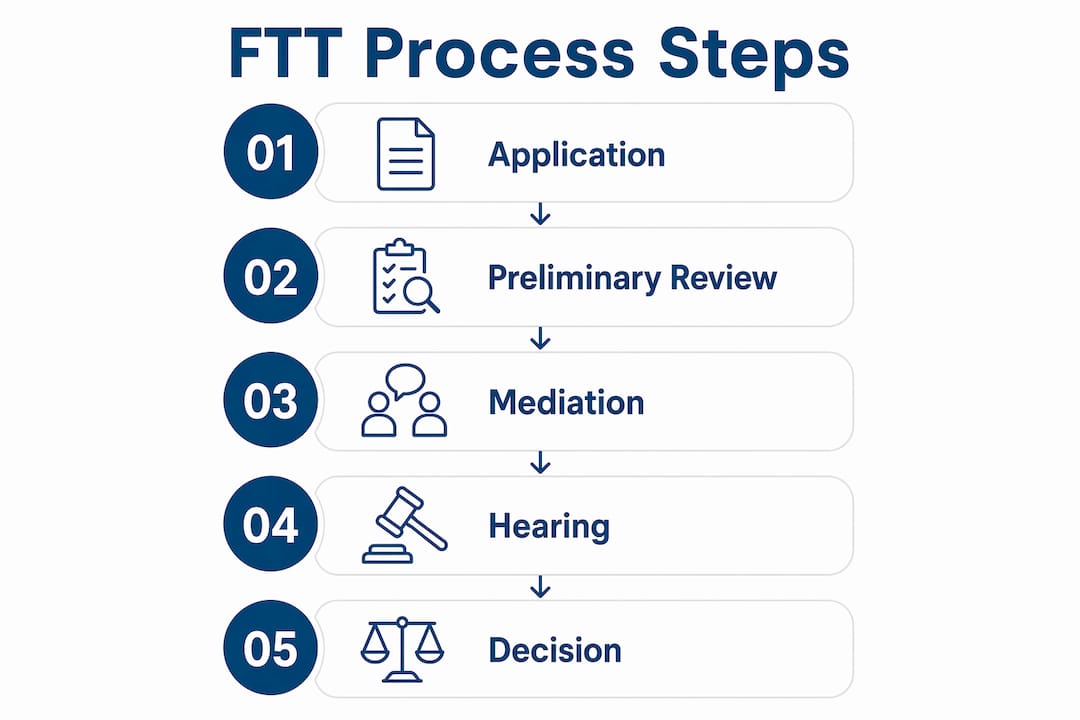
The procedural journey through the Tribunal typically follows this sequence:
- Submit your application using the correct form (T1, T2, or the relevant leasehold form) with the applicable fee and supporting documents.
- Case officer registration: Your application is logged, a case reference assigned, and the respondent is formally notified.
- Directions issued: The Tribunal sets out a timetable for evidence exchange, witness statements, and any expert reports.
- Pre-hearing review: In complex cases, a preliminary hearing may be held to clarify issues and narrow the dispute.
- The hearing: A panel typically comprising a legally qualified judge and one or two specialist members (surveyors or valuers) considers the evidence.
- Decision: The Tribunal issues a written determination, which is legally binding on both parties.
One feature that distinguishes the FTT from a civil court is its inquisitorial approach. Rather than sitting passively while parties argue their positions, the panel actively questions witnesses and investigates beyond the arguments presented. This can work in your favour if you have a strong factual case but limited legal experience. The Tribunal may also conduct a physical inspection of the property, particularly in service charge disputes involving maintenance standards.
Mediation is available before and during proceedings. Settling early avoids the cost and uncertainty of a full hearing, and the Tribunal actively encourages parties to consider it.

Pro Tip: Prepare a clear, indexed bundle of documents before the hearing. The Tribunal panel reads bundles in advance, and a well-organised submission signals credibility and saves hearing time.
What are the Tribunal's powers and limitations?
The FTT holds genuine authority in leasehold disputes, but its powers have defined boundaries that every leaseholder should understand before proceeding.
On the powers side, the Tribunal can:
- Determine whether a service charge is reasonable and payable.
- Appoint an independent manager to replace a failing managing agent.
- Fix the premium payable for a lease extension or collective enfranchisement.
- Make Section 20C cost-limiting orders preventing landlords from recovering tribunal legal costs via the service charge.
- Award costs against a party in limited circumstances, particularly where conduct has been unreasonable.
The Section 20C order is one of the most practically significant tools available to leaseholders. Some leases allow landlords to recoup their legal costs of tribunal proceedings through the service charge unless the Tribunal orders otherwise. You must apply for this protection; it is not granted automatically.
"Winning on a technicality is not the same as winning outright. Upper Tribunal rulings confirm that failures under Section 47 of the Landlord and Tenant Act 1987 typically suspend the payment obligation until the landlord corrects the defect, rather than cancelling the liability entirely."
This distinction matters enormously. Leaseholder wins on procedural technicalities often delay rather than extinguish a payment obligation. A leaseholder who believes they have escaped a charge permanently may find the landlord reissues a corrected demand and the liability revives.
The Upper Tribunal has recently criticised the FTT for mischaracterising outcomes in service charge disputes when ordering cost protections. If the FTT overstates a tenant's success to justify a cost order, the Upper Tribunal (Lands Chamber) will intervene and reverse that decision. Appeals to the Upper Tribunal require permission and must identify a point of law or a serious valuation error. The threshold is high, and most FTT decisions stand.
How does the Tribunal handle RTM and lease extension disputes?
These two dispute types represent the highest-stakes encounters most leaseholders will have with the Tribunal, and each has its own procedural logic.
Right to Manage disputes
When a freeholder serves a counter-notice disputing an RTM claim, the RTM company must apply to the FTT within two months or the claim lapses. The Tribunal then determines whether the qualifying criteria under the Commonhold and Leasehold Reform Act 2002 are met. Common grounds for freeholder objection include the building containing more than 25% non-residential floor space, insufficient qualifying tenants, or procedural defects in the claim notice. You can read about freeholder objection grounds in detail to understand what the Tribunal will scrutinise.
The RTM process timeline from initial notice to acquisition date typically runs four to six months when uncontested. A Tribunal dispute adds time and cost, but the FTT is the correct and only forum for resolving these eligibility challenges.
Lease extension premium disputes
| Aspect | RTM dispute | Lease extension premium dispute |
|---|---|---|
| Statutory basis | Commonhold and Leasehold Reform Act 2002 | Leasehold Reform, Housing and Urban Development Act 1993 |
| Trigger for FTT | Freeholder counter-notice | Failure to agree premium within two months of counter-notice |
| Key evidence | Eligibility documents, lease, building plans | Valuation reports, comparable transactions, expert testimony |
| Typical panel | Legal member plus specialist member | Legal member plus two surveyors |
| Appeal route | Upper Tribunal (Lands Chamber) | Upper Tribunal (Lands Chamber) |
Either party can apply to the FTT under Section 48 to resolve a premium disagreement when negotiations stall. The Tribunal does not simply choose between the landlord's and leaseholder's valuations. Instead, it synthesises elements from both expert reports, applying its own independent judgement on capitalisation rates, deferment rates, and marriage value. This means neither party can rely on their expert's figure being adopted wholesale.
Pro Tip: Commission a surveyor who has given evidence at the FTT before. A report written for negotiation purposes often lacks the structure and methodology the Tribunal expects, which weakens your position even if the figures are sound.
What should leaseholders know before engaging with the Tribunal?
The FTT is more accessible than a civil court, but accessibility does not mean informality. Professional preparation and clear evidence directly affect both case outcomes and cost exposure. Here is what experienced practitioners consistently advise:
- Read your lease before anything else. The Tribunal interprets the specific terms of your lease, not general principles. Knowing what your lease says about service charge consultation, management fees, and insurance procurement is non-negotiable.
- Apply for a Section 20C order at the outset. Do not wait until after the hearing. Apply when you submit your application or as early as possible in proceedings.
- Do not overestimate a technical win. As noted above, procedural defects in a service charge demand suspend rather than cancel liability. Factor this into your strategy.
- Consider self-representation carefully. You can represent yourself, but the opposing party's solicitor will be familiar with Tribunal procedure and case law. For high-value disputes, professional representation often pays for itself in cost protection and outcome quality.
- Seek mediation early. The Tribunal encourages settlement, and a mediated outcome avoids the uncertainty of a panel decision, particularly in valuation disputes where the Tribunal's independent synthesis can produce a figure neither party anticipated.
The Tribunal's inquisitorial style means the panel may raise issues neither party has addressed. Prepare for questions beyond your written submissions, and be ready to explain your evidence clearly under direct questioning from a legally qualified judge.
Key takeaways
The First-tier Tribunal (Property Chamber) is the binding decision-maker for leasehold disputes in England and Wales, with powers covering service charges, RTM claims, lease extensions, and management appointments.
| Point | Details |
|---|---|
| Jurisdiction scope | The FTT covers service charges, RTM, lease extensions, manager appointments, and administration charges. |
| Procedural reality | Proceedings are formal despite being accessible; evidence quality and preparation directly affect outcomes. |
| Cost protection | Apply for a Section 20C order early to prevent landlords recovering tribunal costs via the service charge. |
| Technical wins | Winning on a procedural defect suspends rather than cancels a payment obligation; liability can revive. |
| Valuation independence | The Tribunal synthesises expert evidence independently and will not simply adopt either party's figure. |
The Tribunal is more demanding than most leaseholders expect
I have seen leaseholders arrive at the FTT expecting something close to a consumer complaints process. The reality is different. The Tribunal is a formal legal environment with a legally qualified judge, specialist members who know property valuation in depth, and procedural rules that carry real consequences if ignored.
The most common mistake I observe is treating a technical win as a strategic victory. A service charge demand that fails under Section 47 of the Landlord and Tenant Act 1987 does not disappear. The landlord corrects the notice, reissues it, and the liability returns. Leaseholders who bank on that outcome and spend the disputed funds find themselves in a worse position than if they had engaged substantively from the start.
The Upper Tribunal's recent criticism of FTT cost orders is also worth taking seriously. The FTT has discretion, but that discretion must be exercised accurately. If the Tribunal overstates your success to justify a cost protection order, the Upper Tribunal will correct it on appeal, and you may lose the protection you thought you had secured.
My practical advice for 2026 is this: treat the FTT as a serious legal forum from day one. Prepare your evidence as if a sceptical expert will challenge every figure. Apply for cost protection immediately. And if your dispute involves an RTM claim, understand the eligibility criteria thoroughly before you serve your initial notice, because defects at that stage are far harder to correct once the Tribunal is involved.
— Paul
How Righttomanage can support your leasehold dispute
If your dispute involves a Right to Manage claim, Righttomanage manages the entire process from eligibility check through to acquisition date, including preparing Section 79 claim notices and reviewing freeholder counter-notices before any Tribunal involvement becomes necessary.
Getting the RTM process right from the outset is the most effective way to avoid a contested Tribunal hearing. Righttomanage's guided approach covers every procedural step, reducing the risk of the technical defects that freeholders use to challenge claims. Start with a free RTM eligibility check to understand whether your building qualifies, or review the RTM versus freehold purchase comparison to decide which route best serves your situation.
FAQ
What is the role of the First-tier Tribunal in leasehold disputes?
The First-tier Tribunal (Property Chamber) is the designated judicial body for leasehold dispute resolution in England, with authority to make binding decisions on service charges, Right to Manage claims, lease extensions, and management appointments. It replaced the Leasehold Valuation Tribunal in 2013 and operates under the Tribunal Procedure (First-tier Tribunal) (Property Chamber) Rules 2013.
Can a First-tier Tribunal decision be appealed?
Yes. Appeals from the FTT go to the Upper Tribunal (Lands Chamber), but permission is required and the threshold is high. The Upper Tribunal typically intervenes only where the FTT has made an error of law or a serious valuation error, not simply because a party disagrees with the outcome.
What is a Section 20C order and why does it matter?
A Section 20C order prevents a landlord from recovering the legal costs of tribunal proceedings through the service charge. Without this order, some leases allow landlords to pass those costs back to leaseholders collectively, meaning you could effectively fund the other side's legal fees.
How long does a First-tier Tribunal leasehold case take?
Straightforward service charge disputes typically resolve within three to six months of application. Lease extension premium disputes and contested RTM cases can take six to twelve months, particularly where expert evidence is required and directions timetables are extended.
Do I need a solicitor to appear before the First-tier Tribunal?
You are not required to have legal representation, and many leaseholders self-represent successfully in straightforward cases. For high-value disputes or cases involving complex valuation evidence, professional representation from a solicitor or specialist surveyor significantly improves both the quality of evidence presented and the protection against adverse cost orders.