
Residential leasehold is defined as a form of property ownership where you hold the right to occupy a home for a fixed term under a lease agreement, while the freeholder retains ownership of the land and the building structure. It is not outright ownership. You are, in legal terms, a long-term tenant. Around 5 million homes in England and Wales are leasehold, the majority of them flats. Lease terms typically run for 99, 125, or 999 years, and the freeholder can charge ground rent and service charges throughout. Understanding the residential leasehold meaning before you buy is not optional. It is the difference between a sound investment and a costly surprise.
What is residential leasehold and how does it work?
Residential leasehold grants you a legal right to occupy a property for the duration of your lease term. You own the lease, not the land or the building fabric. The freeholder, sometimes called the landlord, owns both and retains certain controls over how the property is used, maintained, and managed.
When you purchase a leasehold property, you pay a premium for the remaining years on the lease. That premium reflects the value of your right to occupy. Once the lease expires, ownership of the property reverts to the freeholder unless you have extended the lease or purchased the freehold. This is the fundamental distinction that separates leasehold from any other form of property ownership in England and Wales.

Freehold ownership grants indefinite ownership of both the property and the land beneath it. Leasehold ownership is finite and subject to freeholder control over many aspects of daily use. That distinction carries real financial and practical consequences, which every prospective buyer must understand before exchanging contracts.
How long do residential leases last and why does it matter?
Lease length is one of the most financially significant factors in leasehold property ownership. Standard new-build leases are typically granted at 99, 125, or 999 years. A 999-year lease is effectively equivalent to freehold in practical terms. A 99-year lease, however, can become a serious liability within a generation.
The critical threshold is 80 years. Most mortgage lenders require at least 80 years remaining on a lease before they will approve financing. This means a property with fewer than 80 years left becomes significantly harder to sell or remortgage, which directly affects its market value. Buyers who inherit a short lease often find themselves trapped.
The financial consequences of crossing below 80 years are severe. Lease extension costs increase sharply once a lease drops below this threshold because of a concept called marriage value. Marriage value is the additional sum payable to the freeholder, representing a share of the uplift in property value that results from extending the lease. It can add thousands of pounds to the cost of an extension.
- Check the remaining lease term before making an offer on any leasehold property.
- If the lease has fewer than 90 years remaining, obtain a lease extension valuation immediately.
- Confirm that the seller has owned the property for at least two years, as this is required to qualify for a statutory lease extension.
- Factor extension costs into your purchase budget, not as an afterthought.
Pro Tip: Ask your solicitor to request the lease document before you instruct a survey. The lease length and any onerous clauses will affect your valuation and your mortgage offer.
What are ground rent and service charges in leasehold property?
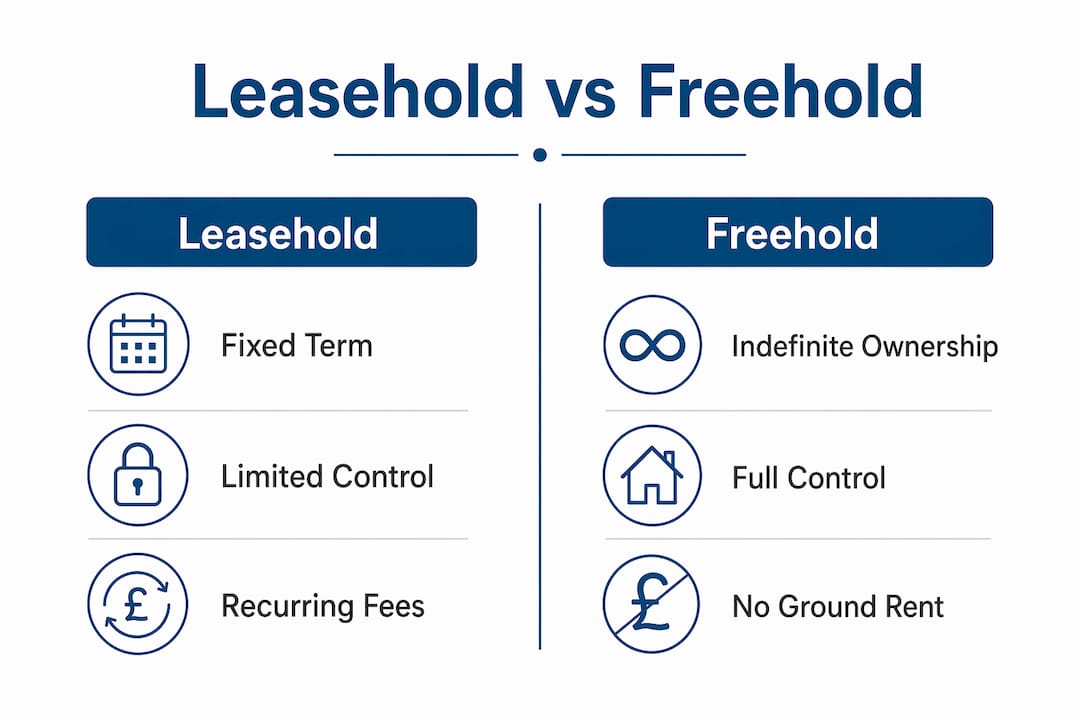
Ground rent and service charges are the two recurring costs that define the financial experience of leasehold ownership. Both are paid to the freeholder or their managing agent, and both can escalate in ways that buyers do not always anticipate.
Ground rent is a payment made to the freeholder simply for occupying the land. For new leases granted after June 2022, the Leasehold Reform (Ground Rent) Act 2022 caps ground rent at a peppercorn, meaning zero financial value. This is a significant protection for new buyers. However, leases granted before this date may still contain escalating ground rent clauses, where the rent doubles every ten or twenty-five years. On a 99-year lease, a ground rent starting at £250 per year can reach thousands annually by the end of the term.
Service charges cover the costs of maintaining and managing communal areas, the building structure, insurance, and shared services such as lifts or concierge staff. These charges are variable and controlled by the freeholder or their appointed managing agent. The scope for overcharging, poor management, and lack of transparency is well documented.
- Review at least three years of service charge accounts before purchasing any leasehold flat.
- Check whether a sinking fund exists and what its current balance is. A sinking fund is a reserve built up over time to cover major repairs such as roof replacement or external decoration.
- Ask whether any major works are planned or anticipated in the next five years, as leaseholders are liable for their share of these costs.
- Scrutinise the insurance policy. Freeholders often place building insurance through brokers who receive commissions, inflating premiums paid by leaseholders.
Pro Tip: Under the Landlord and Tenant Act 1985, you have the right to challenge unreasonable service charges at the First-tier Tribunal (Property Chamber). Keep records of all correspondence with your managing agent.
What is the difference between leasehold and freehold?
The difference between leasehold and freehold is not simply about duration. It is about control, cost, and legal exposure. Freehold ownership means you own the property and the land outright, indefinitely, with no third party holding superior rights over your home.
| Feature | Leasehold | Freehold |
|---|---|---|
| Ownership duration | Fixed term under a lease | Indefinite and outright |
| Land ownership | Freeholder owns the land | Owner holds land and building |
| Ground rent | Payable (peppercorn for new leases) | None |
| Service charges | Payable to freeholder or agent | Owner manages own maintenance |
| Alterations | Require freeholder consent | Owner's discretion |
| Insurance | Arranged by freeholder | Owner's responsibility |
| Property type | Typically flats, some houses | Typically houses |
Leasehold properties are predominantly flats, though some houses were sold as leasehold before the Leasehold Reform (Ground Rent) Act 2022 restricted this practice for new builds. Freehold houses give you full autonomy. You decide when to repair the roof, which insurer to use, and whether to extend the kitchen.
It is worth noting that freeholders are not always large corporations. Some are resident-owned management companies where leaseholders have collectively purchased the freehold through a process called Right to Enfranchise. In those cases, the management dynamic is far more collaborative, though the legal structure of leasehold still applies.
What legal and practical considerations apply to leaseholders?
A lease is a complex legal deed with financial obligations that extend well beyond the purchase price. Many buyers treat it as a formality. It is not. The lease governs almost every aspect of how you can use your home.
Restrictive covenants are clauses within the lease that limit what you can do with the property. Common restrictions include prohibitions on keeping pets, sub-letting without consent, making structural alterations, running a business from the property, or even playing musical instruments after certain hours. These covenants bind you and every future owner of the lease. Breaching them can result in forfeiture proceedings, which in extreme cases can mean losing the property entirely.
Sub-letting is a particularly important consideration for buyers who intend to rent out their flat. Many leases require written consent from the freeholder before any tenancy is granted. Some leases prohibit sub-letting altogether, or restrict it to assured shorthold tenancies of a minimum term. Discovering this restriction after purchase is a costly mistake.
Leaseholders do have statutory rights that can shift the balance of power. The Right to Manage allows qualifying leaseholders to take over the management of their building without purchasing the freehold and without proving any fault on the part of the freeholder. Collective Enfranchisement allows leaseholders to club together and buy the freehold outright. Both routes require careful preparation, but they represent genuine legal tools for leaseholders who are frustrated with poor management or excessive charges. You can compare both options in detail when considering RTM versus buying the freehold.
Pro Tip: Before purchasing a leasehold property, use a solicitor-backed property purchase checklist to assess the lease terms, service charge history, and any pending disputes with the freeholder.
What are the recent reforms to leasehold law in England and Wales?
The leasehold system in England and Wales is undergoing its most significant reform in decades. The Leasehold and Freehold Reform Act 2024 introduced a series of changes designed to improve leaseholder rights, reduce costs, and increase transparency. The government's stated aim is a gradual transition away from traditional leasehold toward commonhold ownership.
| Reform | What it changes |
|---|---|
| Leasehold and Freehold Reform Act 2024 | Makes lease extensions cheaper and easier; bans new leasehold houses |
| Leasehold Reform (Ground Rent) Act 2022 | Caps ground rent on new leases to peppercorn |
| Proposed Commonhold Bill | Aims to replace leasehold for flats with commonhold ownership |
| Service charge transparency rules | Requires freeholders to provide clearer cost breakdowns |
Commonhold is the ownership model that the government is pushing as the long-term replacement for leasehold. Under commonhold, each flat owner holds their unit outright, with no lease and no freeholder. Shared areas are managed collectively through a commonhold association, which all owners belong to. This removes the structural conflict of interest between leaseholders and freeholders that has generated so much friction and litigation over the past thirty years.
The transition will not happen overnight. Existing leases will remain in place for decades. However, the direction of travel is clear, and leaseholders who understand the current system are better placed to benefit from the protections already in force and those still to come.
Key takeaways
Residential leasehold is a finite property right governed by a legal deed, and understanding its terms before purchase is the single most effective way to avoid costly surprises.
| Point | Details |
|---|---|
| Leasehold is not full ownership | You own the right to occupy for a fixed term; the freeholder owns the land and structure. |
| The 80-year threshold is critical | Leases below 80 years are harder to mortgage, sell, and extend without paying marriage value. |
| Service charges require scrutiny | Review three years of accounts and check for sinking fund balances before purchasing. |
| Restrictive covenants bind all future owners | Clauses on pets, sub-letting, and alterations apply to every buyer of the lease. |
| Reforms are improving leaseholder rights | The Leasehold and Freehold Reform Act 2024 and the proposed Commonhold Bill are shifting the balance toward owners. |
Why leasehold still catches buyers off guard
I have reviewed hundreds of leasehold situations over the years, and the pattern is almost always the same. Buyers focus on the property itself, the location, the finish, the price, and treat the lease as a legal formality to hand off to a solicitor. That is the mistake.
The lease is the product. It defines what you own, what you owe, and what you can do with your home. A beautiful flat with a 72-year lease and a doubling ground rent clause is a financial liability dressed up as an asset. I have seen buyers discover this only when they try to sell, by which point the options are expensive and the timeline is urgent.
The reforms are genuinely encouraging. The Leasehold and Freehold Reform Act 2024 is a meaningful step, and the push toward commonhold is the right direction. But the existing stock of leasehold properties will not change overnight. Millions of people are still living under leases that were written to favour freeholders, and the legal tools available to them, particularly the Right to Manage, remain underused simply because leaseholders do not know they exist.
My advice is straightforward. Read the lease before you make an offer. Check the remaining term, the ground rent provisions, the service charge history, and the restrictions on use. If you already own a leasehold property and you are unhappy with your managing agent, look seriously at the Right to Manage. It is a statutory right, not a favour, and it costs far less than most people assume.
— Paul
Take control of your leasehold with Righttomanage
If you own a leasehold flat and you are dealing with poor management, opaque service charges, or a freeholder who is unresponsive, you are not without options.
Righttomanage helps leaseholders legally take control of their building management without purchasing the freehold. The process is governed by statute, and Righttomanage manages every stage from eligibility checks and company setup through to Section 78 notices and acquisition-date preparation. Start with a free RTM eligibility check to find out whether your building qualifies. If you live in a smaller block of two to four flats, the RTM process for small blocks is specifically designed for your situation. Taking control of your building management is a legal right. Righttomanage makes it straightforward.
FAQ
What does residential leasehold mean?
Residential leasehold means you own the right to occupy a property for a fixed term under a lease, while the freeholder owns the land and building structure. It is not outright ownership and is subject to conditions set out in the lease agreement.
How long does a residential lease typically last?
Residential leases in England and Wales are typically granted for 99, 125, or 999 years. The remaining term at the point of purchase is what matters most, as leases below 80 years become difficult to mortgage and expensive to extend.
What is the difference between leasehold and freehold?
Freehold grants indefinite ownership of the property and land with no third-party control, while leasehold is a time-limited right to occupy subject to freeholder conditions, ground rent, and service charges.
Can I extend my leasehold?
Yes. Leaseholders who have owned their property for at least two years have a statutory right to extend their lease by 90 years under the Leasehold Reform, Housing and Urban Development Act 1993. Extending before the lease drops below 80 years avoids the additional marriage value cost.
What is the Right to Manage?
The Right to Manage is a statutory right that allows qualifying leaseholders to take over the management of their building from the freeholder without buying the freehold and without proving mismanagement. It requires a qualifying majority of leaseholders and follows a formal legal process governed by the Commonhold and Leasehold Reform Act 2002.