
Landlord ground rent restrictions are statutory limits on the amounts freeholders can charge leaseholders under long residential leases in England and Wales. The Leasehold Reform (Ground Rent) Act 2022 already abolished ground rents on new leases, reducing them to a peppercorn. The Draft Commonhold and Leasehold Reform Bill 2026 goes further, proposing to cap legacy ground rents at £250 per year before reducing them to a peppercorn after 40 years. With around 3.8 million residential leasehold properties still subject to ground rent across England and Wales, understanding how landlord ground rent restrictions affect leasehold arrangements is no longer optional for buyers, sellers, or existing leaseholders.
What are the current and forthcoming statutory ground rent caps?
The 2022 Act drew a clear line in the sand. Any new residential long lease granted after 30 June 2022 must carry a peppercorn ground rent, meaning the landlord can demand nothing of financial value. Legacy leases granted before that date, however, remain subject to whatever ground rent the original contract specified, and those sums can be substantial.
The proposed cap under the Draft Commonhold and Leasehold Reform Bill addresses this gap directly. The government proposes capping legacy ground rents at £250 per year, with a transition to peppercorn after 40 years, subject to parliamentary approval and expected to take effect no earlier than late 2028. That 40-year glide path is deliberate policy design, not an oversight.
Key features of the forthcoming cap include:
- The £250 ceiling applies to all regulated residential long leases, overriding any higher sum written into the lease itself.
- The cap does not increase any leaseholder's current ground rent. If you already pay £100 per year, your rent stays at £100.
- Exemptions apply to leases below 21 years, business leases, community-led housing, and certain shared ownership arrangements, which complicates universal application.
- Landlords cannot demand payments above the cap once legislation commences, and leaseholders can refuse excess charges without risk of tribunal enforcement.
Pro Tip: Check your lease now. If your ground rent already sits below £250 annually, the cap creates minimal immediate change for you. The leaseholders most affected are those paying above £250, concentrated heavily in London and the South.
The policy rationale for £250 rather than an immediate peppercorn is grounded in financial stability. Immediate peppercorn rents were assessed as higher-risk due to potential freeholder insolvencies and broader market disruption. The phased approach preserves income streams for investors while protecting leaseholders from the worst excesses.
How do ground rent restrictions affect affordability and mortgageability?
The practical consequences of high ground rents extend well beyond an annual cheque. Mortgage lenders treat escalating ground rents as a material risk, and many refuse to lend on properties where the ground rent exceeds a defined threshold relative to the property value. This directly limits the pool of buyers for any affected flat, suppressing demand and, by extension, price.

78% of property agents report difficulty selling leasehold properties with high escalating ground rents, even when priced correctly. That figure illustrates a structural market failure, not an occasional inconvenience. Sellers of affected properties face a narrowed buyer pool, longer marketing periods, and pressure to discount asking prices to compensate for the financing obstacle.
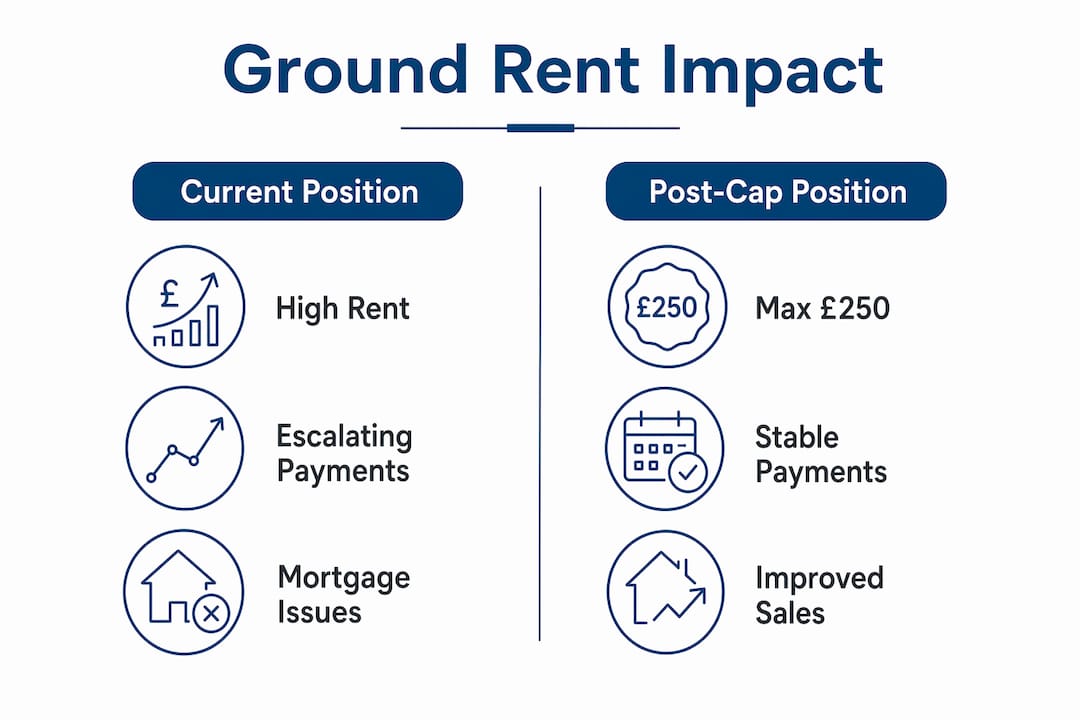
The scale of financial relief the cap is expected to deliver is significant. Leaseholders are estimated to save between £10.0 billion and £12.7 billion over the lifetime of their leases as a result of the cap. That aggregate figure translates into real household savings for hundreds of thousands of families currently paying above the proposed ceiling.
| Impact area | Current position (pre-cap) | Expected position (post-cap) |
|---|---|---|
| Annual ground rent | Can exceed £500 or more on legacy leases | Capped at £250, reducing to peppercorn after 40 years |
| Mortgage availability | Many lenders decline high ground rent properties | Improved lender appetite as risk reduces |
| Resale marketability | Restricted buyer pool, price suppression | Broader buyer pool, more competitive pricing |
| Leaseholder savings | Ongoing financial drain | £10.0bn to £12.7bn aggregate saving projected |
The two-tier market created by the 2022 Act is worth noting. New leases carry zero ground rent, making them straightforwardly mortgageable. Legacy leases remain problematic until the cap commences. Around 770,000 to 900,000 leaseholds pay above £250 annually, mostly in London and the South, and these are the properties most acutely affected by the current distortion.
What transitional risks should leaseholders and buyers watch for now?
The gap between now and late 2028 is not a safe waiting room. Until the cap takes legal effect, your lease terms govern everything, and those terms can be hostile.
Here is what you need to assess before buying or selling a leasehold property in the current window:
- Read the escalation clause. Many legacy leases contain provisions that double ground rent every 10 or 25 years. A ground rent starting at £250 can reach £1,000 or more within decades, and lenders know this.
- Check lender policy now. UK Finance members and individual lenders apply their own ground rent thresholds. A property that one lender will finance today may be declined by another, limiting your buyer pool.
- Understand the lease escalation and mortgage risk. Lease escalation clauses directly affect lender risk appetite in underwriting decisions, even where the current ground rent appears modest.
- Factor in the cap timing. The cap is expected no earlier than late 2028, meaning properties with problematic ground rents remain difficult to sell or remortgage for at least two more years.
- Consider lease extension. Extending your lease to 990 years under the Leasehold Reform (Housing and Urban Development) Act 1993 reduces the ground rent to a peppercorn immediately. This is the most reliable route to resolving the problem before the cap arrives.
Pro Tip: If you are buying a leasehold property today, instruct your solicitor to obtain a full ground rent schedule showing current and future sums. A lease with a doubling clause can become unmortgageable within one review cycle, regardless of what the cap eventually does.
The 40-year transition to peppercorn also deserves scrutiny. The phased throttle balances leaseholder protection with preserving freeholder income to avoid market shocks. For leaseholders, this means the full benefit of peppercorn rent is decades away, not immediate.
How do ground rent restrictions influence leasehold transactions and legal rights?
Ground rent restrictions reshape the legal relationship between freeholder and leaseholder in ways that go beyond the annual payment itself. The most significant change in the draft legislation is the abolition of forfeiture for non-payment of ground rent. Historically, forfeiture penalties risked loss of homes over small unpaid sums. That threat gave landlords disproportionate leverage, particularly over leaseholders who disputed the amount owed or simply missed a payment.
Under the proposed reforms, forfeiture is replaced with a fairer enforcement scheme. Leaseholders who refuse to pay ground rent above the statutory cap face no tribunal enforcement risk. The cap overrides lease contract terms entirely, meaning a landlord cannot rely on the original lease wording to demand more than the ceiling permits.
For buyers and sellers, the interaction with lease extension and collective enfranchisement is equally important:
- Lease extension under the 1993 Act already reduces ground rent to a peppercorn on the extended term. Leaseholders who extend before the cap commences gain the peppercorn benefit immediately rather than waiting for 2028.
- Collective enfranchisement allows leaseholders to purchase the freehold collectively, eliminating ground rent entirely. Exploring right to manage versus buying the freehold is a practical starting point for any group of leaseholders weighing their options.
- Right to Manage does not eliminate ground rent but gives leaseholders control over building management, reducing the broader costs and frustrations that often accompany poor freeholder oversight.
- Sellers of high ground rent properties should disclose the full rent schedule to prospective buyers and price accordingly. Concealing escalation clauses creates legal exposure and delays completion.
- Buyers should treat any ground rent above £250 as a negotiating point, since the cap will eventually apply and the seller's pricing should reflect the incoming restriction.
The reforms collectively shift enforcement power away from landlords and towards leaseholders. That shift is structural, not cosmetic, and it changes the risk calculus for anyone investing in or managing leasehold property.
Key takeaways
Ground rent restrictions under the Draft Commonhold and Leasehold Reform Bill 2026 cap legacy leases at £250 annually, transitioning to peppercorn after 40 years, with projected leaseholder savings of £10.0 billion to £12.7 billion across England and Wales.
| Point | Details |
|---|---|
| Statutory cap level | Legacy ground rents will be capped at £250 per year, expected from late 2028. |
| Transition to peppercorn | After 40 years under the cap, ground rent reduces to a peppercorn, eliminating the charge entirely. |
| Mortgageability impact | High escalating ground rents currently restrict mortgage lending; the cap is expected to improve lender appetite significantly. |
| Forfeiture abolished | Landlords will no longer be able to forfeit a lease for non-payment of ground rent under the new enforcement scheme. |
| Pre-cap due diligence | Until late 2028, lease escalation clauses remain live risks for buyers, sellers, and lenders. |
Why the ground rent debate is more nuanced than the headlines suggest
I have spent years working with leaseholders who are genuinely confused about what ground rent reform means for them right now, as opposed to what it will mean eventually. The most common misunderstanding I encounter is the assumption that the 2022 Act already fixed the problem. It did not. It fixed the problem for new leases. For the millions of people holding legacy leases, the situation remains complicated, and the 2028 timeline means they are living with that complexity for at least another two years.
What concerns me more is the gap between legal protection and practical awareness. The cap will override lease terms, which is powerful. But leaseholders who do not know their current ground rent, do not understand their escalation clause, or have not checked their RTM eligibility are not in a position to use those protections effectively. Reform on paper only helps people who know it exists.
My honest view is that the 40-year transition to peppercorn is a reasonable compromise given the financial complexity of unwinding ground rent investment structures. An immediate peppercorn would have been cleaner for leaseholders but risked genuine market disruption. The phased approach is less satisfying but more durable. What leaseholders should focus on now is not waiting for 2028 but using the tools already available: lease extension, collective enfranchisement, and Right to Manage. These routes deliver real control today, not in two years.
The broader shift towards commonhold as the default ownership model for flats is the right long-term direction. Ground rent as a concept belongs to a feudal property system that has no place in modern housing. The reforms are moving in the right direction, even if the pace is frustrating.
— Paul
Take control of your leasehold management today
If ground rent disputes, excessive service charges, or poor managing agents are affecting your building, Right to Manage gives leaseholders the legal power to take over management without buying the freehold.

Righttomanage handles the entire RTM process from eligibility checks and company setup through to Section 78 notices, Section 79 claim notices, and acquisition-date preparation. Whether you live in a small block of two flats or a larger development, the process is the same: you take control, you choose your managing agent, and you stop paying for services that do not meet your standards. Start with a free RTM eligibility check to find out whether your building qualifies, or explore RTM for small blocks if you are in a building of two to four flats.
FAQ
What is the proposed ground rent cap for existing leases?
The government proposes capping legacy ground rents at £250 per year, transitioning to a peppercorn after 40 years, subject to parliamentary approval and expected to take effect no earlier than late 2028.
Does the 2022 Act affect my existing lease?
No. The Leasehold Reform (Ground Rent) Act 2022 applies only to new residential long leases granted after 30 June 2022. Legacy leases remain subject to their original ground rent terms until the forthcoming cap takes effect.
Can my landlord still enforce ground rent payment above the cap?
Once the cap commences, the legislation overrides lease contract terms and landlords cannot demand payments above £250 per year. Leaseholders can refuse excess charges without risk of tribunal enforcement.
How does a high ground rent affect my ability to sell?
78% of property agents report difficulty selling leasehold properties with high escalating ground rents, even at correct pricing. High ground rents restrict the mortgage-eligible buyer pool, suppressing demand and sale prices.
Is lease extension a better option than waiting for the cap?
Extending your lease under the Leasehold Reform (Housing and Urban Development) Act 1993 reduces ground rent to a peppercorn immediately on the extended term, which is faster and more certain than waiting for the 2028 cap to take effect.