
A Residents' Management Company (RMC) is a non-profit entity formed by leaseholders to manage the communal areas and services of their leasehold property. The role of RMC in leasehold is both legal and operational: it sits between the freeholder and individual leaseholders, taking responsibility for everything from building insurance to stairwell cleaning. If you own a flat in England or Wales, understanding how your RMC works is not optional. It directly affects your service charges, the condition of your building, and your rights as a leaseholder. This guide explains what RMCs do, what their directors must legally deliver, and how you can engage effectively with yours.
What are the main responsibilities of an RMC in managing leasehold properties?
The RMC's core function is to manage and maintain everything that falls outside individual flats. RMCs are formed as non-profit companies, typically limited by shares or guarantee, with leaseholders as members or shareholders. That structure matters because it means the company exists to serve the collective, not to generate profit for a third party.
The day-to-day responsibilities of an RMC cover a broad range:
- Communal area maintenance. The RMC manages roofs, stairwells, lifts, entrance halls, and shared gardens. This includes arranging routine cleaning, lighting repairs, and periodic redecoration. For a block of 20 flats, this alone can involve dozens of contractor visits each year.
- Building and public liability insurance. The RMC organises and pays for buildings insurance covering the entire block, along with public liability cover for communal spaces. Leaseholders fund this through service charges, so the RMC must obtain competitive, appropriate cover.
- Service charge collection and administration. The RMC collects service charges from leaseholders, holds those funds in a designated trust account, and spends them strictly in line with the lease. Service charge funds are legally ring-fenced for building management and maintenance only.
- Lease compliance and safety regulations. The RMC must ensure the building meets fire safety, health and safety, and any other statutory requirements. This includes commissioning fire risk assessments, asbestos surveys where relevant, and electrical inspections.
- Budget preparation and financial control. Each year the RMC prepares a service charge budget, sets demand levels, and accounts for actual expenditure against that budget. Leaseholders are entitled to see these accounts.
Understanding how communal areas are managed in your building gives you a clearer picture of what your service charges are actually funding and where to ask questions if something looks wrong.
What legal and fiduciary duties do RMC directors have?

RMC directors carry the same statutory obligations as any company director under the Companies Act 2006. This surprises many leaseholders who volunteer as directors assuming it is an informal role. It is not.
Directors must act within their powers, promote the company's success, exercise independent judgement, and avoid conflicts of interest. They must also maintain accurate records of persons with significant control and submit annual filings to Companies House. Failure to comply carries financial penalties and, in serious cases, personal liability.
The fiduciary duties run to the company as a whole, not to individual leaseholders. This is a distinction that causes real friction in practice. A director cannot favour one flat owner's complaint over another, or approve expenditure that benefits only part of the building. Every decision must be made in the collective interest.
There is also a critical accounting distinction that directors must grasp. Statutory accounts filed at Companies House are governed by company law, while service charge accounts are governed by trust law and the specific terms of the lease. Conflating the two leads to governance failures that can expose directors to personal liability.
- Act within the powers granted by the company's articles of association and the lease.
- Promote the success of the company for the benefit of all leaseholders collectively.
- Exercise independent judgement on all decisions, including contractor appointments.
- Avoid conflicts of interest, particularly where a director has a personal financial stake in a decision.
- Maintain accurate statutory records and meet all Companies House filing deadlines.
- Ensure service charge budgets are realistic and that funds are held in trust and spent in line with the lease.
Pro Tip: If you are considering becoming an RMC director, read the company's articles of association and the building's lease before accepting the role. These two documents define the boundaries of your authority and your exposure.
How do RMCs delegate operational tasks, and what is the directors' ongoing oversight role?
Most RMCs appoint a managing agent to handle day-to-day operations. This is sensible. Running a residential block requires specialist knowledge of contractor management, service charge accounting, and compliance. Volunteer directors rarely have the time or expertise to do it alone.
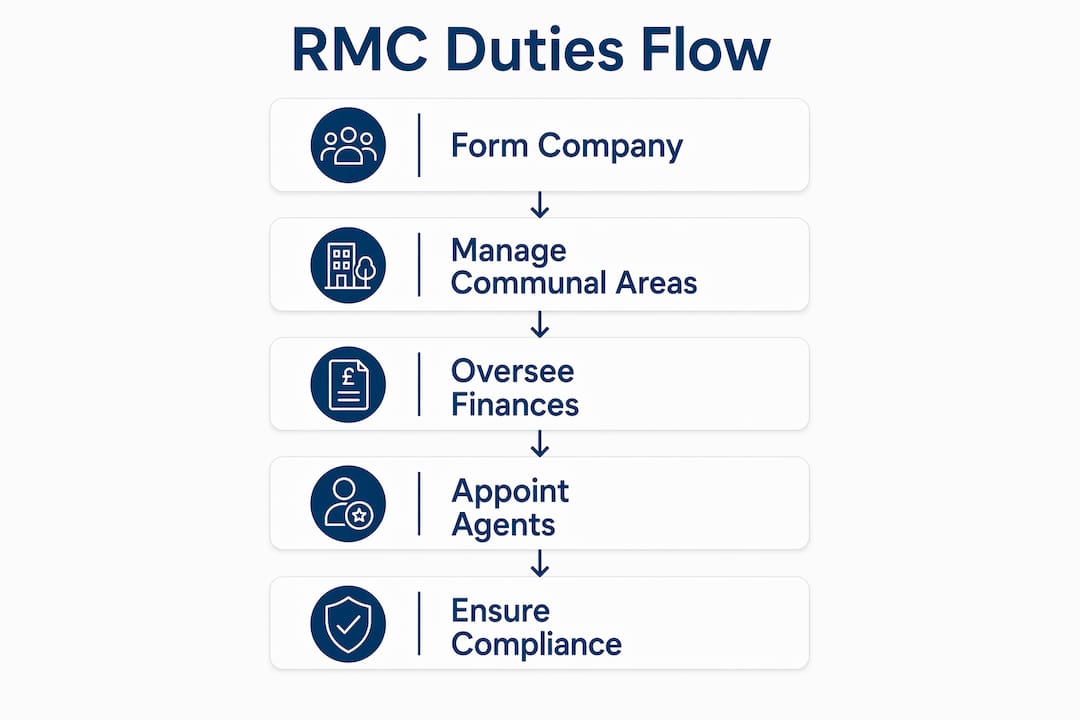
Directors can delegate operational tasks to managing agents, but they retain ultimate legal responsibility for financial reporting, strategic decisions, and service charge budget approval. This is the point that many directors misunderstand. Appointing an agent does not transfer your legal duties. If the agent mismanages funds or fails to comply with safety regulations, the directors remain accountable.
The directors' retained oversight responsibilities include:
- Reviewing management accounts regularly and questioning any variances against budget.
- Approving the annual service charge budget before it is issued to leaseholders.
- Authorising major works expenditure, particularly where Section 20 consultation under the Landlord and Tenant Act 1985 is required.
- Monitoring the managing agent's performance against the terms of their contract.
- Making the decision to switch agents when performance falls below standard.
On that last point: notice periods for terminating a managing agent typically run from three to six months. Directors should factor this into any decision to switch, particularly if urgent works are pending. If your block is suffering under a poor agent, the guidance on taking control through RTM is worth reading alongside your RMC governance review.
Pro Tip: Schedule a quarterly directors' meeting specifically to review management accounts, not just operational updates. Financial oversight is where most governance failures begin.
How does the RMC balance leaseholder representation with company governance?
This is where the role becomes genuinely difficult. Directors are leaseholders themselves, living alongside the people they govern. The personal and professional lines blur constantly.
Directors must prioritise the company's collective success and legal compliance over individual demands. A leaseholder who wants their flat's window replaced at communal expense, or who objects to a necessary but costly roof repair, cannot simply override the directors' judgement. The directors' duty is to the company, not to any one member.
Practical strategies for maintaining that balance include:
- Establishing a clear written complaints procedure so all leaseholders know how to raise concerns formally.
- Publishing annual accounts and budget summaries to all leaseholders without waiting to be asked.
- Holding an annual general meeting where leaseholders can vote on key resolutions and question directors.
- Keeping records of all decisions and the reasoning behind them, particularly for major expenditure.
- Referring leaseholder disputes to a formal resolution process rather than attempting informal resolution that can appear biased.
Transparency about major works and finances significantly reduces leaseholder frustration and the risk of disputes escalating. Regular updates on financial variances and upcoming decisions build the trust that makes governance sustainable. Directors who communicate proactively spend far less time managing complaints reactively.
The risk of conflict of interest is real and underappreciated. A director who also owns a maintenance company, or whose relative does, must declare that interest and recuse themselves from relevant decisions. Failing to do so is a breach of Companies Act 2006 duties, not merely bad form.
What practical steps can leaseholders take to engage with their RMC?
Your RMC is not something that happens to you. As a leaseholder, you are likely a member or shareholder of the company, which gives you formal rights and a voice in how it operates.
- Understand your membership rights. Check whether you hold a share in the RMC or are a member by guarantee. Either way, you have the right to attend general meetings, vote on resolutions, and inspect certain company documents.
- Attend the annual general meeting. This is your primary formal opportunity to question directors, vote on the budget, and influence the direction of the company. Leaseholders who do not attend surrender that influence.
- Request financial transparency. You are entitled to request a summary of service charge accounts under the Landlord and Tenant Act 1985. If accounts are not being shared proactively, ask in writing.
- Raise concerns formally. Use the RMC's written complaints procedure. Informal conversations are easily forgotten or disputed. A written record protects you and creates accountability.
- Consider becoming a director. Volunteer directors are the backbone of every RMC. If governance is poor, the most direct remedy is to stand for election. Go in with a clear understanding of the legal governance requirements and the time commitment involved.
If your building does not have an RMC, or if the existing structure is not working, the Right to Manage process offers leaseholders a statutory route to take control of building management without purchasing the freehold.
Key takeaways
The role of RMC in leasehold is defined by legal accountability, financial stewardship, and collective governance. Directors carry statutory duties under the Companies Act 2006 that cannot be delegated away, regardless of whether a managing agent is appointed.
| Point | Details |
|---|---|
| RMC core function | Manages communal areas, insurance, service charges, and safety compliance on behalf of leaseholders. |
| Directors' legal duties | Statutory obligations under Companies Act 2006 include financial oversight, conflict avoidance, and Companies House filings. |
| Delegation does not remove liability | Appointing a managing agent transfers operational tasks but not legal accountability for compliance or finances. |
| Transparency reduces disputes | Proactive communication about budgets and major works is the most effective way to prevent leaseholder conflict. |
| Leaseholders have formal rights | Members can attend meetings, vote on resolutions, and request service charge accounts under statute. |
Why RMC governance is harder than it looks
Directors often underestimate the time commitment and emotional demands of managing communal property alongside neighbours. I have seen this pattern repeatedly. A leaseholder volunteers as a director with genuine goodwill, then finds themselves fielding complaints at 9pm on a Sunday about a broken communal light. The governance role and the neighbourly relationship collide in ways that are genuinely draining.
The most common mistake I observe is directors treating governance as hands-on management. Directors should not engage in technical site management or repairs. Their role is to oversee contractors and agents, not to become them. The moment a director starts personally arranging repairs or negotiating directly with contractors without proper process, they expose themselves to liability and undermine the agent relationship.
What actually works is clear professional boundaries, a well-chosen managing agent, and a commitment to transparency. Directors who publish accounts without being asked, who hold regular meetings, and who respond to complaints within a defined timeframe build the kind of trust that makes the role sustainable. Those who operate in the dark, even with good intentions, create the frustration that drives leaseholders toward formal disputes or RTM applications.
If you are a leaseholder who feels your RMC is not performing, the answer is not passive frustration. Attend the AGM. Stand for the board. Request the accounts. The governance structure exists to serve you, but only if you use it.
— Paul
How Righttomanage can help you take control
If your RMC is underperforming, or if your building has no effective leaseholder-led management structure at all, Righttomanage offers a direct route to change that.
Righttomanage manages the entire Right to Manage process from start to finish, including eligibility checks, RTM company formation, Section 78 and Section 79 notices, and counter-notice review. The service is built specifically for leaseholders dealing with poor managing agents, excessive service charges, or a freeholder who is not acting in the building's interest. Start with a free RTM eligibility check to find out whether your building qualifies, or explore the RTM company setup process in detail. Taking control of your building management is a legal right. Righttomanage exists to make that process straightforward.
FAQ
What is an RMC in leasehold property?
An RMC (Residents' Management Company) is a non-profit company formed by leaseholders to manage the communal areas, insurance, and services of a leasehold building. Leaseholders are typically members or shareholders of the company.
Do RMC directors have personal legal liability?
Yes. Directors carry statutory duties under the Companies Act 2006 and can face personal liability for failures in financial oversight, record-keeping, or compliance. Appointing a managing agent does not remove those duties.
Can leaseholders remove an RMC director?
Leaseholders who are members of the RMC can vote to remove a director at a general meeting, subject to the company's articles of association. This requires proper notice and a formal resolution.
What is the difference between an RMC and an RTM company?
An RMC is typically established by the freeholder or developer at the outset of a leasehold development. An RTM (Right to Manage) company is formed by leaseholders under the Commonhold and Leasehold Reform Act 2002 to take over management from the freeholder without purchasing the freehold.
How do I find out if my building has an RMC?
Check your lease, which should identify the management company. You can also search Companies House for the building's address or company name to confirm whether an RMC exists and who its directors are.