
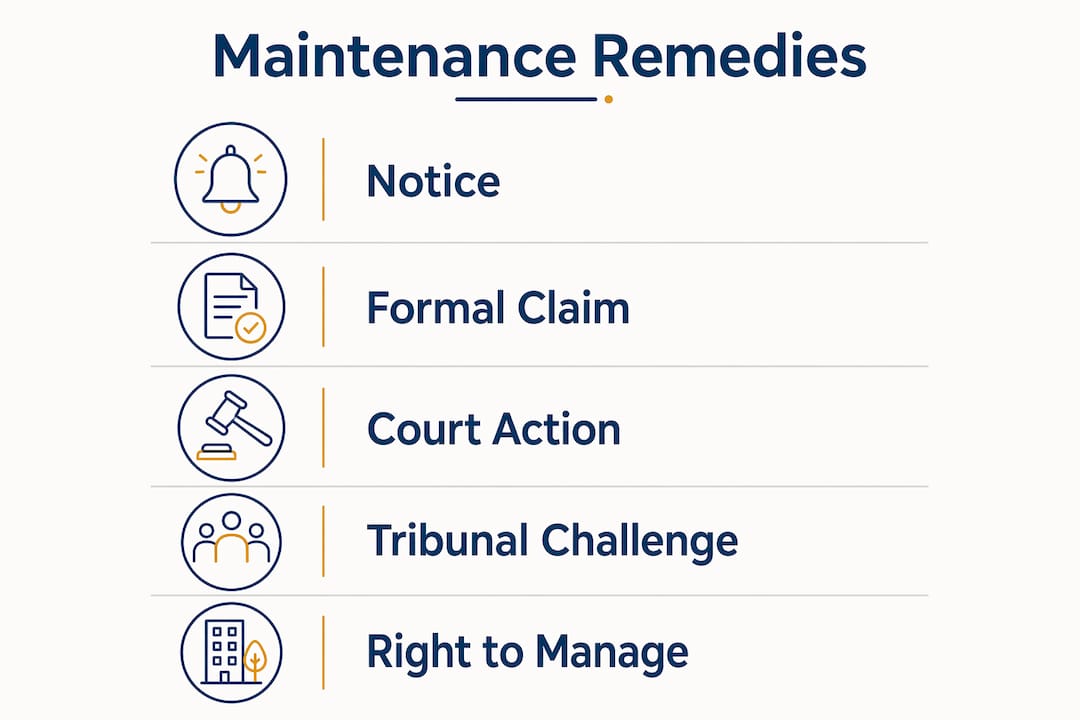
Leasehold maintenance neglect remedies are the legal, statutory, and management tools available to leaseholders in England and Wales to compel repairs, challenge costs, and take control of building management when landlords or managing agents fail their obligations. These remedies range from county court claims and First-tier Tribunal applications to the Right to Manage (RTM), a statutory process that lets leaseholders assume management without buying the freehold. Understanding which remedy fits your situation, and in what order to apply them, is the difference between years of frustration and a building that is properly maintained.
What legal remedies can leaseholders pursue for maintenance neglect?
County court action is the primary formal route for leaseholders seeking orders to compel repairs and claim compensation for significant disrepair such as damp, mould, or faulty electrics. Courts can issue orders for specific performance, requiring the landlord to carry out works within a defined period, alongside damages for the impact of the disrepair on your health, property, or enjoyment of the home.
Before issuing proceedings, you must satisfy the court that the landlord had notice of the defect and a reasonable opportunity to repair it. This is not a technicality. Courts will dismiss or reduce compensation where a leaseholder cannot show they reported the problem clearly and gave the landlord time to act. The pre-action protocol for housing disrepair sets out the steps required before any claim is filed.
Time limits matter significantly here. Most disrepair claims must be brought within six years of the landlord's failure to repair, while personal injury claims arising from disrepair carry a three-year limit. Missing these windows closes off compensation entirely, regardless of how strong the underlying case is.
The types of damages available in court include:
- General damages for inconvenience, distress, and loss of enjoyment of the property
- Special damages for personal property damaged by the disrepair, such as furniture ruined by damp
- Diminution in value where the disrepair has reduced the market or rental value of the flat
- Specific performance orders requiring the landlord to carry out named works by a set date
Pro Tip: Before instructing a solicitor, send a formal letter of claim to the landlord or managing agent setting out the defects, the impact, and a reasonable deadline for response. This satisfies the pre-action protocol and often prompts repairs without litigation.
How can leaseholders challenge unreasonable service charges related to neglect?
Leaseholders have statutory rights to challenge unreasonable service charges at the First-tier Tribunal (Property Chamber), and this route is frequently more accessible than county court proceedings. The tribunal assesses whether charges are reasonable in amount and whether the works or services were carried out to a reasonable standard. You do not need a solicitor to bring an application, though professional advice strengthens complex cases.
The Leasehold and Freehold Reform Act 2024 strengthened leaseholder protections in this area. Service charge monies must be held in trust, and major works above a prescribed threshold require prior consultation under Section 20 of the Landlord and Tenant Act 1985. Where a landlord skips consultation, the tribunal can limit the recoverable charge to £250 per leaseholder for the relevant works.
Practical grounds for a service charge challenge include:
- Works that were never carried out, or carried out to a poor standard
- Charges for management fees that are disproportionate to the services delivered
- Insurance premiums placed without competitive tendering, resulting in inflated costs
- Retrospective charges for historical neglect that the landlord allowed to worsen
The tribunal process begins with an application form and a fee, currently modest compared to court costs. You will need to set out the specific charges you dispute and the reasons. Explore the dispute resolution options available to you before deciding which route to pursue, as some cases are better resolved through negotiation or mediation first.
What is the right to manage and when should leaseholders consider it?
The Right to Manage allows leaseholders to take over the management of their building without proving landlord fault and without buying the freehold. This makes it uniquely powerful as a remedy for neglect. Where a managing agent is simply incompetent or indifferent, RTM removes them from the equation entirely rather than relying on the landlord to discipline them.
To qualify, the building must be a self-contained block of flats, at least two-thirds of the flats must be held on long leases, and at least 50% of all qualifying leaseholders must participate. Recent reforms under the Leasehold and Freehold Reform Act 2024 have expanded eligibility and removed the requirement for leaseholders to pay the freeholder's legal costs in most cases. This significantly reduces the financial barrier that previously deterred smaller blocks from proceeding.
The RTM process involves forming an RTM company, serving a Section 78 invitation notice to all qualifying leaseholders, and then serving a Section 79 claim notice on the freeholder. The freeholder has one month to serve a counter-notice. If no valid counter-notice is served, or if the tribunal dismisses any objection, management transfers on the acquisition date. Check your RTM eligibility before starting the process to avoid procedural errors that could invalidate the claim.
RTM vs appointment of a manager: which is right for you?
| Factor | Right to Manage (RTM) | Tribunal manager appointment (LTA 1987 s.24) |
|---|---|---|
| Need to prove fault | No | Yes. Significant landlord default required |
| Cost to leaseholders | Lower since 2024 reforms | Can be higher; legal evidence needed |
| Ongoing control | Leaseholders run management | Court-appointed manager runs management |
| Speed | Typically 4 to 6 months | Can take longer due to tribunal process |
| Best suited for | Proactive management change | Severe or persistent landlord misconduct |
Pro Tip: RTM and a Section 24 manager application are not mutually exclusive in planning terms. If your building has severe neglect, you can prepare RTM paperwork while simultaneously gathering evidence for a tribunal application, giving you two routes to resolution.
How to document and report maintenance neglect to strengthen your case
Many leaseholders attempt formal action too early, without the documentation needed to convert a complaint into a provable claim. Proper evidence-gathering is the step that separates a successful tribunal application from one that is dismissed for lack of proof.
Follow these steps to build a defensible record:
- Report in writing immediately. Send a written notice to the managing agent or landlord as soon as you identify a defect. Include the location, nature, and date of the problem. Email is acceptable and creates a timestamp.
- Photograph and date everything. Take dated photographs of every defect, including wide-angle shots showing context and close-ups showing severity. Repeat photographs over time to show deterioration.
- Commission a surveyor's report for significant issues. For structural defects, persistent damp, or electrical failures, a professional survey provides independent expert evidence that courts and tribunals treat as credible.
- Keep all correspondence. Save every email, letter, and text message relating to the defect. Note telephone conversations in writing immediately afterwards, including the date, time, and what was said.
- Record the impact. Keep a log of how the disrepair affects your daily life, health, and property. This supports general damages claims and strengthens the narrative for tribunal proceedings.
- Link early reports to later costs. Planning evidence carefully to connect early defect reports with subsequent repair invoices demonstrates causation and shows how historical neglect drove up costs.
This documentation serves multiple purposes simultaneously. It supports a county court disrepair claim, underpins a service charge challenge, and provides the factual basis for an RTM application or a Section 24 manager appointment.
What other dispute resolution options exist besides courts and tribunals?
Alternative Dispute Resolution (ADR), local authority enforcement, and ombudsman services provide additional routes that are sometimes faster and less costly than formal proceedings. These options work best as a first escalation step or in parallel with formal preparation.
Key alternatives include:
- Mediation. A neutral mediator facilitates negotiation between leaseholders and the landlord or managing agent. Mediation is voluntary, confidential, and can resolve disputes in weeks rather than months. It is particularly useful where the relationship with the landlord is not entirely broken.
- Environmental Health Officers. Local councils can enforce health and safety regulations in residential buildings. Environmental Health Officers have the power to issue improvement notices where a property contains hazards under the Housing Health and Safety Rating System (HHSRS). This is a cost-free route for leaseholders dealing with serious disrepair such as structural defects or severe damp.
- Property ombudsman and redress schemes. Managing agents registered with a redress scheme, such as The Property Ombudsman or the Property Redress Scheme, can be subject to complaints. Successful complaints can result in compensation awards and management changes, though the ombudsman cannot compel repairs directly.
- Lease advisory services. The Leasehold Advisory Service (LEASE) provides free initial guidance to leaseholders and can clarify rights before you commit to a formal route.
Key takeaways
Leaseholders in England and Wales have multiple enforceable remedies for maintenance neglect, and combining a service charge challenge with RTM or a manager appointment is the most effective dual-track strategy available.
| Point | Details |
|---|---|
| Court claims require prior notice | You must show the landlord had notice and opportunity to repair before a county court claim will succeed. |
| Tribunal challenges are accessible | The First-tier Tribunal (Property Chamber) lets leaseholders dispute unreasonable service charges without a solicitor. |
| RTM removes the need to prove fault | The Right to Manage transfers management control without requiring evidence of landlord misconduct. |
| Documentation is the foundation | Written reports, photographs, and surveyor evidence are required to support every formal remedy. |
| Dual-track strategy is most effective | Combining RTM with service charge challenges addresses both current disrepair costs and future management accountability. |
Why I think most leaseholders act too late and too narrowly
After working with leaseholders across England and Wales, the pattern I see most often is this: someone tolerates neglect for two or three years, sends a handful of informal messages, and then expects a tribunal to take their side based on memory and frustration. That is not how it works.
The leaseholders who succeed are the ones who started documenting on day one, even when they hoped the problem would be resolved informally. They have timestamped photographs, a paper trail of written notices, and often a surveyor's report commissioned before the situation became critical. That preparation turns a grievance into a case.
The second mistake I see is treating remedies as alternatives rather than complements. Tribunal remedies under LTA 1987 Part II require a defensible narrative of landlord default, not mere dissatisfaction. RTM, by contrast, requires no fault at all. Running both tracks in parallel, preparing RTM paperwork while building a tribunal evidence bundle, is the approach that gives leaseholders genuine leverage. It signals to the freeholder that you are serious, organised, and not going away.
My honest advice: treat your building like a business asset from the moment you notice the first defect. The leaseholders who do that rarely end up in court. The ones who do not often wish they had started sooner.
— Paul
Take control of your building with Righttomanage
If poor maintenance, inflated service charges, or an unresponsive managing agent has brought you to this point, Righttomanage exists to help you act. The RTM process is more accessible than most leaseholders realise, and the 2024 reforms have reduced the cost and complexity significantly.
Righttomanage manages the entire RTM process from eligibility check through to acquisition date, including company setup, Section 78 and Section 79 notices, and counter-notice review. If you are dealing with a poor managing agent, start with a free eligibility check to find out whether your building qualifies. You can also explore the full RTM process timeline to understand exactly what is involved before you commit.
FAQ
What is the time limit for a leasehold disrepair claim?
Most disrepair claims must be brought within six years of the landlord's failure to repair, with a three-year limit for personal injury claims arising from disrepair.
Can leaseholders challenge service charges without a solicitor?
Yes. Applications to the First-tier Tribunal (Property Chamber) to dispute unreasonable service charges do not require legal representation, though professional advice strengthens complex cases.
Does RTM require proof that the landlord has done something wrong?
No. The Right to Manage is a no-fault statutory right, meaning leaseholders can take over management without proving landlord misconduct, provided eligibility criteria are met.
What is a Section 24 manager appointment?
Under LTA 1987 Part II, leaseholders can apply to the tribunal to appoint an independent manager where the landlord or managing agent is in significant default regarding maintenance or management obligations.
How does local authority enforcement help leaseholders?
Environmental Health Officers can issue improvement notices under the Housing Health and Safety Rating System where serious hazards exist, providing a cost-free enforcement route for leaseholders dealing with structural defects or severe damp.