
Leaseholders in England and Wales hold a statutory right to information about their service charges and building management, established under the Landlord and Tenant Act 1985. This right, often called the "leasehold right to information," gives you direct legal access to financial summaries, invoices, receipts, and contracts that your landlord or managing agent would prefer to keep private. The Leasehold and Freehold Reform Act 2024 has since strengthened these protections further, making it harder for landlords to stonewall or overcharge without consequence. Understanding what you can request, when, and how to enforce it is the first step towards genuine accountability in your building.
What is right to information leasehold: the legal foundations
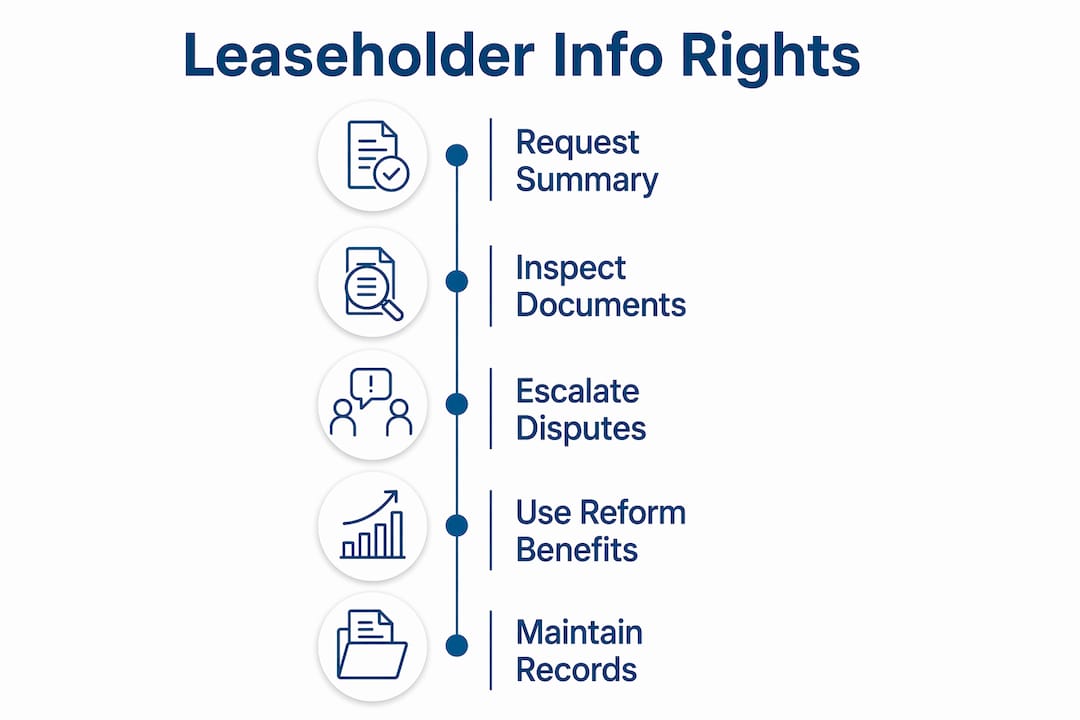
The leasehold right to information is defined by two key provisions in the Landlord and Tenant Act 1985: Section 21 and Section 22. Section 21 gives you the right to request a written summary of service charge costs for the most recent accounting period. Your landlord must provide this within one month of your written request, or within six months of the accounting period ending, whichever is later.

Section 22 goes further. Once you have received the Section 21 summary, you have six months to request inspection of the underlying documents: the original invoices, receipts, and contracts that support every figure in that summary. Your landlord must then make those documents available for inspection within one month of your request and keep them accessible for two months. Inspection is free, though reasonable copying fees may apply.
These are not optional courtesies. Failure to comply without reasonable excuse is a criminal offence, prosecutable in the Magistrates' Court. Understanding your leasehold service charge rights from the outset puts you in a far stronger position when charges look wrong.
What information can leaseholders request?
The scope of what you can request is broader than most leaseholders realise. Under Section 21, the written summary must cover all costs incurred during the accounting period, whether or not those costs have been demanded from leaseholders yet. It must also state which costs are covered by insurance and identify any costs that remain in dispute.
Under Section 22, you can inspect:
- Original invoices from contractors and suppliers
- Receipts confirming payments made on behalf of the building
- Contracts with managing agents, maintenance firms, and insurers
- Any other documents that support the figures in the Section 21 summary
The six-month window for making a Section 22 request is strict. Many leaseholders miss this deadline, which allows some agents to obscure charges without ever facing scrutiny. Mark the date you receive your Section 21 summary and count six months forward immediately.
Pro Tip: Always make your Section 21 and Section 22 requests in writing, sent by recorded post or email with a read receipt. This creates a clear paper trail and starts the statutory clock running.
There is also a separate but related right under Section 48 of the Landlord and Tenant Act 1987. Landlords must provide a valid address in England and Wales for serving notices. If they fail to do so, service charges are not legally payable until that information is supplied. This is a powerful but underused tool when landlords are unresponsive.
How have recent reforms strengthened information access?
The Leasehold and Freehold Reform Act 2024 represents the most significant shift in leasehold information rights in a generation. The 2024 Act introduced enhanced rights to request information about service charges, management practices, and building insurance commissions. Insurers and managing agents who receive commissions must now disclose them on request.
The reforms also tackled one of the most effective weapons landlords used against leaseholders: legal costs. Previously, leaseholders who challenged charges at the First-tier Tribunal risked being ordered to pay the landlord's legal costs, even when they won. The removal of this presumption means leaseholders can now pursue disputes without the threat of disproportionate financial punishment.
The practical effect of these changes is significant. Leaseholders now have:
- Stronger rights to commission disclosure on insurance and other contracts
- Reduced financial risk when challenging unreasonable charges or management failures
- Clearer routes to dispute poor management through the First-tier Tribunal
- Greater pressure on landlords to maintain accurate and accessible records
For a full breakdown of how these changes affect conveyancing and property transactions, the Leasehold Reform Act 2024 guide on the Righttomanage blog covers the detail clearly.
Common challenges when exercising your right to information
Landlords and managing agents use a predictable set of tactics to deflect information requests. Knowing these tactics in advance means you will not be put off by them.
The most common excuse is "board eyes only" or "commercial sensitivity." These phrases have no legal standing whatsoever. There is no exemption in the Landlord and Tenant Act 1985 for commercial sensitivity when a leaseholder makes a genuine statutory request. An agent who uses this excuse is either misinformed or deliberately obstructive.
Other common obstacles include:
- Ignoring the request entirely, hoping the leaseholder gives up
- Providing incomplete summaries that omit disputed costs or insurance details
- Delaying beyond the statutory deadline without acknowledging the request
- Demanding payment before releasing documents, which has no legal basis
The remedy for each of these is the same: escalate formally and quickly. Leaseholders should escalate beyond the managing agent to the local housing authority or Tenancy Relations Officer, who can bring legal proceedings against a non-compliant landlord. The First-tier Tribunal also has jurisdiction to order compliance and award costs.
Pro Tip: When writing your formal request, cite Section 21 or Section 22 of the Landlord and Tenant Act 1985 by name and state clearly that non-compliance constitutes a summary criminal offence under Section 22(2). This single step prompts compliance far more reliably than a polite email.
For practical guidance on making formal requests correctly, the leasehold property enquiries guide sets out best practices in plain terms.
How information rights help you manage charges and disputes
Access to invoices and contracts is not just a legal exercise. It is the most direct way to verify whether your service charges are reasonable and to build a case if they are not.
When leaseholders inspect original invoices, they regularly find charges that do not match the work carried out, contractor rates that are well above market rates, or costs allocated to the wrong properties. These findings form the basis of a challenge at the First-tier Tribunal. The Tribunal plays a central role in resolving service charge disputes, and leaseholders who arrive with documented evidence consistently achieve better outcomes than those who rely on general complaints.
The table below summarises how each type of document request supports a specific dispute outcome.
| Document requested | What it reveals | How it helps your case |
|---|---|---|
| Section 21 summary | Total costs for the period | Identifies unexplained increases or missing categories |
| Original invoices (Section 22) | Actual contractor charges | Confirms whether billed amounts match real costs |
| Insurance contracts | Commission paid to agent | Reveals undisclosed financial interests |
| Management contracts | Agent fee structure | Shows whether fees are proportionate to services |
| Maintenance receipts | Work completion records | Proves whether charged work was actually done |
Maintaining your own records is equally important. Keep copies of every request you send, every document you receive, and every deadline you calculate. Leaseholders who manage this process carefully are far better placed to challenge charges, negotiate with agents, and, if necessary, pursue the Right to Manage.
Key takeaways
Leaseholders in England and Wales hold enforceable statutory rights to inspect service charge summaries and underlying documents, and non-compliance by landlords is a criminal offence under the Landlord and Tenant Act 1985.
| Point | Details |
|---|---|
| Section 21 summary right | Request a written cost summary within one month; the six-month accounting deadline also applies. |
| Section 22 inspection right | Inspect invoices and contracts within six months of receiving the summary; inspection is free. |
| Criminal penalties apply | Non-compliance without reasonable excuse is a Magistrates' Court offence with unlimited fines. |
| 2024 reforms reduced financial risk | Leaseholders no longer face a presumption of paying landlord legal costs when disputing charges. |
| Escalate when blocked | Involve the local housing authority or Tenancy Relations Officer if a landlord ignores your request. |
Why leaseholders should assert these rights without hesitation
I have seen the same pattern repeat itself across hundreds of leasehold cases. A leaseholder notices that their service charge has risen sharply. They ask their managing agent for an explanation. The agent sends a vague letter citing "increased maintenance costs" and suggests the matter is closed. The leaseholder, unsure of their rights, accepts this and pays.
That outcome is avoidable every single time. The law is clear, the timelines are specific, and the penalties for non-compliance are real. What stops most leaseholders from acting is not the complexity of the law. It is the confidence to use it. Agents rely on that hesitation. The moment you send a formal written request citing Section 21 or Section 22 by name, the dynamic shifts. You are no longer a passive payer. You are a leaseholder exercising a statutory right.
The 2024 reforms have made this even more worthwhile. The removal of the costs presumption means the financial risk of challenging charges has fallen significantly. Leaseholders who previously held back because they feared a legal bill now have far less reason to do so. The law is moving in your direction. Use it.
— Paul
How Righttomanage can help you go further
If your landlord or managing agent is withholding information, inflating charges, or simply failing to manage your building properly, information rights are the starting point. The next step is taking control of the management entirely.

Righttomanage helps leaseholders in England and Wales exercise the Right to Manage from start to finish, including eligibility checks, company formation, and all statutory notices. If poor management or a lack of transparency has pushed you to this point, the RTM process timeline explains every stage clearly. For buildings where the managing agent is the core problem, the RTM for poor managing agents page sets out exactly how the process works and what to expect.
FAQ
What is the leasehold right to information?
The leasehold right to information is a statutory right under the Landlord and Tenant Act 1985 that lets leaseholders request a written summary of service charge costs and inspect the underlying invoices, receipts, and contracts.
How long does a landlord have to respond to a Section 21 request?
A landlord must provide the written summary within one month of the request, or within six months of the end of the accounting period, whichever is later.
Can a managing agent refuse to show invoices on grounds of commercial sensitivity?
No. Commercial sensitivity provides no legal exemption from a genuine statutory request under Section 22. Refusal without reasonable excuse is a criminal offence.
What happens if my landlord ignores my information request?
You can report the non-compliance to your local housing authority or Tenancy Relations Officer, who can bring legal proceedings. The First-tier Tribunal can also order compliance and award costs against the landlord.
Do the 2024 leasehold reforms change my right to information?
Yes. The Leasehold and Freehold Reform Act 2024 extended information rights to include insurance commissions and management details, and removed the presumption that leaseholders pay landlord legal costs when disputing charges.