
Leasehold purchase service charge disclosure is the legal process by which leaseholders obtain transparent, itemised details of ongoing and historical service charges before completing a property purchase. Under the Landlord and Tenant Act, sellers and managing agents must provide this information to protect buyers from hidden financial obligations. Getting this disclosure right before exchange of contracts is the single most effective way to avoid costly surprises after you move in. This guide covers the documents you need, the red flags to spot, your statutory rights, and what to do when something looks wrong.
What documents must you obtain for service charge disclosure?
The management pack is the cornerstone of any leasehold property purchase. It contains the documents that reveal the true financial health of your building, and ordering it early is critical because it can take up to eight weeks to arrive. Delays here can stall your entire conveyancing transaction.
The LPE1 form (Leasehold Property Enquiries form) is the standard document your solicitor requests from the managing agent. It covers current service charge estimates, reserve fund balances, insurance details, and any ongoing disputes. Beyond the LPE1, you should request the last three years of audited service charge accounts and the current year's budget estimate.
The reserve fund statement deserves particular attention. A low or zero reserve fund significantly increases the risk of a large one-off demand for major works landing on your doorstep shortly after purchase. That demand could run to tens of thousands of pounds with little warning.

Section 20 notices are also worth reviewing. These are formal notices issued when major works costing above a statutory threshold are planned. If a Section 20 notice has been served but the works are not yet complete, you could inherit a substantial liability.
| Document | Contents | Who Provides It | Typical Cost |
|---|---|---|---|
| LPE1 Form | Charges, disputes, insurance, reserve fund | Managing agent | £100–£350 |
| Last 3 years' accounts | Audited income and expenditure | Managing agent | Included in pack |
| Current year estimate | Projected service charge budget | Managing agent | Included in pack |
| Reserve fund statement | Sinking fund balance and contributions | Managing agent | Included in pack |
| Section 20 notices | Planned major works and costs | Managing agent | Included in pack |
Pro Tip: Ask your solicitor to request the management pack on the day your offer is accepted. Do not wait for the seller to instruct their solicitor first. Those eight weeks matter.
How do you interpret service charge accounts and spot red flags?
Service charge accounts show income collected from leaseholders and expenditure on building maintenance, insurance, cleaning, and management fees. The gap between what was budgeted and what was actually spent tells you a great deal about how competently the building is managed. Consistent overspend signals either poor planning or inflated costs.
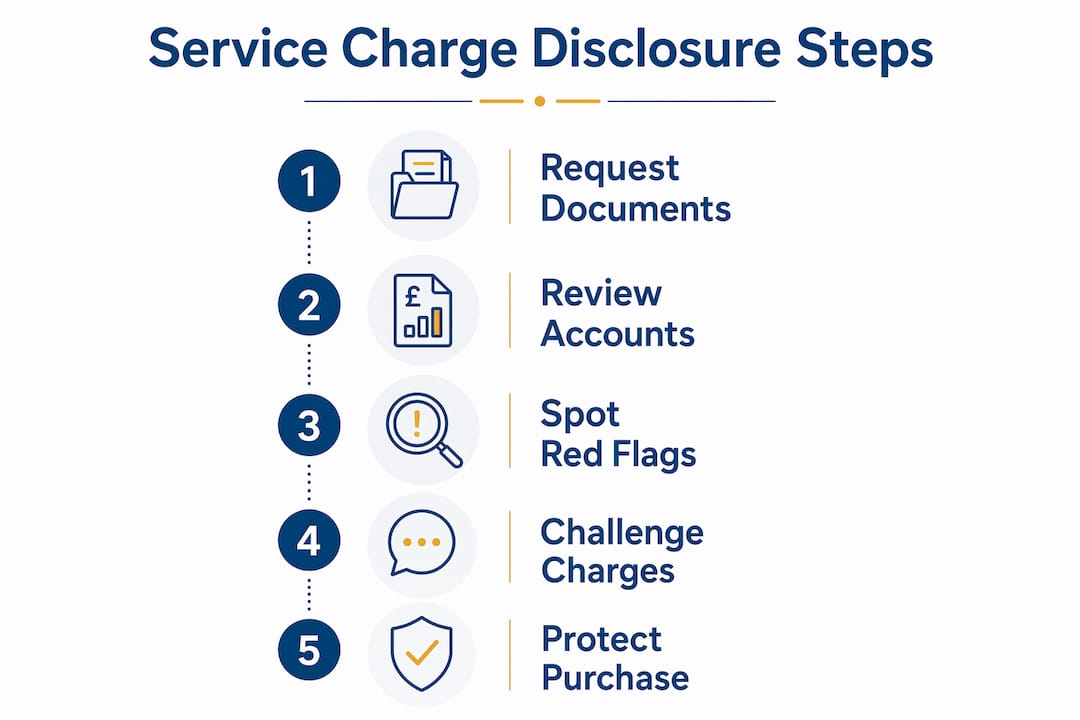
Common red flags include rapidly increasing charges beyond inflation rates, low sinking funds, and ongoing disputes noted in the management pack. Any one of these warrants further investigation before you proceed.
Watch for these specific indicators in the accounts:
- Rapid charge increases. If service charges have risen more than 10–15% year on year without a clear explanation, ask why.
- Low or depleted reserve fund. A fund covering less than one year's service charge expenditure is a warning sign.
- Opaque management fees. Fees described only as "management" without a breakdown suggest a lack of transparency.
- Ongoing disputes. Any reference to tribunal proceedings or leaseholder complaints in the LPE1 is a serious flag.
- Unexplained one-off charges. Large sums labelled as "special levies" without supporting documentation require explanation.
- Arrears from other leaseholders. High collective arrears reduce the funds available for maintenance and can lead to shortfalls.
The lease agreement is the definitive document specifying what service charges can be levied. Charges must conform to a reasonableness test to be enforceable. If the accounts show expenditure on items not authorised by the lease, those charges may be legally challengeable.
Pro Tip: If the accounts run to more than a few pages or include complex major works expenditure, pay a specialist leasehold surveyor or solicitor to review them. The fee is modest compared to the liability you could be taking on.
What statutory rights do leaseholders have to request and challenge disclosures?
Leaseholders in England have statutory rights to obtain a written summary of service charge costs and to inspect the supporting accounts and invoices. These rights are set out in Sections 21 and 22 of the Landlord and Tenant Act 1985. Section 21 gives you the right to demand a written summary of costs. Section 22 gives you the right to inspect the underlying receipts and documents.
Landlords must also hold service charge monies in trust at a regulated financial institution. This protects your money if the landlord becomes insolvent. If you discover that funds are not held in a designated trust account, that is a serious legal breach.
Service charge demands must be accompanied by a summary of costs, and leaseholders can challenge unreasonable charges at the First-tier Tribunal (Property Chamber). The Tribunal has the power to determine whether charges are reasonable and whether works were carried out to an adequate standard.
Here is a summary of the main dispute resolution pathways available to you:
- Written request to the landlord or managing agent. Start here. Request a full breakdown of any charge you dispute in writing.
- Leasehold Advisory Service (LEASE). LEASE provides free, impartial advice on service charge disputes and can clarify your legal position.
- First-tier Tribunal (Property Chamber). Apply to the Tribunal if informal resolution fails. The Tribunal can rule on reasonableness and order repayment.
- County Court. Used primarily for recovering overpaid charges or pursuing landlords who breach statutory obligations.
| Pathway | Cost | Timeframe | Outcome |
|---|---|---|---|
| Written landlord request | Free | Days to weeks | Breakdown or explanation |
| LEASE advice | Free | Immediate | Guidance only |
| First-tier Tribunal | Low court fees | Months | Binding determination |
| County Court | Higher legal costs | Months to a year | Enforceable judgment |
For a deeper look at how the Tribunal process works, the Leasehold Reform Act 2024 introduced further changes to conveyancing obligations that affect disclosure requirements.
What steps should you take during conveyancing to protect yourself?
The conveyancing process is your window to gather and verify all service charge information before you are legally committed. Acting in the right order protects you from inheriting someone else's financial problems.
Follow these steps in sequence:
- Instruct your solicitor to request the management pack immediately. Do not wait for the seller's solicitor to act first. Time is the scarcest resource in conveyancing.
- Review the LPE1 form as soon as it arrives. Check for arrears, disputes, pending major works, and reserve fund levels before you proceed further.
- Request three years of audited accounts. Compare budgeted versus actual expenditure each year to identify trends.
- Confirm the reserve fund balance and recent contributions. A healthy fund suggests the building is being managed with foresight.
- Check for any outstanding Section 20 notices. Ask explicitly whether any major works are planned or in progress that have not yet been billed.
- Raise all queries with the managing agent in writing. Written responses create a paper trail you can rely on later.
- Negotiate a retention if significant uncertainty remains. Your solicitor can hold a sum from the purchase price in escrow until outstanding service charge liabilities are confirmed.
The most common mistake buyers make is treating the management pack as a formality. It is not. Managing agents cannot charge for anything not explicitly authorised in the lease, and charges must be reasonable. Knowing this before you buy gives you leverage to negotiate or walk away.
Pro Tip: Ask the seller directly whether they have received any informal communications about planned major works, even if no Section 20 notice has been served yet. Verbal warnings from managing agents do not always appear in the formal pack.
How should you respond if disclosure raises concerns?
If the documents reveal problems, you have several options before you are committed to the purchase. The worst response is to proceed and hope for the best. The second worst is to panic and withdraw without exploring your options.
Start by raising specific concerns with your solicitor in writing. Your solicitor can then formally request clarification from the seller's solicitor or the managing agent. If the concern relates to a potential major works bill, a retention from the purchase price is often the most practical solution.
Use these steps to document and communicate concerns effectively:
- Put every query in writing and keep copies of all responses.
- Request confirmation of any verbal assurances in writing before exchange.
- Ask the managing agent to confirm in writing whether any major works are planned within the next 12 months.
- If disputes are ongoing, ask for copies of all correspondence and Tribunal applications.
- Consult the leaseholder dispute resolution options available to you before deciding whether to proceed.
If you buy the property and then discover that service charges are excessive or poorly managed, the Right to Manage process offers a long-term solution. Leaseholders can collectively take over building management from a failing managing agent without buying the freehold. This gives you direct control over how service charge funds are spent and how the building is maintained.
Key takeaways
Leasehold purchase service charge disclosure requires you to obtain the management pack, review three years of accounts, check the reserve fund, and understand your statutory rights under the Landlord and Tenant Act before exchange of contracts.
| Point | Details |
|---|---|
| Order the management pack early | Packs take up to eight weeks; request on the day your offer is accepted. |
| Check the reserve fund balance | A low or zero balance signals a likely major works demand shortly after purchase. |
| Know your Section 21 and 22 rights | You can demand written summaries and inspect supporting invoices by law. |
| Challenge unreasonable charges | The First-tier Tribunal can rule on reasonableness and order repayment. |
| Use a retention if uncertain | Ask your solicitor to hold funds in escrow until outstanding liabilities are confirmed. |
The part most buyers get wrong about service charge disclosure
I have seen leaseholders spend months negotiating the purchase price of a flat, then spend less than an hour reviewing the management pack. That imbalance is where financial pain begins. The purchase price is fixed the moment you exchange. The service charge liability is not.
The most underestimated document in any leasehold transaction is the reserve fund statement. A building with a depleted sinking fund is not just a warning sign. It is a near-certain indicator that a large demand is coming. I have spoken with leaseholders who received bills for £15,000 to £30,000 within eighteen months of purchase, for works that were clearly foreseeable from the accounts they never properly read.
The Leasehold Reform Act 2024 is improving transparency obligations, but legislation moves slowly. Your best protection right now is understanding what you are entitled to ask for and actually asking for it. Statutory rights under Sections 21 and 22 of the Landlord and Tenant Act 1985 are powerful tools. Most buyers never use them because they do not know they exist.
My consistent advice is this: treat the service charge disclosure process with the same rigour you apply to the survey. Both tell you what you are really buying.
— Paul
Take control of your service charges with Righttomanage
If your service charge disclosure has revealed excessive costs, a lack of transparency, or a managing agent who is not performing, you are not without options.
Righttomanage helps leaseholders in England and Wales legally take control of their building management through the Right to Manage process. From RTM eligibility checks to company setup, Section 78 and Section 79 notices, and acquisition-date preparation, the entire process is managed for you. If poor management or inflated service charges prompted your search today, find out whether your building qualifies by visiting Righttomanage for a free eligibility check.
FAQ
What is leasehold purchase service charge disclosure?
Leasehold purchase service charge disclosure is the process of obtaining itemised details of a property's service charge history, current obligations, and reserve fund status before completing a leasehold purchase. It is a legal requirement under the Landlord and Tenant Act 1985.
Which documents should i request before buying a leasehold flat?
Request the LPE1 form, the last three years of audited service charge accounts, the current year's budget estimate, the reserve fund statement, and any Section 20 notices for planned major works.
Can i challenge service charges i think are unreasonable?
Yes. Leaseholders can challenge unreasonable charges at the First-tier Tribunal (Property Chamber), which has the power to determine whether charges are reasonable and whether works met an adequate standard.
What does a low reserve fund mean for a buyer?
A low or zero reserve fund means the building has little financial buffer for major repairs. You are likely to face a large one-off demand for works shortly after purchase.
What is the right to manage and how does it help with service charges?
Right to Manage is a statutory right allowing leaseholders to collectively take over building management from the freeholder or managing agent without buying the freehold. It gives leaseholders direct control over how service charge funds are spent and how the building is maintained.