
The Leasehold Reform Act 2024 is the most significant overhaul of leasehold law in England and Wales in over two decades, and it directly reshapes how leasehold property transactions are handled. Understanding how leasehold reform act 2024 affects conveyancing is no longer optional for buyers, sellers, or their solicitors. The Act grants leaseholders immediate statutory rights to extend leases up to 990 years with near-zero ground rent, removes the two-year ownership wait from january 2025, and sets in motion a phased reform programme that is still unfolding. Conveyancing practice in 2026 sits squarely in that transition, with some provisions live and others pending secondary legislation.
How the leasehold reform act 2024 affects conveyancing
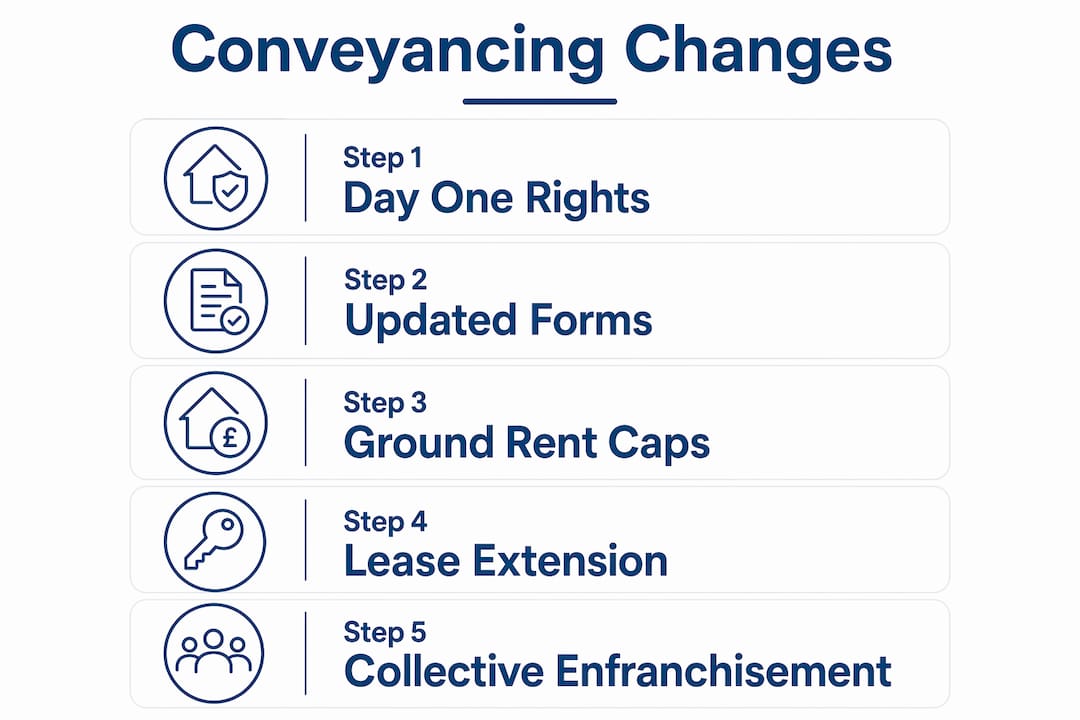
The Act introduces two headline rights that change conveyancing from the moment a buyer exchanges contracts. First, leaseholders now hold a statutory right to extend leases by up to 990 years, replacing the previous standard of 90 years. Second, ground rent is capped at a peppercorn rate for the full extended term, effectively reducing it to zero. These two changes alone alter how solicitors assess lease quality, advise on value, and negotiate terms during a purchase.
Before the Act, a buyer had to own a leasehold property for two years before exercising statutory extension rights. That restriction is gone. As of 31 january 2025, Day One statutory rights apply, meaning a buyer can serve a lease extension notice the moment they complete their purchase. This transforms the negotiating position of any buyer acquiring a short lease.
The Act also strengthens collective enfranchisement rights, making it easier for groups of leaseholders to buy their freehold collectively. For conveyancers, this means the RTM versus buying the freehold question now arises earlier in the transaction process and requires clearer client advice.
Pro Tip: If you are buying a flat with fewer than 80 years remaining on the lease, ask your solicitor to calculate the extension premium under both current and anticipated future valuation rules before you exchange.
Key statutory rights now active or imminent under the Act include:
- 990-year lease extensions replacing the old 90-year standard
- Peppercorn ground rent for the full extended term
- Day One extension rights removing the two-year ownership requirement
- Stronger enfranchisement rights for collective freehold purchase
- Increased transparency on service charges and management costs
Which provisions are live and which are still pending?
The phased implementation of the Act creates a two-tier system that is the single biggest source of confusion in leasehold conveyancing today. Some provisions are fully in force. Others await commencement orders or secondary legislation that had not arrived by mid-2026. Conveyancers warn that clients must confirm precisely which provisions apply to their specific transaction before making any financial decisions.
The following provisions were active as of 2026:
- Removal of the two-year ownership requirement (from 31 january 2025)
- Strengthened service charge transparency obligations
- Right to request information from landlords on insurance and costs
- Restrictions on landlord recovery of legal costs in certain disputes
The following provisions remain subject to secondary legislation:
- Full commencement of 990-year lease extensions under the new valuation framework
- Abolition of marriage value in premium calculations
- Prescribed rates for valuation of lease extension premiums
- Full commonhold transition provisions
"Many significant provisions of the Act, including 990-year lease extensions and marriage value removal, remain subject to secondary legislation that may change implementation timing. Leaseholders must confirm with solicitors which provisions are currently live to avoid costly mistakes." — Leasehold Reform Act 2024 Summary
This staged approach means your conveyancer cannot give you a single clean answer about what the Act delivers today. The advice must be transaction-specific and updated regularly as commencement orders are issued.
What changes in the conveyancing process itself?
The practical conveyancing workflow for leasehold properties has shifted in several concrete ways. Early lease term review is now a priority task rather than a late-stage check. Solicitors are expected to assess lease length, ground rent provisions, and service charge structures at the outset of a transaction, not after a survey or mortgage offer arrives.

The updated Property Information Forms, revised to their 6th Edition as of march 2026, now standardise material disclosures earlier in the transaction. Sellers must provide accurate leasehold and building safety information upfront. Incomplete or inaccurate data from sellers now creates direct risk of transaction delays and potential legal liability.
Ground rent enforcement has also changed. Under the Act, ground rent clauses in new leases are restricted, and conveyancers must check existing leases carefully for prohibited escalation clauses. You can read more about ground rent restrictions and how they affect your position as a buyer or seller.
Pro Tip: Request the leasehold management pack as early as possible in your transaction. Delays in receiving this document are one of the most common causes of extended conveyancing timelines under the new disclosure requirements. See the management pack guide for a full breakdown.
Service charge transparency is another area where conveyancers now carry more advisory weight. Buyers have stronger rights to scrutinise historic service charge accounts, and solicitors are expected to flag anomalies before exchange.
How does the reform affect valuation, mortgageability, and pricing?
Valuation is where the reform creates the most immediate financial uncertainty. Prescribed valuation rates for calculating lease extension premiums have not yet been finalised by secondary legislation. This means premium quotes from different surveyors can vary significantly for the same property.
The abolition of marriage value is the provision with the largest financial impact. Marriage value is the uplift in a property's value that occurs when a short lease is extended, and freeholders currently capture a share of it. When abolished, savings of £15,000 to £75,000 are anticipated depending on property value and lease length. That provision is not yet in force, which means buyers of short-lease properties today still face the full cost.
| Provision | Current Status | Financial Impact |
|---|---|---|
| 990-year lease extensions | Pending full commencement | Significant long-term value gain |
| Peppercorn ground rent | Active for new extensions | Removes recurring ground rent liability |
| Marriage value abolition | Pending secondary legislation | Potential saving of £15,000–£75,000 |
| Prescribed valuation rates | Not yet set | Creates premium uncertainty now |
| Day One extension rights | Active from january 2025 | Removes two-year ownership wait |
Mortgage lenders are watching these changes closely. Most mainstream lenders already require a minimum unexpired lease term, typically 70–85 years at the end of the mortgage term. The prospect of 990-year extensions improves mortgageability in theory, but lenders will not fully adjust criteria until the valuation framework is settled. Buyers relying on mortgage finance for short-lease properties should discuss lender requirements with their solicitor before committing to a purchase.
What should leaseholders and buyers do right now?
Practical guidance for navigating these reforms during conveyancing comes down to five clear steps.
-
Instruct a specialist conveyancer early. Not all solicitors are equally up to date on the Act's phased commencement. Choose one with demonstrable leasehold experience and ask directly what provisions they consider live for your transaction.
-
Get a lease extension premium estimate before exchange. Even with valuation uncertainty, a surveyor can give you a range. That range informs your negotiating position on purchase price, particularly for short-lease properties.
-
Decide whether to extend before or after purchase. With Day One rights now active, you no longer need to wait two years. However, if marriage value abolition is imminent, waiting a short period could save tens of thousands of pounds. Your solicitor and surveyor should model both scenarios.
-
Review the management pack thoroughly. Under the new disclosure requirements, the management pack carries more weight than before. Anomalies in service charge accounts or building safety compliance can now affect both price and mortgage eligibility.
-
Monitor commencement orders. The Government issues commencement orders as secondary legislation is finalised. Sign up for updates from the Law Society or the Leasehold Advisory Service (LEASE) to stay current. Your conveyancer should be doing this too, but do not assume it.
Conveyancers increasingly act as strategic advisors rather than process administrators under this reform. The best ones will model different scenarios for you, not just report what the lease says. If yours is not doing that, ask for it explicitly.
Key takeaways
The Leasehold Reform Act 2024 fundamentally changes conveyancing by activating Day One extension rights, capping ground rent, and creating valuation uncertainty that requires specialist advice on every leasehold transaction.
| Point | Details |
|---|---|
| Day One extension rights | Buyers can serve a lease extension notice immediately on completion, removing the two-year wait. |
| Peppercorn ground rent | New lease extensions carry zero effective ground rent for the full 990-year term. |
| Phased implementation | Marriage value abolition and prescribed valuation rates are not yet in force as of mid-2026. |
| Valuation uncertainty | Premium quotes vary widely until secondary legislation sets prescribed rates. |
| Conveyancer role | Solicitors must now act as strategic advisors, modelling extension scenarios before exchange. |
The part that most buyers are not being told
I have spoken with leaseholders who completed purchases in early 2025 genuinely believing the full Act was in force. They were not misled exactly. Their solicitors told them the Act had received Royal Assent. What was not made clear was that Royal Assent and commencement are two entirely different things. A law can pass Parliament and sit dormant for years while secondary legislation catches up.
The marriage value issue is the sharpest example. A buyer purchasing a flat with 68 years on the lease today still faces the full marriage value premium when they extend. That could mean paying £30,000 more than they would pay once the abolition provision commences. That is not a minor footnote. It is a material financial decision that should be front and centre in every leasehold conveyancing file right now.
The commonhold transition adds another layer. As commonhold becomes a viable alternative tenure, mixed buildings with some commonhold and some leasehold flats will create management complexity that nobody has fully mapped yet. Buyers and investors in larger blocks should be asking their solicitors about this now, not after they complete.
My honest view is that the Act is genuinely good news for leaseholders. The direction of travel is right. But the phased rollout means you need to be more informed, not less, during the transition. Do not assume your solicitor is tracking every commencement order. Ask the question directly.
— Paul
How Righttomanage can help you take control
If the reform has made you realise your building's management is the real problem, not just the lease length, Righttomanage is built for exactly that situation.

Righttomanage manages the entire Right to Manage process from eligibility check through to acquisition date, covering Section 78 notices, Section 79 claim notices, and counter-notice review. If you are dealing with excessive service charges, poor maintenance, or a freeholder who stonewalls your requests, the RTM route gives you legal control without buying the freehold. Check whether your building qualifies with a free RTM eligibility check, or explore the RTM process for small blocks if you own one of two to four flats.
FAQ
When did the two-year ownership rule change?
The two-year ownership requirement for lease extensions and enfranchisement was removed on 31 january 2025. Buyers can now exercise statutory extension rights from the day they complete their purchase.
Is marriage value abolished under the 2024 act?
Marriage value abolition is included in the Act but has not yet commenced. It requires secondary legislation before it takes effect, meaning leaseholders extending short leases today still pay the full marriage value premium.
How does the reform affect my mortgage application?
Lenders still apply minimum unexpired lease term requirements. The prospect of 990-year extensions improves long-term mortgageability, but lenders will not fully revise criteria until the new valuation framework is settled by secondary legislation.
What are the updated property information forms?
The 6th Edition Property Information Forms, introduced in march 2026, require sellers to disclose leasehold and building safety information earlier in the transaction. Incomplete data from sellers is now a direct cause of conveyancing delays.
Should i extend my lease now or wait for full implementation?
The answer depends on your lease length and the likely timing of marriage value abolition. If your lease is above 80 years, extending now under current rules may cost less than waiting. If it is below 80 years, the marriage value saving from waiting could be substantial. A specialist surveyor should model both scenarios before you decide.