
A long leasehold is a property ownership arrangement where you own the right to occupy a home for a fixed, lengthy period but not the land it stands on. The land remains owned by a freeholder, and your rights are governed by a legal agreement called the lease. Around 5 million homes in England and Wales are leasehold, with flats making up the vast majority. Understanding what is a long leasehold explained in plain terms matters enormously when buying, selling, or remortgaging a property, because the lease length and its conditions directly affect your finances and your rights.
What does long leasehold mean legally?
The phrase "long leasehold" does not have a single legal definition. It means different things depending on the legal context, and confusing them is a common and costly mistake.
Under tenancy law, a lease of more than 21 years qualifies as a long lease. This classification determines whether a lease is treated as an assured tenancy, which carries specific rights and risks for both leaseholders and freeholders. Under tax law, HMRC defines a long lease as one with more than 50 years remaining for Capital Gains Tax purposes. A lease of 50 years or fewer is a short lease and is taxed differently on disposal. These two thresholds, 21 years and 50 years, apply in entirely separate legal frameworks. Knowing which one applies to your situation is not optional.

Pro Tip: Always ask your solicitor to confirm which legal definition of "long lease" applies to your transaction. The answer changes depending on whether you are dealing with tenancy rights, tax, or mortgage lending.
In practice, most residential leases in England and Wales are far longer than either threshold. The mean average remaining lease length in 2024–25 was 483 years. That figure reflects the reality that many leases were originally granted for 999 years or 125 years, and most still have substantial time left.
| Lease length remaining | Legal classification | Key implication |
|---|---|---|
| Over 21 years | Long lease (tenancy law) | Not an assured tenancy |
| Over 50 years | Long lease (HMRC/CGT) | Standard tax treatment on sale |
| 80 years or fewer | Approaching short lease | Mortgage risk; extension advised |
| 50 years or fewer | Short lease (HMRC/CGT) | Higher CGT on disposal |
32% of leasehold dwellings have over 900 years remaining. That sounds reassuring, but it masks the fact that roughly 10% have 80 years or fewer left, which is where real financial problems begin.
Long leasehold vs freehold: what is the practical difference?
Freehold ownership means you own the property and the land outright, with no fixed term and no landlord above you. Long leasehold ownership means you hold the right to occupy for a set period, subject to the terms of a lease and obligations to a freeholder.
The distinction matters most in three areas: ongoing costs, control, and resale. Freeholders pay no ground rent and answer to no landlord. Leaseholders typically pay ground rent to the freeholder and service charges towards the upkeep of shared areas and the building structure. Long leaseholds, even with hundreds of years remaining, can still carry significant ongoing costs through these charges, and they require active management regardless of how much time is left on the lease.
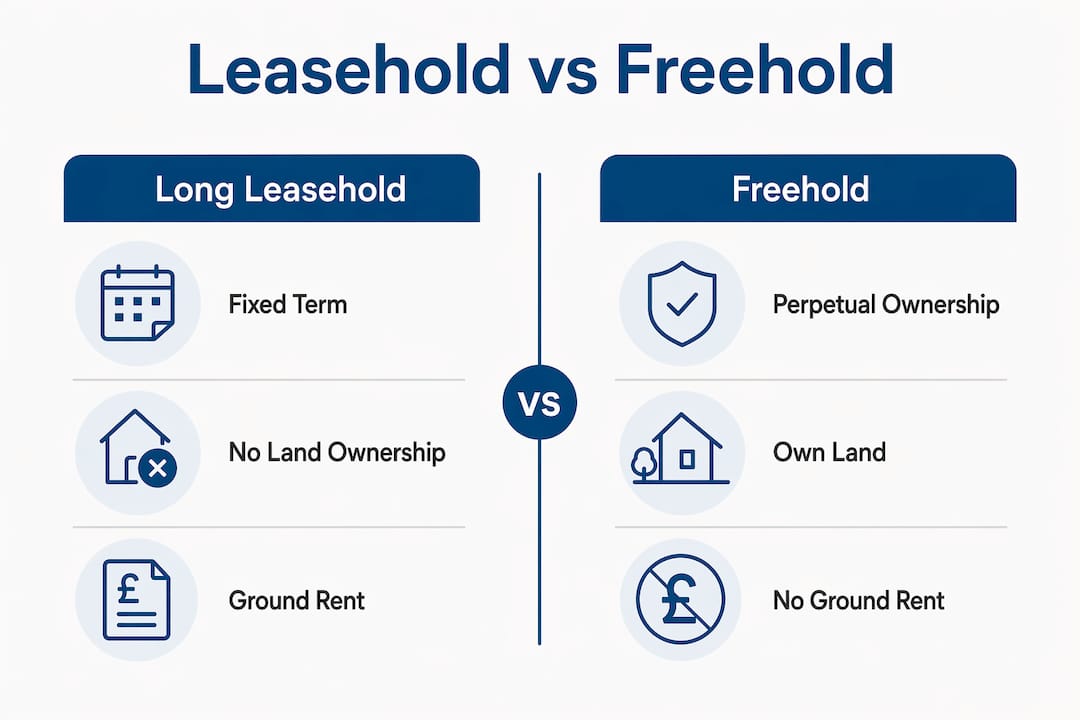
The comparison below shows the core differences at a glance.
| Feature | Long leasehold | Freehold |
|---|---|---|
| Ownership of land | No. Land owned by freeholder | Yes |
| Fixed term | Yes. Set number of years | No |
| Ground rent | Potentially payable | Not applicable |
| Service charges | Usually payable | Not applicable |
| Lease extension right | Yes, under statute | Not applicable |
| Mortgage availability | Can be restricted near 80 years | Generally unrestricted |
The long leasehold model does offer genuine benefits. It gives buyers access to flats and properties at lower upfront costs than purchasing the freehold outright. Shared building maintenance is managed collectively, which suits flat ownership particularly well. The long leasehold benefits are real, but they come with responsibilities that freehold ownership does not.
One area where government reforms have reduced ground rent burdens is new leases. Ground rents on most new residential leases are now capped at a peppercorn, meaning effectively zero. Existing leases with historic ground rent clauses remain in place, but the direction of travel is clear.
What are the rights and responsibilities of long leaseholders?
Long leaseholders in England and Wales hold a defined set of rights and carry specific obligations. Both sides of that equation affect your finances and your ability to sell or remortgage.
Your core obligations as a leaseholder include:
- Paying ground rent if the lease requires it (subject to reforms on new leases)
- Paying service charges for building maintenance, insurance, and shared services
- Maintaining the interior of your property in good repair
- Seeking consent from the freeholder for certain alterations or subletting
- Complying with all other conditions set out in the lease
Your statutory rights as a long leaseholder include:
- The right to extend your lease under the Leasehold Reform, Housing and Urban Development Act 1993
- The right to collectively purchase the freehold through enfranchisement
- The right to challenge unreasonable service charges at the First-tier Tribunal
- The right to request a summary of service charge accounts
- The right to participate in building management through the Right to Manage process
Lease length directly affects your ability to exercise these rights in practice. Mortgage lenders may be less willing to lend on properties with short remaining terms. NatWest guidance highlights that leaseholders should consider renewal when around 80 years remain, because below that threshold, extension costs rise sharply due to the freeholder's right to a share of the marriage value.
Pro Tip: Check the remaining lease term before you make an offer on any leasehold property. If it is below 90 years, factor in the cost of a lease extension before agreeing a price.
About 10% of leasehold properties have 80 years or fewer remaining. That minority faces the sharpest challenges around saleability, mortgage availability, and extension costs. Checking the lease term early is not a formality. It is a financial necessity.
Your leaseholder rights in England and Wales also include protections around service charges. Charges must be reasonable and supported by proper consultation for major works. If your managing agent is not meeting that standard, you have legal routes to challenge them.
How do government reforms affect long leasehold ownership?
The leasehold system in England and Wales has undergone significant reform since 2022, with further changes taking effect in 2025 and 2026. These changes improve the position of long leaseholders in several concrete ways.
The most significant recent change came into force on 27 december 2025. From that date, long leases of over 21 years no longer qualify as assured tenancies, regardless of the ground rent level. This removes a risk that previously exposed leaseholders to private tenancy rules and complicated financing or sales. The change applies to all qualifying leases, not just new ones.
Other key reforms include:
- Ground rents on new residential leases are capped at a peppercorn under the Leasehold Reform (Ground Rent) Act 2022
- The Leasehold and Freehold Reform Act 2024 makes it easier and cheaper to extend a lease or buy the freehold
- Service charge transparency requirements have been strengthened, giving leaseholders better access to financial information
- The government has committed to introducing commonhold as a mainstream alternative to leasehold for flats
The Leasehold Reform Act 2024 conveyancing changes are particularly relevant for anyone buying or selling a leasehold property now. Solicitors must now provide more detailed information about lease terms and charges as part of the conveyancing process. These reforms give leaseholders more control and faster access to ownership changes, which is a material improvement on the position that existed even five years ago.
Commonhold, where flat owners collectively own the building and the land with no fixed term, remains the long-term direction of government policy. It has not yet replaced leasehold at scale, but the legislative groundwork is being laid.
Key takeaways
A long leasehold gives you the right to occupy a property for a set term, but the land remains with the freeholder, and the lease length, costs, and recent reforms all shape what that ownership means in practice.
| Point | Details |
|---|---|
| Legal definition varies | "Long lease" means over 21 years under tenancy law and over 50 years under HMRC Capital Gains Tax rules. |
| Most leases are very long | The mean remaining lease length in 2024–25 was 483 years, but 10% have 80 years or fewer left. |
| Costs continue regardless | Ground rent and service charges apply even with centuries left on the lease. |
| 80-year threshold matters | Below 80 years, mortgage availability tightens and lease extension costs rise sharply. |
| Reforms improve protections | From december 2025, long leases no longer count as assured tenancies, removing a key financing risk. |
Why the 80-year rule catches more leaseholders off guard than it should
I have spoken with leaseholders who bought confidently on a 99-year lease, then found themselves ten years later with a property that was genuinely difficult to sell. The 80-year threshold is not a technicality. It is the point at which the freeholder gains the right to claim a share of the marriage value when you extend, and that can add tens of thousands of pounds to the cost of an extension.
The most common misconception I encounter is that a long lease is simply a long lease. Leaseholders assume that 75 years remaining is plenty of time. It is not, at least not in financial terms. The market, the mortgage lenders, and the law all treat sub-80-year leases differently, and buyers notice.
The 2025 reforms are genuinely positive. Removing the assured tenancy risk from long leases was overdue, and the ground rent cap on new leases eliminates one of the most exploitative features of the old system. But the reforms do not retroactively fix short leases or waive extension costs for existing leaseholders. If your lease is approaching 80 years, the reforms do not solve your problem. Acting early does.
My practical advice is this: treat the lease term as a core financial metric, not a legal footnote. Check it before you buy, review it before you remortgage, and factor in extension costs as part of your long-term ownership budget. The leaseholders who manage this well are the ones who treat it like a mortgage renewal, not a surprise.
— Paul
How Righttomanage can help you manage your leasehold
If you are a leaseholder frustrated with poor building management, excessive service charges, or a freeholder who is not responsive, you have legal options beyond simply complaining.
Righttomanage helps leaseholders exercise the Right to Manage, which lets you take control of your building's management without buying the freehold. The process covers eligibility checks, company formation, Section 78 and Section 79 notices, and counter-notice review. You can check whether your building qualifies with a free RTM eligibility check or review the full RTM process timeline to understand what is involved at each stage. Taking control of your building's management is one of the most practical steps a leaseholder can take.
FAQ
What is a long leasehold in simple terms?
A long leasehold means you own the right to live in a property for a set number of years, but the land belongs to a freeholder. The lease sets out your obligations and the duration of your ownership rights.
How long does a long leasehold last?
There is no single answer. Most residential leases in England and Wales were originally granted for 99, 125, or 999 years. The mean remaining lease length in 2024–25 was 483 years, though about 10% of leases have 80 years or fewer left.
What is the difference between long leasehold and freehold?
Freehold ownership means you own the property and the land outright with no time limit. Long leasehold means you own the right to occupy for a fixed term, subject to a lease, ground rent, and service charges.
When should I extend my lease?
Extend before the remaining term drops below 90 years. Below 80 years, extension costs rise sharply because the freeholder gains the right to a share of the marriage value, and mortgage lenders become more cautious.
Do the 2025 leasehold reforms affect existing leases?
Yes, in part. From 27 december 2025, long leases of over 21 years no longer count as assured tenancies, which removes a financing risk for existing leaseholders. Ground rent caps on new leases do not apply retroactively to older leases.