
Leasehold property enquiries best practices are defined as the structured, documented, and timely process of collecting, reviewing, and acting on critical information before or during leasehold property transactions and management. In England and Wales, this process centres on standardised tools like the LPE1 form, thorough review of service charge accounts, and proactive checks on building safety, ground rent, and major works. Poor enquiry management is one of the leading causes of post-purchase disputes, unexpected costs, and failed transactions. Getting this right protects both leaseholders and property managers from avoidable financial and legal risk.
1. What is the LPE1 form and why does it matter?
The LPE1 form is the industry standard questionnaire used to collect management and landlord information during leasehold conveyancing. Issued by the Law Society, it creates a consistent framework that reduces confusion between solicitors, managing agents, and buyers. Without it, each transaction would rely on ad hoc requests, increasing the risk of missing critical details.
The LPE1 standardises enquiry collection from landlords and managing agents, but it is not a substitute for professional legal advice to interpret lease risks. A solicitor must still review the responses and flag anything unusual or legally significant. Treating the LPE1 as a tick-box exercise is one of the most common mistakes in leasehold transactions.

Common misunderstandings include assuming that a completed LPE1 confirms a lease is problem-free, or that all questions will receive full answers. Managing agents sometimes leave sections incomplete, particularly around planned major works or insurance details. Leaseholders and their solicitors should chase incomplete responses before exchange.
Pro Tip: Ask the managing agent to confirm in writing whether any Section 20 consultation notices are planned in the next 12 months. This question is not always covered fully in standard LPE1 responses.
2. How to review service charge accounts effectively
Best practice requires reviewing the last three years of service charge accounts and demands to detect unexplained cost increases and major works, cross-referenced with Section 20 consultation notices issued in the last 24 months. Three years of data reveals patterns that a single year cannot. A sudden spike in year two, for example, may indicate a major repair that was not properly consulted on.
Look for year-on-year increases that are not explained by inflation or planned maintenance. Large one-off demands, particularly those labelled as "major works," deserve close scrutiny. Check whether a Section 20 consultation under the Landlord and Tenant Act 1985 was properly carried out for any works exceeding £250 per leaseholder. Failure to consult limits what a landlord can legally recover.
The reserve fund, also called the sinking fund, is equally telling. Buyers should request the current reserve fund balance and compare it against the building's age and condition. An underfunded reserve in an older block signals that a large special levy may be imminent. That cost falls on whoever owns the flat at the time.
A useful way to structure your financial review is to check these key areas in order:
- Total service charge demanded each year for the last three years
- Reserve fund balance and date of last valuation or condition survey
- Any Section 20 notices issued in the last 24 months
- Planned major works disclosed in the LPE1 or management pack
- Insurance premium history and whether it is competitively tendered
Pro Tip: Request a copy of the most recent building condition survey or planned maintenance schedule. Managing agents are not always required to provide this, but many will if asked directly.
| Document | What to check | Red flag |
|---|---|---|
| Service charge accounts | Year-on-year cost movement | Unexplained increases above inflation |
| Reserve fund statement | Current balance vs building age | Balance below one year's service charge |
| Section 20 notices | Works consulted in last 24 months | Major works with no prior notice |
| Insurance schedule | Premium trend and cover level | Premium rising sharply without explanation |
3. Ground rent, building safety, and management structure
Ground rent terms must be confirmed in writing before exchange. The Leasehold Reform (Ground Rent) Act 2022 capped ground rent on new leases at a peppercorn, but many existing leases retain doubling clauses or RPI-linked escalation. These clauses can make a property unmortgageable and difficult to sell. Always request the full ground rent schedule and any review mechanism written into the lease.
Building safety is now a central part of any leasehold enquiry checklist, particularly for flats in buildings over 11 metres or four storeys. Key documents to request include:
- The most recent fire risk assessment
- An EWS1 form where cladding concerns are relevant
- Confirmation of registration with the Building Safety Regulator for higher-risk buildings
- Any remediation notices or building safety fund applications
Understanding the management structure is equally important. Identify whether the building is managed by a professional managing agent, a residents' management company (RMC), or directly by the freeholder. Each structure carries different implications for accountability and leaseholder rights. The role of an RMC differs significantly from a commercial managing agent, particularly in how decisions are made and how disputes are handled.
4. How to organise and track leasehold enquiries efficiently
Effective enquiry management requires separating documents into three clear categories: official copies such as the lease and title register, management responses including the LPE1, and user-generated uploads such as correspondence and notes. Mixing these together creates confusion, redundant questions, and delays. A simple folder structure, whether digital or physical, removes this risk entirely.
Every enquiry and response should be logged with a date. This dated audit trail prevents duplicate requests and gives you a clear record if a dispute arises later. Property managers benefit from this as much as buyers. If a leaseholder later challenges a service charge demand, a well-maintained log of what was disclosed and when is a strong defence.
Unanswered or vague responses require a proactive approach. Experts advise slowing the purchase process if written, clear responses to key enquiries such as lease length or major works cannot be obtained before exchange. Rushing to exchange without complete answers is a significant risk. A short delay is far less costly than discovering a £30,000 major works demand six months after completion.
Pro Tip: Use a shared document or spreadsheet to track every enquiry, the date it was sent, who it was sent to, and the date a response was received. This takes 10 minutes to set up and saves hours of back-and-forth later.
5. Leasehold enquiry strategies by scenario
Different leasehold situations call for different emphases. A first-time buyer purchasing a new-build flat faces different risks from an existing leaseholder managing a block with ageing infrastructure. The table below sets out where to focus your efforts depending on your situation.
| Scenario | Primary focus | Key documents |
|---|---|---|
| New buyer, modern building | Lease terms, ground rent, service charge history | LPE1, lease, three years of accounts |
| New buyer, older building | Reserve fund, major works, building safety | Condition survey, EWS1, Section 20 notices |
| Short lease (under 80 years) | Lease extension costs, marriage value | Lease, valuation advice, lender requirements |
| Existing leaseholder | Service charge scrutiny, management accountability | Annual accounts, management contract |
| Property manager | Audit trail, communication records, compliance | All of the above, plus maintenance logs |
Leases below 80 years trigger costly marriage value premiums on lease extension, and most high-street lenders require at least 70–85 years remaining to offer a mortgage. This makes lease length one of the first things to confirm in any leasehold purchase report checklist. If the lease is short, factor in the cost of extension before agreeing a purchase price.
For properties with building safety concerns, a standard LPE1 is not sufficient. Request specific written confirmation of the building's safety status, any remediation works planned or underway, and whether the leaseholder will bear any costs. The Building Safety Act 2022 introduced protections for qualifying leaseholders, but these protections depend on meeting specific criteria that must be verified through enquiry.
6. Communication between leaseholders, solicitors, and managing agents
Clear communication is the single biggest factor in whether leasehold enquiries run smoothly or collapse into delay. Each party, the leaseholder, the solicitor, and the managing agent, has a different role, and confusion arises when those roles overlap or are left undefined. The solicitor leads on legal interpretation. The managing agent provides management information. The leaseholder must make the final decisions based on what both parties report.
Managing agents are not always incentivised to respond quickly or fully. Setting a written deadline for LPE1 responses, typically 10 working days, keeps the process moving. If a managing agent fails to respond within that window, the solicitor should escalate in writing. A pattern of poor communication from a managing agent before purchase is a warning sign about how the building will be managed after it.
Leaseholders managing their own blocks through an RMC or Right to Manage company face the same communication challenges from the other side. Responding to pre-contract enquiries promptly and accurately protects the RMC from future disputes. A leasehold management pack that is well-prepared and up to date signals a professionally run building and can accelerate a sale.
7. When to slow down or stop the process
Slowing or pausing a leasehold transaction is the right call when key enquiries remain unanswered. The most common triggers are: no written confirmation of major works status, incomplete ground rent information, missing fire risk assessment, or a reserve fund balance that cannot be explained. Each of these represents a financial or legal risk that cannot be quantified without a proper answer.
Property managers should apply the same logic when responding to enquiries. If a question cannot be answered accurately, say so in writing and give a date by which the information will be available. A vague or misleading response creates liability. An honest acknowledgement of a gap does not.
The leasehold conveyancing changes introduced in recent years have raised the standard of what buyers and their solicitors expect. Incomplete responses that were once accepted are now more likely to be challenged. Both leaseholders and property managers benefit from treating every enquiry as if it will be scrutinised in a tribunal.
Key takeaways
Effective leasehold property enquiry management requires the LPE1 form, three years of service charge accounts, a dated audit trail, and written confirmation of ground rent, building safety, and major works status before exchange.
| Point | Details |
|---|---|
| Use the LPE1 correctly | Treat it as a starting point, not a final answer; always seek legal interpretation of responses. |
| Review three years of accounts | Check for unexplained cost increases and cross-reference with Section 20 notices. |
| Check the reserve fund | Compare the balance against building age to identify imminent major repair risk. |
| Confirm ground rent terms | Request the full schedule and any escalation clause, especially in older leases. |
| Maintain a dated audit trail | Log every enquiry and response with dates to prevent duplication and support dispute resolution. |
Why most leasehold enquiries fail before they start
The honest truth, after years of working in this space, is that most leasehold enquiry problems are not caused by complex legal issues. They are caused by disorganisation and a reluctance to slow down. Buyers feel pressure to exchange quickly. Managing agents feel pressure to respond minimally. Solicitors are juggling multiple files. The result is that critical questions get glossed over, and the problems surface six months after completion when nobody wants to hear about them.
The LPE1 is a genuinely useful tool, but only when treated as the beginning of a conversation, not the end of one. I have seen transactions where the LPE1 was returned with half the questions unanswered and the solicitor accepted it anyway. That is not best practice. That is a shortcut that transfers risk from the seller to the buyer.
The Building Safety Act 2022 has changed the stakes considerably. Leaseholders in affected buildings now have statutory protections, but those protections only apply if the right questions were asked and the right documents were obtained. A leaseholder who did not request an EWS1 form or confirm their qualifying status before purchase may find those protections harder to rely on.
My advice is simple. Build a checklist before you start. Use the LPE1 as your baseline. Add the financial, safety, and management questions on top. Log everything with dates. And if you do not get a clear written answer to a material question, do not exchange. The cost of waiting is always lower than the cost of getting it wrong.
— Paul
How Righttomanage can help you take control
If poor management, excessive service charges, or a lack of transparency has made your leasehold situation difficult, Righttomanage offers a clear path forward. The Right to Manage process gives leaseholders in England and Wales the legal right to take over building management without buying the freehold, and Righttomanage manages every step from eligibility check to acquisition date.
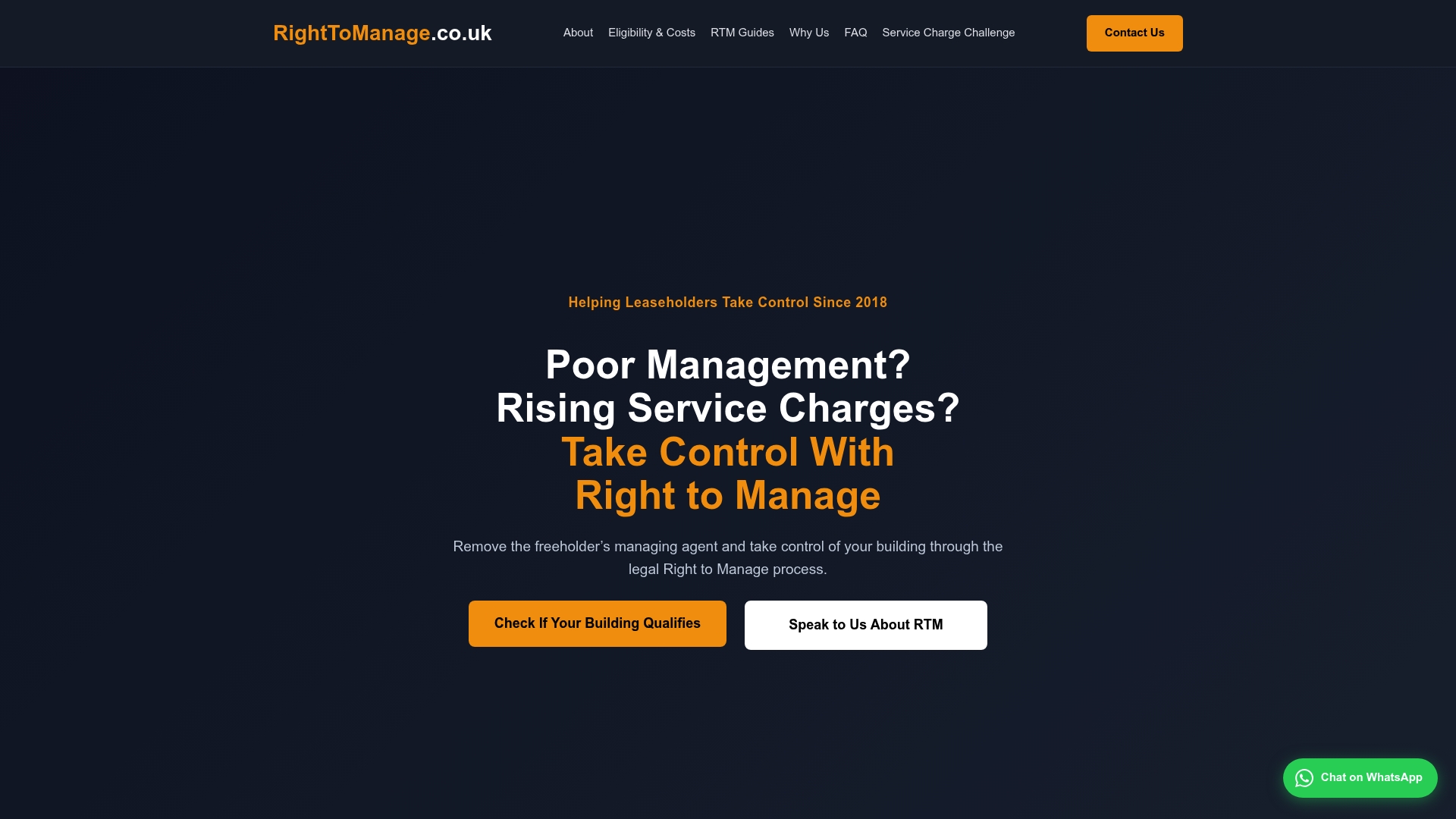
Start with a free RTM eligibility check to find out whether your building qualifies. Righttomanage handles company setup, Section 78 and Section 79 notices, counter-notice review, and the full claim process. If you are dealing with a poor managing agent, the RTM route gives you the authority to replace them without the cost of collective enfranchisement. Visit Righttomanage to access guides, timelines, and expert support built specifically for leaseholders ready to act.
FAQ
What is the LPE1 form used for?
The LPE1 form is the Law Society's standard questionnaire for collecting landlord and management information during leasehold conveyancing. It covers service charges, ground rent, major works, and insurance, but does not replace legal advice.
How many years of service charge accounts should I request?
Best practice is to request at least three years of service charge accounts and demands. This allows you to identify cost trends, unexplained increases, and any major works that may not have been properly consulted on.
What is a Section 20 consultation notice?
A Section 20 notice is a legal requirement under the Landlord and Tenant Act 1985. Landlords must issue one before carrying out major works costing more than £250 per leaseholder, or they risk losing the right to recover the full cost.
When should I delay a leasehold exchange?
Delay exchange if you have not received clear, written answers on lease length, major works status, ground rent terms, or building safety. Proceeding without these answers transfers significant financial and legal risk to the buyer.
What does the reserve fund tell me about a building?
The reserve fund balance, compared against the building's age and condition, indicates whether the building is financially prepared for major repairs. A low balance in an older block is a strong signal that a large special levy may be due shortly after purchase.