
A leasehold report on title is a legal document that identifies every party with an interest in your leasehold property, and it is the foundation of any valid Right to Manage (RTM) claim. RTM is a statutory no-fault process under the Commonhold and Leasehold Reform Act 2002, updated by the Leasehold and Freehold Reform Act 2024, that lets qualifying leaseholders take control of building management without buying the freehold and without proving landlord fault. The 2024 reforms also eliminated leaseholders' obligation to pay the freeholder's legal fees in most claim scenarios, making RTM considerably more accessible. Getting your title report right from the outset is what separates a successful claim from a costly 12-month delay.
What does a leasehold report on title include for RTM?
A leasehold report on title, formally known in conveyancing practice as a "report on title," sets out the legal ownership structure of your building. For RTM purposes, it must identify the freeholder, any intermediate landlords, the current managing agent, and any court-appointed manager. All relevant parties must receive your statutory notices, and a gap in that list invalidates the entire claim.
A thorough report covers the following:
- Freehold title: The registered owner at HM Land Registry, including any charges or restrictions on the title.
- Intermediate landlords: Head lessees or superior lessees who sit between the freeholder and your lease. These are frequently missed and are the most common cause of invalid notices.
- Managing agent details: The company currently contracted to manage the building, including their registered address for service.
- Court-appointed managers: Any manager appointed under section 24 of the Landlord and Tenant Act 1987, whose appointment must be acknowledged in your notices.
- Lease covenants and restrictions: Any clauses that affect RTM eligibility or the transfer of management functions.
- Management agreements: The contract between the freeholder and the current agent, which reveals notice periods and handover obligations.
The report also confirms whether your building has a Residents' Management Company (RMC). Existing RMCs may already hold authority to replace the managing agent without a formal RTM claim, which is a faster and cheaper route many leaseholders overlook entirely.
Pro Tip: Commission your title report before recruiting leaseholders to join the RTM company. Discovering an intermediate landlord after you have already served notices forces you to restart the entire process.
How do you obtain and review a leasehold title report?
A reliable title report comes from a solicitor or licensed conveyancer with leasehold experience, or from a specialist leasehold advisory service. Generic property searches do not go deep enough. You need someone who will pull the full registered title from HM Land Registry, review the lease itself, and cross-reference any management agreements or court orders.
Follow these steps to obtain and review your report properly:
- Order the full registered title from HM Land Registry. This costs a few pounds and gives you the official record of ownership, charges, and any restrictions. Do not rely on old copies from when you purchased your flat.
- Obtain a copy of your lease and any superior leases. Superior leases reveal intermediate landlords who will not appear on your individual title register.
- Request the management agreement. Your freeholder or managing agent is obliged to provide this under the Landlord and Tenant Act 1985. It confirms who manages the building and on what terms.
- Check for any section 24 court orders. Search the First-tier Tribunal (Property Chamber) records if you suspect a court-appointed manager is in place.
- Verify all addresses for service. Each party must be served at their correct legal address. A company's registered office at Companies House is not always the same as their address for service under the lease.
Obtaining a full report requires scrutinising leases, freehold titles, and any court orders to identify all relevant parties. That level of detail is not optional. It is the statutory baseline for a valid claim.
Pro Tip: Cross-reference the managing agent's address on the management agreement with their current entry at Companies House. Agents change their registered offices, and serving notice at an outdated address is treated the same as not serving at all.

How does the title report fit into the RTM process timeline?
The RTM process follows a fixed statutory sequence, and your title report underpins every step. You cannot serve valid notices without first knowing who to serve them on. The RTM process timeline runs as follows, with the title report feeding directly into stages two and three.
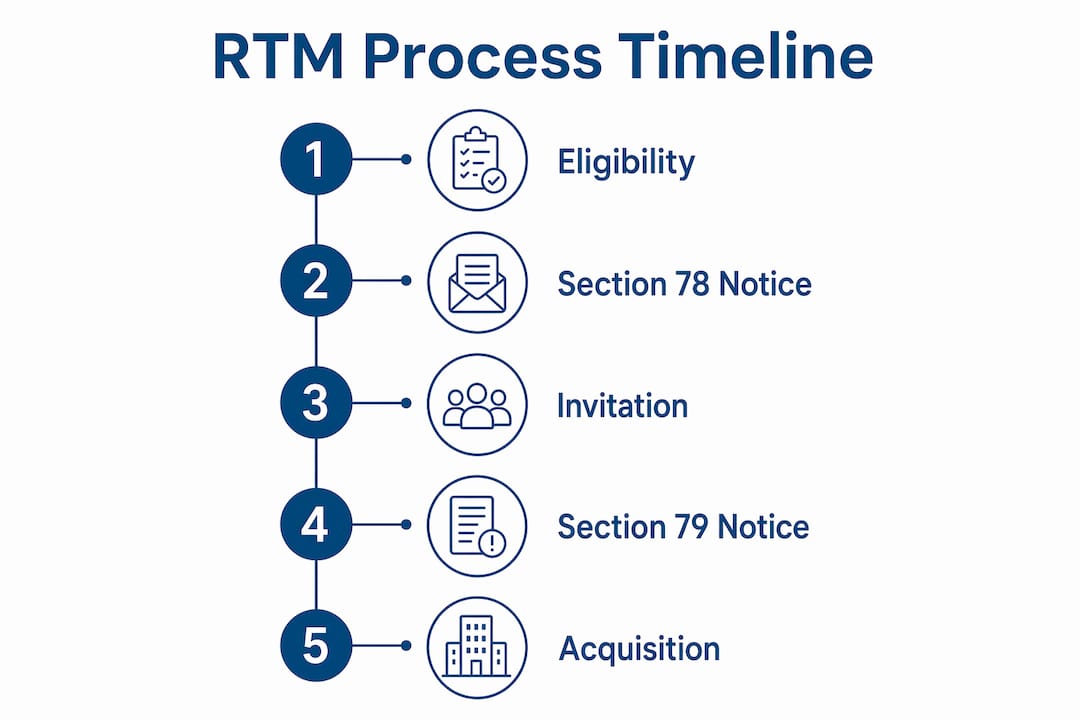
| RTM Stage | What Happens | Role of Title Report |
|---|---|---|
| Eligibility check | Confirm building qualifies: residential use, correct lease length, leaseholder numbers | Confirms lease terms and any mixed-use floor area ratios |
| RTM company formation | Incorporate the RTM company at Companies House | Confirms correct building address and freeholder details for the memorandum |
| Section 78 notice | Invite participation from all qualifying leaseholders | Identifies all leaseholders and their addresses for service |
| Section 79 claim notice | Formal claim served on the freeholder and all relevant parties | Provides the complete list of recipients and their correct addresses |
| Counter-notice period | Freeholder has one month to accept or object | Title report evidence supports your claim if challenged |
| Acquisition date | Management transfers to the RTM company | Confirms management agreement terms for handover |
The Section 78 notice is a prerequisite to the Section 79 claim notice. You must invite participation before you can formally claim. Both notices must be served on every party identified in your title report. The 2024 reforms raised the non-residential floor area threshold from 25% to 50%, meaning more mixed-use buildings now qualify for RTM. If your building has commercial units, your title report must also confirm the proportion of non-residential floor space.
At least 50% of qualifying leaseholders must be members of the RTM company before the Section 79 notice is served. Your title report helps you calculate that threshold accurately by confirming the total number of qualifying flats in the building.
What are the most common mistakes in RTM title reports?
Procedural errors in RTM notices are the primary cause of invalid claims. The most damaging mistakes all trace back to an incomplete or poorly reviewed title report.
- Missing intermediate landlords. A head lessee sitting between the freeholder and your lease must receive the Section 79 notice. Omitting them invalidates the claim entirely, regardless of how well everything else was prepared.
- Serving notice at the wrong address. Companies move. Freeholders use nominee companies. Always verify addresses immediately before serving, not months earlier when you first commissioned the report.
- Failing to identify a court-appointed manager. If a section 24 manager is in place, they must be served. This is easy to miss if you only check HM Land Registry and do not search Tribunal records.
- Overlooking a Residents' Management Company. If an RMC already exists with authority to change agents, launching a full RTM claim wastes time and money.
- Using an outdated title report. Ownership structures change. A report that is six months old may no longer reflect the current registered proprietor.
"Missing a required recipient in serving RTM notices invalidates the claim and triggers a mandatory 12-month waiting period before re-serving can occur." Source: Neon Properties London
A 12-month delay is not just frustrating. It means another year of the managing agent you are trying to replace continuing to operate. If you discover an error after serving notices, take legal advice immediately. In some cases, you can withdraw and re-serve before the counter-notice period expires, avoiding the full 12-month lockout. Righttomanage recommends commissioning a fresh title report within 30 days of serving any notice to confirm nothing has changed in the registered title.
How does the title report affect leasehold purchases and pre-contract enquiries?
The leasehold report on title is not only relevant when you are launching an RTM claim. It plays a significant role when you are buying a leasehold flat, and the RTM status of the building should be a key factor in your purchase decision.
During pre-contract leasehold enquiries, your solicitor should be asking the seller and their solicitor for the following RTM-related information:
- Whether an RTM company is already in place. If it is, you will be joining an existing structure with its own obligations and financial responsibilities.
- Whether an RTM claim is in progress. A pending claim affects the management of the building and may affect your service charge obligations from the acquisition date.
- Whether the building has a history of failed RTM claims. Repeated failures may indicate structural title issues or a complex ownership chain that will complicate future claims.
- The identity of all landlords in the chain. This is the same information needed for an RTM claim, and your conveyancer should be producing a full report on title as part of the conveyancing process regardless.
Understanding how RTM differs from buying freehold is also relevant at the purchase stage. RTM gives you management control but not ownership of the building. Collective enfranchisement gives you ownership but requires a premium payment and a more complex legal process. Knowing which route is available to the building you are buying informs the price you pay and the risks you accept. For new build leasehold purchases in particular, specialist RTM advice before exchange can reveal whether the developer has structured the title in a way that complicates future RTM claims.
Key takeaways
A valid RTM claim depends entirely on a complete and accurate leasehold report on title that identifies every party requiring statutory notice.
| Point | Details |
|---|---|
| Title report is the foundation | Identify every freeholder, intermediate landlord, and manager before serving any RTM notice. |
| Missing one party invalidates the claim | A single omission triggers a mandatory 12-month delay before you can re-serve notices. |
| 2024 reforms expanded eligibility | The non-residential threshold rose to 50%, bringing more mixed-use buildings into RTM scope. |
| Pre-contract enquiries matter | RTM status and title complexity should inform leasehold purchase decisions before exchange. |
| Outdated reports cause errors | Commission a fresh title report within 30 days of serving notices to confirm current ownership. |
Why i think most RTM claims fail before they even start
In my experience working with leaseholders across England and Wales, the single biggest predictor of a failed RTM claim is not the freeholder's opposition. It is the leaseholders' own title report. Specifically, it is the absence of one, or the use of a report that was never designed for RTM purposes.
I have seen cases where leaseholders used the report on title from their original purchase, sometimes years old, and served notices based on that. Ownership had changed. The managing agent had been replaced by a subsidiary company with a different registered address. The Section 79 notice was invalid before it was even opened.
The uncomfortable truth is that many leaseholders treat the title report as a formality rather than the operational document it actually is. RTM grants leaseholders rights to manage but the RTM company remains liable for financial management and service charge collection from day one. That level of responsibility demands precision at every stage, starting with the title report.
My advice is straightforward. Before you recruit a single leaseholder or form your RTM company, commission a fresh, RTM-specific title report from someone who understands the statutory requirements. The cost is modest. The cost of getting it wrong is a year of your life and another year of the managing agent you are trying to remove. Some leaseholders also benefit from checking whether an existing RMC already gives them the power to change agents without a formal claim. That check takes an afternoon and could save months.
— Paul
Start your RTM claim the right way with Righttomanage
If you are ready to take control of your building's management, the title report is your starting point, and getting it right matters more than any other single step in the process.
Righttomanage manages the entire RTM process from eligibility check through to acquisition date, including identifying all relevant parties from your title, preparing your Section 79 claim notice, and reviewing any counter-notice from your freeholder. Start with a free RTM eligibility check to confirm your building qualifies and find out exactly what your title structure looks like before you commit to the process. You can also explore real RTM case studies to see how leaseholders in similar buildings have successfully taken control of their management.
FAQ
What is a leasehold report on title for RTM?
A leasehold report on title is a legal document identifying every party with an interest in your building, including freeholders, intermediate landlords, and managing agents. For RTM claims, it is the source document for all statutory notice recipients under sections 78 and 79 of the 2002 Act.
What happens if you miss a party in an RTM notice?
Missing any required recipient, such as an intermediate landlord or court-appointed manager, invalidates the claim and triggers a mandatory 12-month waiting period before you can re-serve.
How does RTM differ from buying the freehold?
RTM transfers management control to leaseholders without requiring a purchase premium, whereas collective enfranchisement involves buying the freehold outright. RTM is faster and cheaper but does not give leaseholders ownership of the building.
Do i need a new title report if i already have one from my purchase?
Yes. Ownership structures change, and a report from your original purchase may be years out of date. Commission a fresh report within 30 days of serving any RTM notice to confirm the current registered proprietor and all relevant addresses.
Can i use RTM if my building has commercial units?
The 2024 Leasehold and Freehold Reform Act raised the non-residential floor area threshold from 25% to 50%, effective march 2025. Buildings where commercial space accounts for less than 50% of total floor area now qualify for RTM.