
A leasehold management pack review is the process of examining all official leasehold documents and financial records to understand the management, costs, and obligations tied to your property. For leaseholders in England and Wales, this review is the difference between entering a property transaction with confidence and discovering costly surprises after exchange. The pack typically contains the lease itself, service charge accounts, ground rent statements, insurance certificates, fire risk assessments, and major works notices. Key guidance sources include the GOV.UK leasehold toolkit, Property Passport, and the Leasehold and Freehold Reform Act 2024. Together, these resources define what you should expect, what you can demand, and what your rights are when something is missing or wrong.
What does a leasehold management pack contain?
The standard leasehold management pack is built around two core forms: the LPE1 (Leasehold Property Enquiries) and the FME1 (Freeholder Management Enquiries). The LPE1 pack contains detailed information about the leasehold property including the landlord's identity, service charges, insurance, fire risk assessments, and any planned major works. The FME1 covers the freeholder's position where a separate management company is also involved.
Multiple LPE1 packs may be required when a management company sits between the freeholder and leaseholder, because service charge and ground rent responsibilities are held separately. This is one of the most misunderstood aspects of leasehold property documents, and missing a second pack is a common cause of incomplete disclosure.
The table below summarises the core document categories you should expect in a thorough pack:
| Document category | Purpose |
|---|---|
| Lease document | Sets out your rights, obligations, term length, and any onerous clauses |
| Service charge accounts | Shows historic expenditure, budgets, and any arrears |
| Ground rent statements | Confirms current ground rent and any review provisions |
| Insurance certificate | Evidences building cover and compliance with lease obligations |
| Fire risk assessment | Demonstrates compliance with building safety legislation |
| Major works notices | Alerts you to planned Section 20 consultations and estimated costs |
| Asbestos report | Required for buildings of certain age and construction type |

The Leasehold and Freehold Reform Act 2024 introduces new transparency requirements around service charges and building safety information. This means managing agents are now under greater obligation to provide clear, complete documentation rather than partial or ambiguous responses.
How to review a leasehold management pack step by step
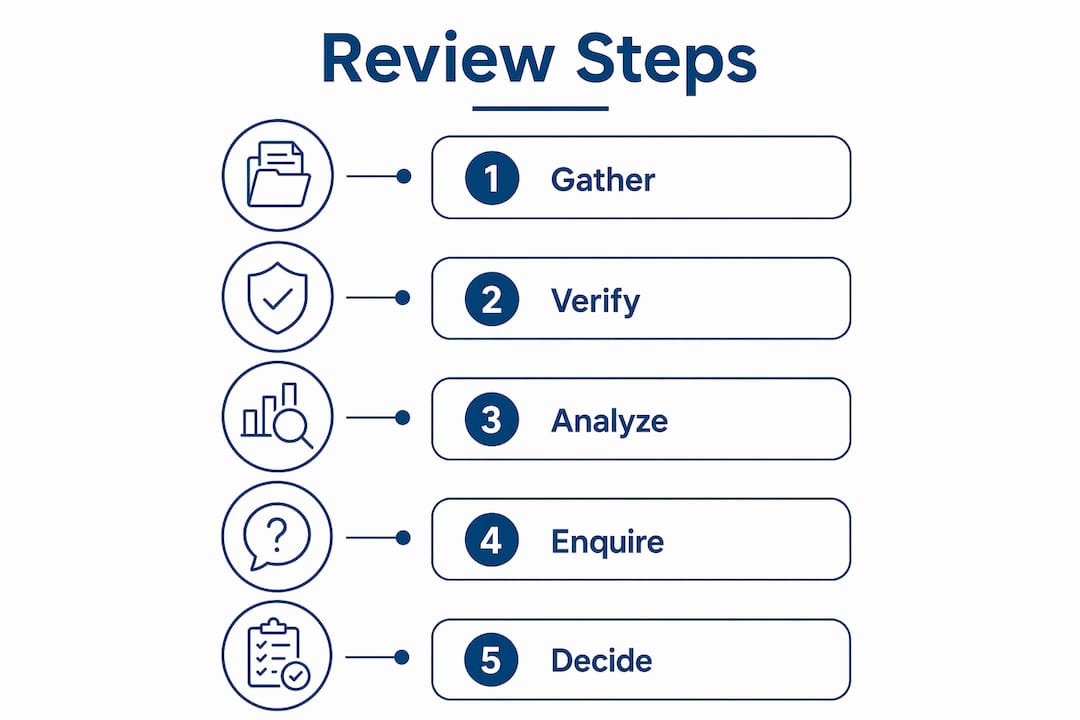
A structured approach to reviewing leasehold packs prevents you from missing critical details under time pressure. Follow these steps in order:
- Verify document provenance. Confirm whether each document is an official management reply or a user upload. Document confusion is the primary cause of avoidable additional enquiry rounds. Note the date and source of every item.
- Check the lease term and extension rights. A lease with fewer than 80 years remaining is harder to mortgage and more expensive to extend. Look for any onerous clauses around alterations, subletting, or pet ownership.
- Scrutinise service charge accounts. Compare the last three years of accounts against the current budget. Look for unexplained spikes, unresolved disputes, or a reserve fund that is significantly underfunded.
- Review ground rent provisions. Ground rents were abolished for new leases since 2022, but legacy leases may carry doubling or RPI-linked clauses that affect mortgageability and resale value.
- Assess building safety evidence. Confirm the fire risk assessment is current and that any remediation works are either complete or properly funded. Check whether the building is registered under the Building Safety Act 2022 if it is over 18 metres.
- Identify upcoming major works. Buildings without a sinking fund and with deferred maintenance carry significant financial risk. Your solicitor should flag any planned major works before exchange.
- Record all discrepancies and raise formal enquiries. Keep dated notes of every question raised and every response received.
Pro Tip: Create a simple spreadsheet with one row per document. Record the source, date received, and any outstanding questions. This single habit prevents the most common cause of delays: losing track of which version of a document is the authoritative one.
The following table summarises what to look for at each stage:
| Review stage | Key question to answer |
|---|---|
| Lease terms | Are there any clauses that restrict use, increase costs, or affect mortgageability? |
| Service charges | Is expenditure transparent, reasonable, and supported by accounts? |
| Building safety | Is the fire risk assessment current and are remediation costs resolved? |
| Major works | Are Section 20 notices issued and are estimated costs disclosed? |
| Ground rent | Does the lease contain any doubling or escalating ground rent provisions? |
Common challenges when reviewing leasehold packs
The most frequent problem leaseholders encounter is receiving incomplete or conflicting information from different parties. When a landlord and a managing agent both hold parts of the management record, neither may provide a full picture without explicit prompting. Understanding who holds responsibility for each aspect of management is the starting point for resolving this.
Delays are the second major issue. Confusing document sources frequently cause repeated enquiry rounds that add weeks to a transaction. The fix is straightforward: treat the pack review as a document quality exercise from day one, not an afterthought.
Leaseholders should treat the information request and pack process as a document quality exercise, verifying sources and keeping dated notes throughout. This approach reduces timeline and frustration significantly. (Property Passport UK)
Common mistakes to avoid during a leasehold management pack review:
- Accepting a pack without checking whether a second LPE1 is needed from a management company
- Failing to request the last three years of service charge accounts rather than just the most recent year
- Overlooking the reserve fund balance relative to the age and condition of the building
- Not asking whether any Section 20 major works consultations are planned but not yet issued
- Treating uploaded documents as equivalent to official management replies without verifying their source
- Missing ground rent review dates buried in lease schedules rather than the main body of the lease
Pro Tip: If you receive conflicting figures for service charges from the landlord and the managing agent, request a written reconciliation from both parties before proceeding. Verbal clarifications are not sufficient and will not protect you after exchange.
When issues cannot be resolved through direct enquiry, free independent advice from LEASE (the Leasehold Advisory Service) is available. LEASE is government funded and provides guidance on disputes, service charge challenges, and leaseholder rights.
How do recent legal reforms affect leasehold pack reviews?
The Leasehold and Freehold Reform Act 2024 is the most significant change to leasehold law in England and Wales in a generation. For leaseholders reviewing packs, the practical implications are immediate. Consumer protections now focus on service charge transparency and building safety safeguards, meaning managing agents must provide clearer, more complete information than was previously required.
The RTM improvements introduced as of March 2025 extend Right to Manage rights to buildings with up to 50% non-residential space and remove the requirement to pay the freeholder's legal fees in many cases. The two-year qualifying period for RTM has also been abolished, making it accessible to more leaseholders sooner.
The table below compares the pack review context before and after the 2024 reforms:
| Area | Before 2024 reforms | After 2024 reforms |
|---|---|---|
| Service charge transparency | Limited statutory disclosure requirements | Mandatory itemised accounts and clearer explanations required |
| RTM eligibility | Two-year qualifying period; 25% non-residential limit | No qualifying period; up to 50% non-residential space permitted |
| Freeholder legal fees in RTM | Leaseholders often liable for freeholder's costs | Removed in most cases, reducing financial barrier |
| Building safety disclosure | Variable; dependent on managing agent practice | Stronger obligations under Building Safety Act 2022 |
For leaseholders reviewing packs today, this means you have stronger grounds to challenge incomplete or opaque responses. If a managing agent refuses to provide itemised service charge accounts or current fire risk assessments, the 2024 Act gives you clearer legal footing to demand them. Checking your RTM eligibility is now a realistic option for more leaseholders than ever before.
What are the next steps after completing your review?
Once you have completed your leasehold management pack review, the findings should directly inform your next decisions. Do not treat the review as a box-ticking exercise. Use it as the basis for negotiation, legal action, or a change in management strategy.
- Raise formal written enquiries for any discrepancies, missing documents, or unexplained charges. Written records protect you if disputes arise later.
- Instruct a solicitor to advise on any onerous lease clauses, ground rent provisions, or unresolved major works before exchange.
- Assess whether Right to Manage is appropriate. If the pack reveals poor management, lack of transparency, or inflated costs, taking control through RTM may be the most effective long-term solution.
- Challenge unreasonable service charges through the First-tier Tribunal (Property Chamber) if the managing agent does not respond adequately to written enquiries.
- Seek independent advice from LEASE or a chartered surveyor if building safety or major works costs are unclear or disputed.
Pro Tip: Keep a single folder, physical or digital, containing every document received, every enquiry sent, and every response. Date-stamp everything. If a dispute reaches a tribunal, this record is your most valuable asset.
Understanding what happens after RTM is worth reading before you commit to that route, so you enter the process with clear expectations about handover, contracts, and ongoing responsibilities.
Key takeaways
A thorough leasehold management pack review requires verifying document provenance, scrutinising service charge accounts, and understanding your legal rights under the Leasehold and Freehold Reform Act 2024.
| Point | Details |
|---|---|
| Verify document sources first | Confirm whether each item is an official reply or an upload before relying on its contents. |
| Request multiple LPE1 packs | Where a management company is involved, separate packs for service charges and ground rent are needed. |
| Check the reserve fund | A low or absent sinking fund signals financial risk from future major works charges. |
| Know your post-2024 rights | The 2024 Act mandates service charge transparency and removes barriers to Right to Manage. |
| Act on findings in writing | Raise all discrepancies formally and keep dated records to protect your position. |
Why document provenance is the detail most leaseholders miss
I have worked with leaseholders across England and Wales who have spent months in transactions only to discover that a key document in their pack was an outdated upload rather than a current official reply. The frustration is real and entirely avoidable. The single most underestimated step in any leasehold management pack review is confirming the source and date of every document before you rely on it.
The legislative environment has shifted significantly in leaseholders' favour since 2024, but legislation only helps you if you know what to ask for. I have seen leaseholders accept vague service charge summaries when they were entitled to full itemised accounts. The 2024 Act gives you the right to demand clarity. Use it.
My honest view is that most leaseholders approach the pack review as a formality rather than a forensic exercise. The ones who treat it seriously, who cross-reference accounts, question reserve fund balances, and push back on incomplete fire risk assessments, are the ones who avoid expensive surprises. If your managing agent is unresponsive or evasive during the review process, that behaviour is itself a signal worth taking seriously. It may be the strongest argument for pursuing RTM.
— Paul
How Righttomanage can help you act on your findings
If your leasehold management pack review has revealed poor management, opaque service charges, or a managing agent who is not meeting their obligations, Righttomanage is built for exactly this situation.
Righttomanage helps leaseholders in England and Wales take legal control of their building management without buying the freehold. From a free RTM eligibility check through to Section 78 notices, claim notices, and acquisition-date preparation, the service covers the entire RTM process. If you want to understand your options before committing to any course of action, the RTM guides hub provides clear, practical guidance on every stage. Your pack review is the starting point. What you do with the findings is what determines the outcome.
FAQ
What is included in a leasehold management pack?
A leasehold management pack contains the lease document, service charge accounts, ground rent statements, insurance certificates, fire risk assessments, asbestos reports, and major works notices. The LPE1 form covers most of this information, though a separate FME1 may be needed where a management company is involved.
How long does a leasehold management pack review take?
The review itself can take a few days once all documents are received, but obtaining the pack from managing agents often takes two to four weeks. Delays are most commonly caused by confusing document sources or incomplete disclosure from multiple management parties.
Do I need a solicitor to review a leasehold management pack?
A solicitor is not legally required to review the pack, but their involvement is strongly recommended. Solicitors are trained to identify onerous lease clauses, flag major works risks, and raise formal enquiries that protect you before exchange.
What changed for leaseholders under the Leasehold and Freehold Reform Act 2024?
The Act introduced mandatory service charge transparency, removed the two-year RTM qualifying period, extended RTM to buildings with up to 50% non-residential space, and removed the requirement for leaseholders to pay freeholder legal fees in most RTM cases.
What should I do if the management pack is incomplete?
Raise a formal written enquiry with the managing agent or landlord specifying exactly which documents are missing. If they do not respond adequately, seek advice from LEASE or consider whether Right to Manage is an appropriate route to take control of the management directly.