
Leasehold building insurance overcharging is defined as any situation where leaseholders pay more than the reasonable cost of insuring their building, a cost they are legally entitled to dispute. Under section 19 of the Landlord and Tenant Act 1985, building insurance costs are treated as service charges and must be reasonably incurred. If they are not, the First-tier Tribunal can reduce or refuse recovery of those costs entirely. The good news is that leaseholders in England and Wales have clear statutory tools to challenge inflated premiums, and recent case law has sharpened exactly what "reasonable" means in practice.
What does leasehold building insurance overcharging actually mean in law?
The legal standard for leasehold insurance costs is set by section 19 of the Landlord and Tenant Act 1985. A charge is only recoverable if it is reasonably incurred and the services or works are of a reasonable standard. The Court of Appeal confirmed this in Spender v FIT Nominee Ltd (2025), applying a combined "process and outcome" test.
What that means in practice is that a tribunal will look at two things. First, was the decision-making process behind the premium sound? Second, was the resulting cost itself reasonable? A landlord cannot simply point to a high premium and say the market demanded it. They must show the reasoning behind the choice of insurer and policy.

Factors that can justify a higher premium include genuine underwriting risk, contractual obligations in the lease, and documented evidence of the renewal process. Cost alone does not define reasonableness. A premium that looks expensive on paper may still pass the test if the landlord followed a proper procurement process and can evidence it.
Key indicators that a premium may fail the reasonableness test:
- No evidence of market testing or broker comparison at renewal
- Undisclosed commissions or referral fees added to the base premium
- Reinstatement values significantly above an independent surveyor's assessment
- Premium increases far exceeding inflation without a documented underwriting reason
Pro Tip: Ask your managing agent for the insurance renewal report and broker recommendation letter. If they cannot produce these, that absence itself is evidence the process was not sound.
How can leaseholders access and review their building insurance information?
Transparency is the foundation of any building insurance dispute. The UK Government Leasehold Toolkit confirms that leaseholders have the right to receive written summaries of service charge costs, including insurance, and to inspect supporting documentation. Without these documents, you cannot assess whether you have been overcharged.
The process for obtaining information follows a clear sequence:
- Send a written request under section 21 of the Landlord and Tenant Act 1985. This requires the landlord to provide a written summary of costs for the accounting period. Send it by recorded post and keep a copy.
- Request the full insurance policy and schedule. You are entitled to see the policy itself, not just a summary. Ask specifically for the schedule of cover, the reinstatement value used, and the total premium paid.
- Request the renewal documentation. This includes any broker reports, market comparison evidence, and correspondence with the insurer at renewal.
- Ask for a breakdown of any commissions or fees. Managing agents sometimes receive referral fees from insurers. These must be disclosed and, under the Leasehold Reform (Ground Rent) Act 2022 and associated guidance, should be transparent.
- Compare year-on-year figures. Pull together at least three years of insurance demands and schedules. Sudden spikes without explanation are a red flag.
After a section 21 request, the landlord must respond within one month or within six months of the accounting period end, whichever is later. Missing this deadline does not automatically void the charge, but it weakens the landlord's position considerably in any subsequent dispute.
Pro Tip: When reviewing the insurance schedule, check the declared reinstatement value against the Association of British Insurers' rebuild cost calculator or a RICS-accredited surveyor's estimate. Even minor errors in reinstatement assumptions can raise premiums significantly, and documenting the discrepancy gives you a concrete basis for challenge.
Once you have the documents, look for three things: whether the reinstatement value is realistic, whether any commissions are disclosed and proportionate, and whether the premium level is consistent with the building's actual risk profile.
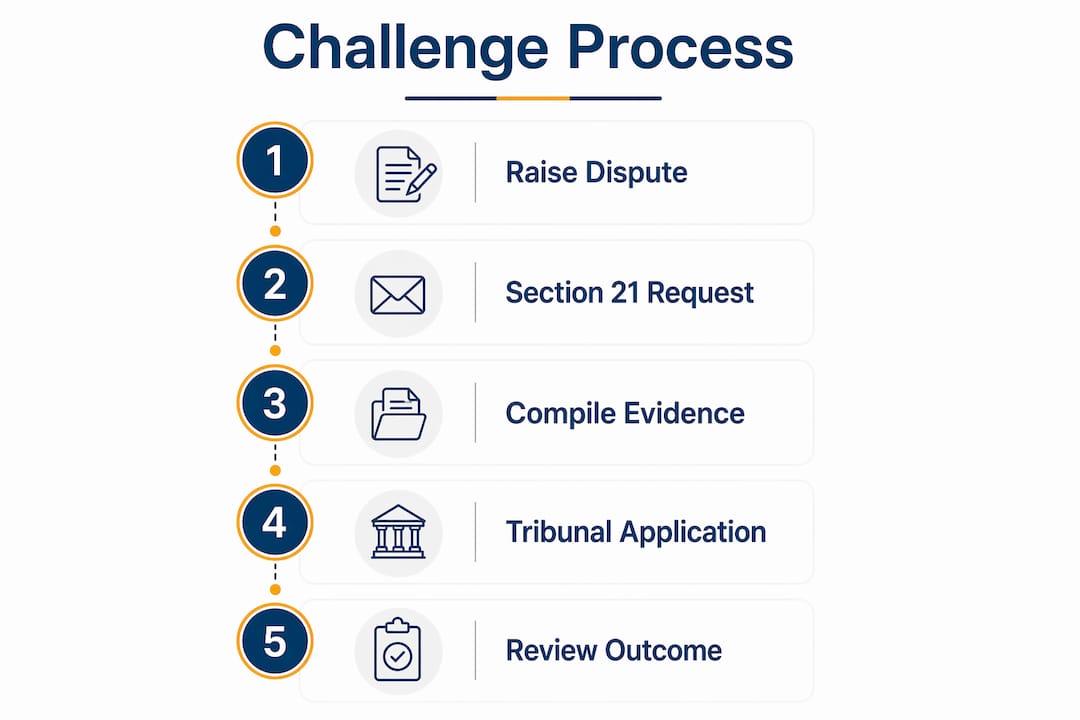
Step-by-step: how to challenge insurance fees formally
Challenging overcharged property insurance requires a structured approach. Rushing to a tribunal without first exhausting informal routes can damage your credibility and waste time.
Step 1: Raise the dispute informally
Write to your landlord or managing agent setting out your concerns clearly. Reference the specific figures you are querying and ask for a written explanation. Keep a record of all correspondence. Many disputes are resolved at this stage, particularly where the overcharge involves an administrative error such as an incorrect reinstatement value.
Step 2: Make a formal section 21 request
If the informal approach fails, submit a formal section 21 request for a written summary of costs. Review the documents carefully against the checklist above. This step also starts the clock on the landlord's legal obligation to respond.
Step 3: Build your evidence bundle
Organising your evidence is the single most important step before any tribunal application. A well-structured bundle should include:
- All service charge demands and insurance schedules for the period in dispute
- The full insurance policy and any renewal documentation you have obtained
- Independent reinstatement valuations or broker comparisons
- Correspondence with the landlord or agent about the charges
- Any section 21 summaries provided
The First-tier Tribunal expects leaseholders to present both factual and legal arguments clearly. Disorganised evidence is one of the most common reasons challenges fail on procedural grounds.
Step 4: Apply to the First-tier Tribunal under section 27A
Leaseholders can apply to the First-tier Tribunal (Property Chamber) under section 27A of the Landlord and Tenant Act 1985 to determine whether a service charge is payable and whether it is reasonable. The application uses Leasehold Form 1, available from the HM Courts and Tribunals Service website. There is an application fee, though fee remission may be available.
The tribunal will consider both the process the landlord followed and the reasonableness of the outcome, in line with the Spender v FIT Nominee Ltd (2025) test. Correct pleading and presentation of insurance premium evidence is critical for success. Tribunal outcomes can be overturned for procedural defects, so precision matters.
| Stage | What to do | Likely outcome |
|---|---|---|
| Informal dispute | Write to landlord with specific queries | Resolution or documented refusal |
| Section 21 request | Formal written summary request | Documents for evidence bundle |
| Evidence preparation | Compile schedules, policies, comparisons | Structured case for tribunal |
| Tribunal application | Submit Leasehold Form 1 under s.27A | Binding determination on reasonableness |
Common causes of inflated leasehold insurance costs
Understanding why premiums spike helps you identify the right target for your challenge. The most common causes of disputed leasehold insurance costs fall into four categories.
Risk reclassification is the most dramatic driver. In one widely reported West London case, an insurance premium rose from £14,500 to £310,998 after insurers reclassified the building's risk profile following cladding and fire safety investigations. That is a 21-fold increase. Managing agents attributed the rise to health and safety investigations and insurer reclassification, but leaseholders challenged whether the process behind the renewal was sound.
Undisclosed commissions are a persistent problem. Managing agents sometimes receive referral fees from insurers or brokers. These fees inflate the effective cost to leaseholders without appearing on the face of the premium. Common overcharging aspects include undisclosed commissions, inflated reinstatement values, and insurance costs not aligned with actual building risks.
Overstated reinstatement values increase premiums directly because the insured sum is too high. A building valued at £2 million for reinstatement purposes when a RICS surveyor would assess it at £1.4 million generates a materially higher premium for no legitimate reason.
Claims history and excess levels also affect cost. If a managing agent has allowed a poor claims history to develop through inadequate maintenance, leaseholders end up paying higher premiums as a result. Reviewing the claims history included in the renewal documentation can reveal whether this is a factor.
Key takeaways
Leasehold building insurance overcharging is a legally defined problem with a clear statutory remedy: leaseholders who gather the right documents and apply the correct legal test have a genuine route to cost reduction through the First-tier Tribunal.
| Point | Details |
|---|---|
| Legal standard for costs | Premiums must be reasonably incurred under s.19 Landlord and Tenant Act 1985, assessed by both process and outcome. |
| Right to information | Leaseholders can demand insurance policies, schedules, and renewal documents via a section 21 request. |
| Tribunal route | Apply under s.27A using Leasehold Form 1 for a binding determination on whether charges are reasonable. |
| Evidence quality matters | A structured bundle of schedules, policies, and independent comparisons is the strongest basis for any challenge. |
| Common overcharging causes | Undisclosed commissions, inflated reinstatement values, and risk reclassification are the most frequent drivers of disputed premiums. |
What I have learned from watching leaseholders challenge insurance premiums
Most leaseholders who lose at tribunal do not lose because their premium was fair. They lose because they focused entirely on the price and ignored the process. The Spender v FIT Nominee Ltd (2025) ruling makes this explicit: a tribunal will assess whether the landlord followed a sound decision-making process, not just whether you could have found a cheaper quote online.
The second mistake I see repeatedly is treating the section 21 request as a formality. It is not. The documents you receive in response to that request are your primary evidence. Leaseholders who skim through them and file a tribunal application without properly analysing the renewal documentation, commission disclosures, and reinstatement assumptions are building on sand.
The third pitfall is underestimating the value of professional support in complex cases. Where premiums involve cladding risk reclassification or large commercial blocks, the underwriting arguments can be genuinely technical. A specialist leasehold solicitor or a RICS-accredited building surveyor can make the difference between a tribunal accepting your reinstatement challenge and dismissing it as unsubstantiated.
My honest view is that the statutory tools available to leaseholders in England and Wales are genuinely powerful. The leasehold reform changes introduced in recent years have strengthened transparency obligations further. The problem is not the law. The problem is that most leaseholders do not use it. If your premium has risen sharply, request the documents, analyse the process, and do not accept a vague explanation from your managing agent as a final answer.
— Paul
How Righttomanage can help you address building insurance concerns
If inflated insurance costs are a symptom of a wider problem with your managing agent, the Right to Manage process gives leaseholders in England and Wales a legal route to take over building management entirely, without buying the freehold.
Righttomanage manages the entire RTM process from eligibility check through to acquisition date, including company setup, Section 78 and Section 79 notices, and counter-notice review. Once leaseholders hold the management, they control the insurance procurement directly, which means no hidden commissions and no inflated reinstatement values imposed by a third party. You can check whether your building qualifies with a free RTM eligibility check or read through the full RTM guides to understand what taking control actually involves. For leaseholders specifically concerned about insurance responsibilities after RTM, the dedicated building insurance after RTM page sets out exactly what changes and what does not.
FAQ
What is leasehold building insurance overcharging?
Leasehold building insurance overcharging occurs when leaseholders are charged more than the reasonable cost of insuring their building as a service charge. Under section 19 of the Landlord and Tenant Act 1985, such costs must be reasonably incurred or the First-tier Tribunal can reduce them.
Can I see my building's insurance policy as a leaseholder?
Yes. Leaseholders have a statutory right to request the full insurance policy, schedule, and supporting renewal documents from their landlord or managing agent. A section 21 request under the Landlord and Tenant Act 1985 triggers a legal obligation to provide this information within one month or six months after the accounting period end, whichever is later.
How do I apply to the First-tier Tribunal for a building insurance dispute?
Apply under section 27A of the Landlord and Tenant Act 1985 using Leasehold Form 1, available from HM Courts and Tribunals Service. The tribunal will determine whether the insurance charge is payable and whether it is reasonable, assessing both the landlord's decision-making process and the premium outcome.
What evidence do I need to challenge an insurance premium?
Compile service charge demands, insurance schedules, the full policy, renewal documentation, any commission disclosures, and an independent reinstatement valuation. Organising these into a clear evidence bundle is critical, as procedural weaknesses are a common reason tribunal challenges fail.
Can a managing agent receive commission on my building insurance?
Yes, managing agents can receive referral fees or commissions from insurers or brokers. These fees must be disclosed. Undisclosed commissions are one of the most common causes of inflated leasehold insurance costs and form a strong basis for a formal challenge.