
Leaseholders in England and Wales have a statutory right to remove a managing agent without needing to prove fault or buy the freehold. The two primary legal routes are the Right to Manage (RTM) under the Commonhold and Leasehold Reform Act 2002, and a tribunal application under Section 24 of the Landlord and Tenant Act 1987. Understanding how leaseholders remove a managing agent starts with knowing which route fits your building's circumstances. Both paths have distinct requirements, timelines, and evidence burdens. This guide covers each route in full, along with the practical steps and pitfalls that determine whether a removal succeeds or stalls.
How leaseholders remove a managing agent through Right to Manage
The Right to Manage is the most widely used route for changing managing agent leaseholders rely on. It is a no-fault statutory right that allows leaseholders to take over building management without proving the existing agent has done anything wrong. That distinction matters enormously. You do not need a catalogue of failures to qualify.

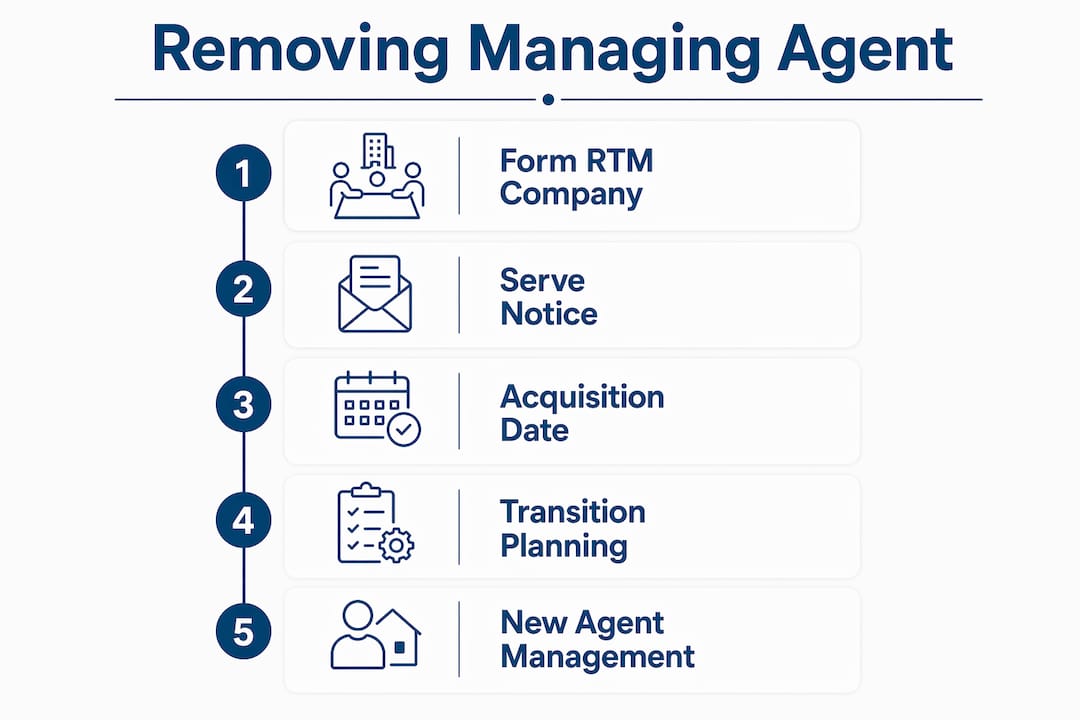
RTM eligibility and company formation
To exercise RTM, leaseholders must first form an RTM company, a private company limited by guarantee, registered at Companies House. At least two thirds of the flats in the building must be held on long leases, and at least half of all qualifying leaseholders must become members of the RTM company. Buildings where more than 25% of the floor area is non-residential do not qualify. Righttomanage provides a free eligibility check to confirm whether your building meets these thresholds before you commit to the process.
Serving notices and the acquisition date
Once the RTM company is formed, the process follows a statutory sequence. The company must serve a Section 78 notice on every qualifying leaseholder, inviting them to participate. It then serves a Section 79 claim notice on the freeholder, formally asserting the right to manage. The freeholder has one month to serve a counter-notice. If no valid counter-notice is received, management transfers on the acquisition date, which falls one month after the claim notice period expires. RTM transitions typically take 2–4 months from notice to acquisition. That timeline is predictable, which makes planning the handover straightforward.
What RTM actually gives you
A common misconception is that RTM means leaseholders must manage the building themselves. RTM companies commonly retain professional managing agents after acquisition. The critical difference is that leaseholders control who that agent is and can replace them at any time. You appoint the agent on your terms, set the scope of their work, and hold them accountable directly.
Practical tips for a smooth RTM transition
- Confirm eligibility before approaching fellow leaseholders to avoid raising expectations prematurely.
- Appoint a solicitor or specialist service familiar with RTM procedure to draft and serve notices correctly.
- Identify a replacement managing agent before the acquisition date so there is no gap in service.
- Notify all contractors, insurers, and service providers of the change in management authority.
- Arrange for the outgoing agent to transfer all financial records, contracts, keys, and compliance documents on or before the acquisition date.
Pro Tip: Start recruiting a replacement agent at least six weeks before your acquisition date. Agents need time to conduct due diligence on the building, and a rushed appointment often leads to the same problems you were trying to leave behind.
How can leaseholders use the First-tier Tribunal to remove a managing agent?
The First-tier Tribunal route applies when the freeholder retains management control and leaseholders cannot or do not wish to exercise RTM. Under Section 24 of the Landlord and Tenant Act 1987, leaseholders can apply for the tribunal to appoint an independent manager in place of the existing one.
This route is adversarial by nature. The tribunal will only make an order if leaseholders can demonstrate that the manager has breached their obligations, charged unreasonably, or failed to comply with an approved code of practice. The burden of proof sits firmly with the applicants.
Evidence the tribunal expects to see includes:
- Financial statements showing unexplained or excessive service charges
- Written records of maintenance failures and the dates they were reported
- Correspondence demonstrating the agent ignored or delayed responding to complaints
- Evidence of insurance irregularities or inflated premiums
- Any previous tribunal decisions or formal warnings issued to the agent
Tribunal action requires substantial documentary evidence, including financial statements and detailed records of breaches, making it time-consuming and sometimes costly. That is not a reason to avoid it. It is a reason to prepare thoroughly before filing.
The outcome of a successful tribunal application is the appointment of an independent professional manager. Tribunal-appointed managers are independent professionals chosen by the tribunal, not by the leaseholders. That means you lose some control over who takes over, which is a meaningful trade-off compared to RTM.
Pro Tip: Before filing a tribunal application, send a formal letter of complaint to the managing agent and freeholder and give them a reasonable period to respond. A documented refusal to engage strengthens your case considerably.
What practical steps should leaseholders take before removing a managing agent?
Preparation determines whether a removal goes smoothly or collapses mid-process. Leaseholders who skip this stage often find themselves legally exposed or without a functioning management structure during the transition.
Document everything first
Leaseholders should formally document all communications, breaches, and failures before initiating any removal process. Create a chronological log of every complaint, every missed repair, every unexplained charge, and every unanswered email. This record serves two purposes: it supports a tribunal application if needed, and it helps a new agent understand the building's history from day one.
Review the management agreement carefully
Most management agreements require a notice period of 3–6 months to terminate. Read the contract to identify the exact notice period, any early termination fees, and whether the agreement contains an automatic renewal clause. Missing a renewal deadline can lock leaseholders into another full contract term.
Build consensus among leaseholders
Removing a managing agent works best when leaseholders act collectively. Hold a residents' meeting, share your documentation, and agree on the preferred route before serving any notices. Divided leaseholders give the freeholder and the outgoing agent grounds to challenge or delay the process.
Plan the handover in detail
A well-managed agent transition includes transferring financial records, contracts, keys and access, and compliance documents. Coordinate with the incoming agent to agree a handover checklist. Confirm that the outgoing agent will provide a full account reconciliation, including any service charge balances held in trust.
| Handover item | Why it matters |
|---|---|
| Financial records and accounts | New agent needs accurate balances and expenditure history |
| Contracts with suppliers | Prevents service gaps with cleaners, lift engineers, and insurers |
| Keys, fobs, and access codes | Residents and contractors need uninterrupted access |
| Compliance certificates | Fire risk assessments and EICRs must remain current |
| Correspondence files | Ongoing disputes or warranty claims must not be lost |
What challenges and pitfalls do leaseholders face when removing a managing agent?
The removal process has several traps that catch leaseholders off guard. Knowing them in advance is the difference between a clean exit and a costly delay.
The most common pitfall is the auto-renewal clause. Many contracts automatically renew if cancellation notice is not served 60–90 days before the contract anniversary. Missing that window by even a day can bind leaseholders to another year of service and potential penalties. Diarise the renewal date the moment you start the removal process.
Key pitfalls to watch for include:
- Auto-renewal deadlines. Serve written notice well before the contractual deadline, not on the day.
- For-cause versus without-cause termination. Termination without cause is often simpler and less costly than for-cause removal, which requires detailed proof of failings. If your contract allows termination on notice alone, use that route.
- Incomplete record transfers. Outgoing agents sometimes delay or withhold records. Specify in writing what must be transferred and by when.
- Freeholder resistance. Where the freeholder has a financial relationship with the managing agent, expect pushback. RTM bypasses this entirely; tribunal action does not.
- Leaseholder disengagement. Removals stall when leaseholders lose interest mid-process. Appoint a lead resident director to keep momentum.
Pro Tip: Send the termination notice by recorded post and email simultaneously. Keep the delivery receipt. Disputes about whether notice was served are more common than you might expect, and a paper trail resolves them instantly.
For-cause termination requires rigorous evidence and is more complex than termination without cause. Where leaseholders have a choice, the simpler route saves time, money, and stress.
Key takeaways
Leaseholders in England and Wales can remove a managing agent through RTM under the Commonhold and Leasehold Reform Act 2002 or via a Section 24 tribunal application, with RTM being the faster and less adversarial route for most buildings.
| Point | Details |
|---|---|
| Two legal routes exist | RTM suits most buildings; tribunal action applies where freeholder control persists and mismanagement is evidenced. |
| RTM requires no proof of fault | Leaseholders form an RTM company and serve statutory notices to acquire management rights. |
| Tribunal demands strong evidence | Financial records, maintenance logs, and correspondence are needed to satisfy the First-tier Tribunal. |
| Contract review is non-negotiable | Check notice periods and auto-renewal clauses before serving any termination notice. |
| Handover planning prevents disruption | Transfer financial records, contracts, keys, and compliance documents before the acquisition date. |
What I have learned from watching leaseholders take back control
Leaseholders consistently underestimate how much leverage they already hold. The RTM legislation is genuinely powerful, and yet most people sit on it for years because they assume the process is too complicated or too expensive to attempt.
The removals I have seen go wrong share one pattern: leaseholders acted in isolation. One or two residents drove the process, the rest stayed passive, and the moment the freeholder pushed back, the whole effort collapsed. The buildings where removal succeeded had a resident director who held regular meetings, shared documents openly, and kept every leaseholder informed at each stage. That transparency is not just good practice. It is the structural foundation the process depends on.
The other thing I would say plainly is this: appoint a local agent when you replace the incumbent. A managing agent based three hours away will never respond to a burst pipe at 11pm with the same urgency as one whose office is ten minutes from your building. Local agents improve satisfaction through accessibility and faster communication. That is not a soft benefit. It directly affects the condition of your building and the value of your flat.
Finally, do not treat the handover as an afterthought. Coordinating supplier continuity prevents service gaps during handover and protects the building's asset value. The most successful transitions I have seen treated the handover with the same rigour as the legal process itself. The ones that struggled treated it as something to sort out later.
— Paul
How Righttomanage supports leaseholders through the removal process
Leaseholders who know their rights but are unsure how to act on them often need a clear, structured path forward.
Righttomanage manages the RTM process from start to finish. That includes eligibility checks, RTM company setup, Section 78 and Section 79 notices, counter-notice review, and acquisition-date preparation. If you are dealing with a poor managing agent, inflated service charges, or a freeholder who resists change, the RTM process timeline sets out exactly what happens at each stage and when. Righttomanage also publishes real RTM case studies from buildings that have successfully replaced their managing agents. Check your eligibility today and find out whether your building qualifies.
FAQ
What is the quickest way to remove a managing agent?
RTM is the fastest statutory route for most leaseholders. The process typically takes 2–4 months from serving the claim notice to the acquisition date.
Can leaseholders remove a managing agent without the freeholder's agreement?
Yes. RTM is a no-fault statutory right under the Commonhold and Leasehold Reform Act 2002. Leaseholders do not need the freeholder's consent to exercise it.
What evidence do I need for a tribunal application?
The First-tier Tribunal requires documented proof of mismanagement, including financial statements, maintenance failure records, and correspondence showing the agent breached their obligations.
What happens to the management contract when RTM is acquired?
The RTM company takes over management responsibility on the acquisition date. The existing management contract with the freeholder's agent ends, and the RTM company appoints its own agent on its own terms.
How do I avoid being locked into a contract renewal?
Check your management agreement for the auto-renewal notice period, commonly 60–90 days before the contract anniversary, and serve written termination notice before that deadline.