
Right to manage (RTM) is a statutory right for leaseholders to collectively take over the management of their building from the landlord, without needing consent and without proving any fault. Introduced by the Commonhold and Leasehold Reform Act 2002, RTM gives qualifying flat leaseholders in England and Wales direct control over services, repairs, insurance, and managing agent appointments. The right is no-fault by design. You do not need to demonstrate that your freeholder or managing agent has done anything wrong. If you meet the eligibility criteria and follow the statutory process correctly, the right is yours.
What is right to manage and who does it apply to?
RTM is the formal legal mechanism that allows leaseholders to assume management responsibility for their building through a specially formed company. The right sits entirely within statute. It does not depend on your lease terms, your landlord's cooperation, or any history of dispute. That distinction matters because many leaseholders assume they need a compelling grievance to act. They do not.
The right applies specifically to leaseholders of flats in England and Wales. Houses are excluded. The building must be self-contained, which typically means it stands alone or is structurally detached from any other building. Mixed-use buildings are eligible provided commercial space does not exceed 50% of the total floor area. If your block includes a ground-floor shop, that alone does not disqualify you, though the calculation requires care. Righttomanage has a dedicated guide on RTM and commercial space for buildings where this is a concern.

Who qualifies to exercise the right to manage?
Eligibility rests on three core conditions, all of which must be satisfied before a valid claim can proceed.
- Lease length. You must hold a long lease of 21 years or more. Business leases are excluded regardless of their length.
- Qualifying tenant threshold. At least two-thirds of the flats in the building must be held by qualifying tenants. This is a building-wide test, not just a count of those willing to participate.
- Participation threshold. At least half of all qualifying tenants in the building must become members of the RTM company before the claim notice is served.
The RTM company itself must be a private company limited by guarantee, constituted with articles of association that specify its sole object as exercising the right to manage. This is not a formality. A company formed with incorrect articles cannot validly exercise RTM, and the claim will fail at the first challenge.
Pro Tip: Before spending time recruiting neighbours, run a quick eligibility check. Righttomanage offers a free RTM eligibility check that confirms whether your building and leases meet the statutory criteria before you commit to the process.
How does the right to manage process work?
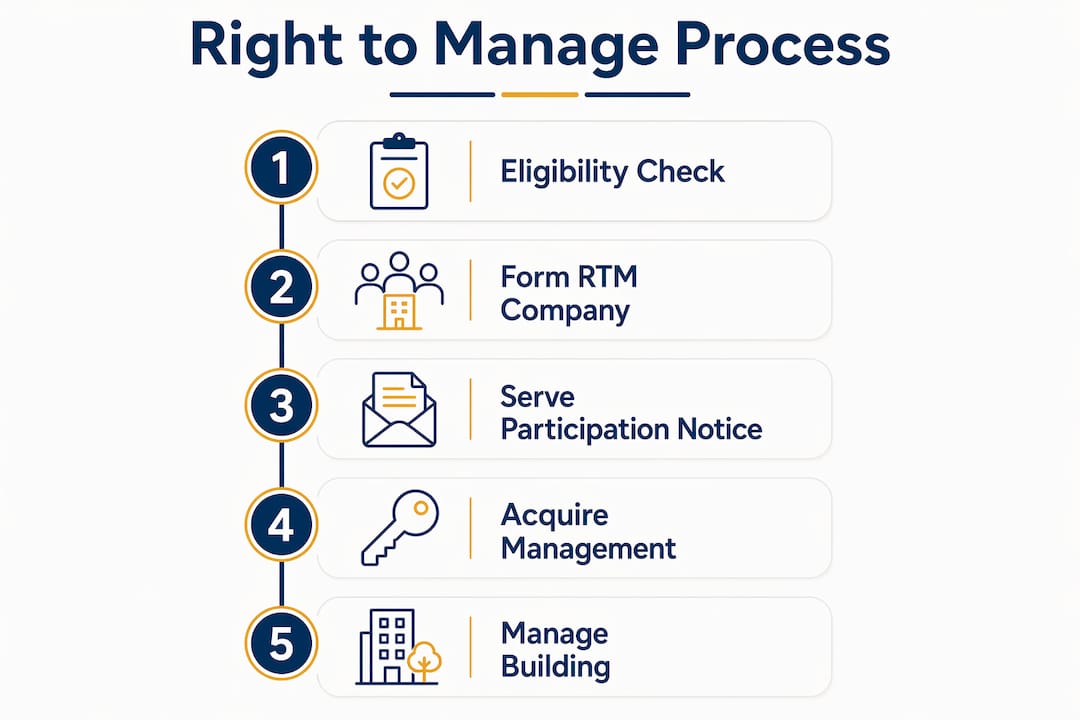
The RTM process follows a strict statutory sequence. Deviating from it, even in minor ways, can invalidate the entire claim and force you to restart. The right to manage process timeline at Righttomanage sets out each stage in full, but the core steps are as follows.
- Form the RTM company. Register a private company limited by guarantee with the correct articles at Companies House. Appoint directors from among the qualifying leaseholders.
- Serve the notice of invitation to participate. This notice must be sent to every qualifying tenant in the building, not just those you expect to join. It invites them to become members of the RTM company before the claim notice is served.
- Wait at least 14 days. The two-stage notice procedure requires a minimum gap of 14 days between the participation notice and the claim notice. This is a hard statutory requirement.
- Serve the claim notice. The claim notice (a Section 79 notice under the 2002 Act) is served on the landlord, any intermediate landlords, and the current managing agent. It must contain prescribed information including the RTM company details, the premises, and the proposed acquisition date.
- Landlord's response period. The landlord has one month to serve a counter-notice. If they accept the claim, management transfers on the acquisition date, which must be at least three months after the claim notice. If they dispute it, the matter goes to the First-tier Tribunal (Property Chamber).
- Tribunal determination (if disputed). If the landlord serves a counter-notice, the RTM company must apply to the tribunal within two months. Rights transfer three months after a successful tribunal decision.
- Acquisition date. Management formally transfers to the RTM company. The existing managing agent must hand over all relevant documents, contracts, and service charge funds.
Pro Tip: Failure to serve the participation notice on every qualifying tenant, even one who is absent or unresponsive, can invalidate the claim notice. A Court of Appeal ruling confirmed this. Keep a signed record of every notice served and the method of service.
What powers transfer to the RTM company and what stays with the landlord?
This is where many leaseholders have unrealistic expectations. RTM transfers management functions, not ownership. The distinction is significant.
| What transfers to the RTM company | What remains with the landlord |
|---|---|
| Day-to-day services and repairs | Freehold title and ownership |
| Building maintenance and upkeep | Ground rent collection |
| Building insurance procurement | Forfeiture and possession rights |
| Service charge collection and management | Consent for alterations under the lease |
| Appointment and oversight of managing agents | Enforcement of lease covenants |
The RTM company assumes responsibility for everything that a managing agent would ordinarily handle on the landlord's behalf. That includes organising repairs, placing buildings insurance, collecting service charges, and complying with health and safety obligations. The landlord retains the title to the building and all rights that flow from ownership.
One common misconception is that RTM means leaseholders must manage the building themselves. That is not the case. Many RTM companies appoint professional managing agents to handle day-to-day operations. The difference is that the RTM company, not the freeholder, chooses that agent and holds them accountable. That shift in control is the point of the exercise. For guidance on what happens once management transfers, Righttomanage covers post-acquisition responsibilities in detail.
What are the benefits and common pitfalls of the right to manage?
The benefits of right to manage are real and practical, but they come with genuine responsibilities that leaseholders must be prepared to meet.
Key benefits:
- You can replace a poor or unresponsive managing agent without the landlord's agreement.
- Service charge expenditure becomes transparent and subject to leaseholder scrutiny.
- You control which contractors are appointed and at what cost.
- You can prioritise maintenance that the freeholder has historically neglected.
- The process does not require you to purchase the freehold, so costs are lower than collective enfranchisement.
Common pitfalls:
- Serving the participation notice on all qualifying tenants is a strict requirement. Missing even one can invalidate the entire claim, forcing you to restart from the beginning.
- Timing errors between the participation notice and claim notice are a frequent cause of failed claims.
- Recruiting enough committed leaseholders is harder than it sounds. The collective nature of RTM means the company depends on engaged members willing to fulfil legal duties.
- Directors of the RTM company take on legal responsibilities. Appointing directors who understand those obligations is not optional.
- If a tribunal hearing becomes necessary, assembling a documentary bundle with leases, notices, membership lists, and title documents is standard practice. Gaps in that evidence weaken your position significantly.
Understanding the importance of right to manage goes beyond the legal mechanics. It is about whether your building is managed to the standard you and your neighbours deserve, and whether you are willing to take collective responsibility for making that happen.
How does right to manage compare with collective enfranchisement?
Leaseholders in England and Wales have two main statutory routes to improve their situation: RTM and collective enfranchisement. They serve different purposes and suit different circumstances.
| Factor | Right to manage | Collective enfranchisement |
|---|---|---|
| What you gain | Management control | Freehold ownership |
| Landlord consent required | No | No |
| Proof of fault required | No | No |
| Cost | Lower (legal and admin fees) | Higher (purchase price plus legal fees) |
| Ownership of building | Remains with freeholder | Transfers to leaseholders |
| Ongoing obligations | Management duties | Freeholder duties |
| Reversibility | RTM can be lost or surrendered | Permanent transfer of title |
RTM does not transfer freehold ownership. The landlord continues to hold the title and collect ground rent. Collective enfranchisement, by contrast, allows qualifying leaseholders to purchase the freehold outright, which gives them permanent control over both management and ownership. The trade-off is cost and complexity. Buying the freehold requires a valuation, negotiation, and a significant capital outlay. RTM requires legal compliance and collective organisation, but no purchase price. For leaseholders weighing both options, Righttomanage has a detailed comparison of RTM versus buying the freehold.
Key takeaways
Right to manage is a no-fault statutory right that transfers building management, not ownership, to qualifying leaseholders through a properly constituted RTM company following a strict two-stage notice procedure.
| Point | Details |
|---|---|
| No-fault statutory right | Leaseholders need no evidence of mismanagement to claim RTM under the 2002 Act. |
| Strict eligibility criteria | Two-thirds of flats must be held by qualifying tenants with leases of 21 years or more. |
| Two-stage notice procedure | Participation notice must precede the claim notice by at least 14 days; errors invalidate the claim. |
| Management transfers, not ownership | The RTM company controls services, repairs, and insurance; the freeholder retains the title. |
| RTM is not self-management | Most RTM companies appoint professional managing agents, gaining control over who that agent is. |
Why procedural precision matters more than most leaseholders expect
I have seen leaseholders approach RTM with genuine enthusiasm and a clear grievance, only to have their claim fail on a technicality that had nothing to do with the merits of their case. That is the uncomfortable reality of this process. The right is strong, but it is unforgiving of procedural errors.
The participation notice requirement is the most common trap. Leaseholders focus on recruiting supporters and forget that the notice must go to every qualifying tenant, including those who are absent, unresponsive, or actively opposed. A single missed notice has ended claims that were otherwise watertight. The Court of Appeal has confirmed this position, and there is no discretion available to the tribunal to overlook it.
My view is that the collective dimension of RTM is both its greatest strength and its most underestimated challenge. Recruiting directors who understand their legal obligations, not just their frustrations with the current management, is what separates successful RTM companies from those that acquire management and then struggle to exercise it competently. Post-acquisition, the RTM company becomes the responsible party for health and safety compliance, service charge accounting, and contractor oversight. Those are real obligations, not administrative formalities.
The practical answer for most leaseholder groups is to appoint a professional managing agent from day one, chosen by the RTM company on terms the company controls. That combination of legal authority and professional support is where RTM delivers its full value. The right gives you the power to choose. Use that power deliberately.
— Paul
Take control of your building management with Righttomanage
If you are frustrated with your current managing agent, concerned about service charges, or simply want to understand your options, Righttomanage is built specifically for leaseholders in your position.
Righttomanage manages the entire RTM process from start to finish. That includes a free eligibility check to confirm whether your building qualifies, company formation, Section 78 participation notices, Section 79 claim notices, counter-notice review, and acquisition-date preparation. You can also explore the full RTM process timeline to understand exactly what each stage involves before you commit. Whether you are at the research stage or ready to act, Righttomanage provides the legal structure and practical support to get it done correctly.
FAQ
What does right to manage mean for leaseholders?
Right to manage means qualifying leaseholders can collectively take over building management from the landlord without consent and without proving fault. The right is granted by the Commonhold and Leasehold Reform Act 2002 and applies to eligible flat leaseholders in England and Wales.
Do I need to prove my landlord has done something wrong?
No. RTM is a no-fault right, meaning you do not need evidence of mismanagement or any history of dispute to make a valid claim. Eligibility and procedural compliance are the only requirements.
How long does the right to manage process take?
From serving the participation notice to the acquisition date, the process takes a minimum of around four to five months if the landlord does not dispute the claim. A contested claim referred to the First-tier Tribunal adds approximately three months to that timeline.
Can the freeholder stop a right to manage claim?
The freeholder can serve a counter-notice disputing the claim, but they cannot simply refuse it. If the RTM company meets all eligibility criteria and has followed the statutory procedure correctly, the First-tier Tribunal will uphold the claim. Righttomanage explains the grounds for objection in full.
What happens to the managing agent after RTM is acquired?
The existing managing agent's appointment ends on the acquisition date. The RTM company then has full authority to appoint a new managing agent of its own choosing, renegotiate contracts, and set its own management standards going forward.