
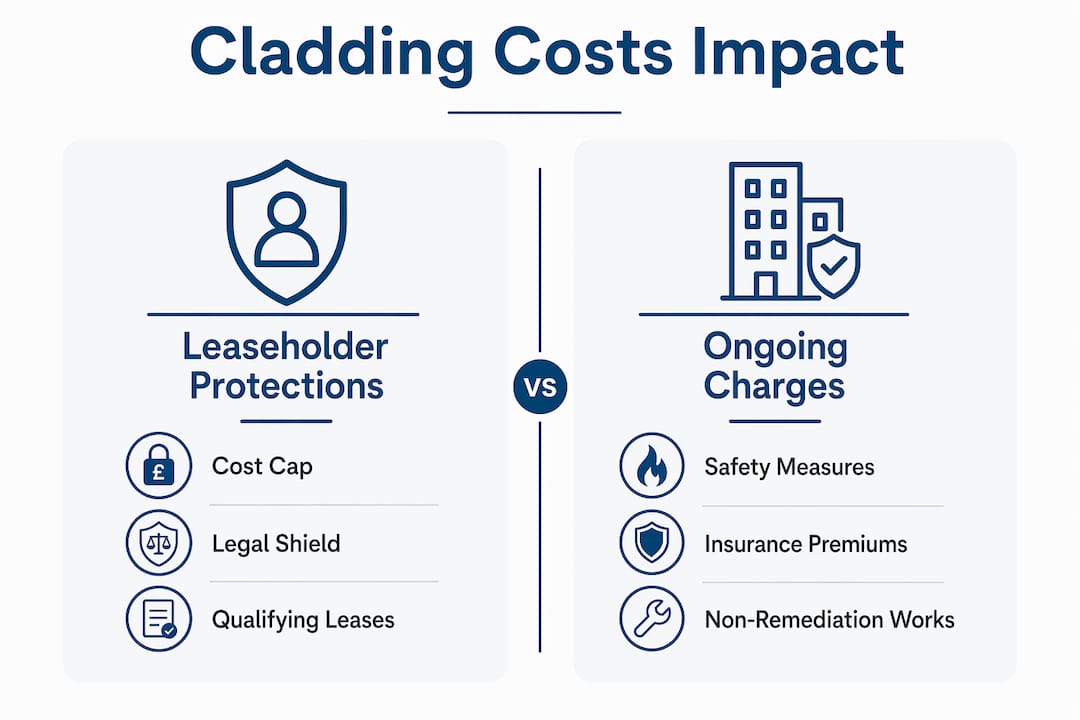
Cladding remediation is defined as the removal or replacement of unsafe cladding forming part of a building's external wall system, and qualifying leaseholders in buildings of at least 11 metres or five storeys are legally protected from paying service charges for this work under the Building Safety Act 2022. That protection is not theoretical. It is written into Paragraph 8 of Schedule 8 of the Act and has been confirmed by Upper Tribunal rulings. Yet leaseholders across England and Wales still see their service charges rise sharply when cladding problems emerge. Understanding why cladding affects leaseholder service charges requires separating what the law prohibits from what it permits.
Why cladding affects leaseholder service charges: the legal framework
The Building Safety Act 2022 draws a clear line between cladding remediation costs and other building safety costs. Cladding remediation covers the physical removal or replacement of unsafe cladding on external wall systems. No qualifying leaseholder must pay service charges for this work. That commitment is backed by ministerial statement and confirmed in law.
What makes a lease "qualifying"
A qualifying lease is one that was granted before 14 february 2022 and relates to a dwelling in a relevant building. A relevant building stands at least 11 metres tall or has at least five storeys. The leaseholder must also have owned the property as their only or principal home on 14 february 2022, or must not own more than two other dwellings in the United Kingdom.
How costs are capped for other remediation work
For building safety defects that fall outside cladding remediation, the Act does not impose a blanket prohibition. Instead, it caps what landlords can recover. Recoverable remediation costs are spread over ten years, with leaseholders paying no more than one tenth of the total cap per year. The cap itself is calculated using the lease value as of 14 february 2022 and varies by location and property value. This structure prevents landlords from front-loading large bills.
What costs are excluded entirely
Professional and legal costs related to leaseholder liability for remediation cannot be recovered from leaseholders at all. This matters because managing agents sometimes include legal and consultancy fees within service charge demands. Leaseholders should scrutinise every line of a service charge demand, not just the headline figure.
Why service charges still rise despite cladding protections
The legal protection against cladding remediation costs does not freeze service charges. Several legitimate and some questionable costs continue to flow through to leaseholders even when the Act applies.
Interim safety measures and monitoring costs
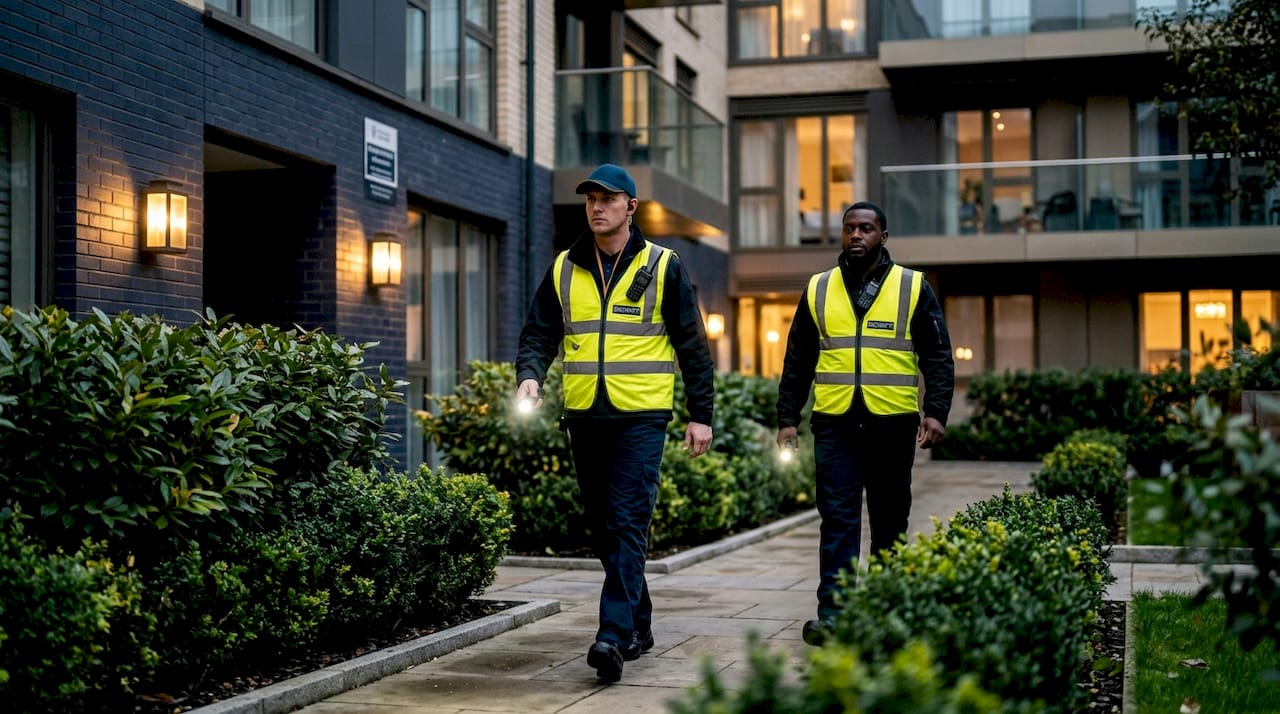
Alternative risk mitigation measures such as waking watch patrols, enhanced fire alarm systems, and increased building inspections are the most common cause of rising service charges linked to cladding. These are not remediation costs. They are ongoing safety management costs, and the Act does not prohibit passing them to leaseholders. A waking watch alone can cost thousands of pounds per month across a block, shared between all leaseholders.
Building insurance premiums
Cladding problems cause insurers to treat a building as high risk. That risk classification pushes premiums sharply upward. Higher building insurance premiums are recoverable through service charges and are not subject to the same caps as remediation costs. Leaseholders in affected buildings have reported insurance costs multiplying several times over within a single year.
Non-remediation safety works
Fire door replacements, compartmentation surveys, and structural assessments are classified as relevant defect works rather than cladding remediation. These costs sit in a different legal category and may be partially recoverable from qualifying leaseholders, subject to the annual caps described above.
The scale of financial impact
Reported cases show some leaseholders facing service charge increases of over £500 per month, with total fire safety and cladding-related costs reaching £65,000 in individual cases. That figure illustrates why the distinction between protected and unprotected costs is not academic. It is the difference between financial stability and genuine hardship.
Pro Tip: Request a full breakdown of every service charge line item in writing. Landlords and managing agents must provide this under the Landlord and Tenant Act 1985. If a charge is labelled vaguely as "building safety works", ask specifically whether it relates to cladding remediation, interim measures, or insurance.
Common misconceptions leaseholders have about cladding costs
Several misunderstandings cause leaseholders to accept charges they are not legally required to pay, or to assume protections apply when they do not.
-
You must prove a relevant defect to be protected from cladding costs. This is false. The Upper Tribunal confirmed that Paragraph 8 of Schedule 8 operates as a standalone provision. Protection from cladding remediation costs applies whenever cladding is deemed unsafe, regardless of whether a relevant defect has been proved. The unsafe nature of the cladding is the only test.
-
Old cladding installed before 1992 is not covered. Also false. The 30-year limitation period that applies to relevant defects does not apply to cladding remediation protections. Cladding installed before 1992 is still covered if it is deemed unsafe today.
-
The landlord's financial position is irrelevant. Not so. Landlords and developers may use net worth assessments or developer conditions to absorb remediation costs themselves. Local authorities and registered providers are exempt from net worth assessment and typically bear costs directly. Where a landlord has sufficient net worth, they cannot pass cladding remediation costs to leaseholders.
-
Leaseholders who do not live in the property have no protection. Eligibility depends on the lease, not current occupation. A leaseholder who owned the flat as their principal home on 14 february 2022 retains qualifying status even if they have since moved or let the property, provided they hold no more than two other UK dwellings.
-
Charges added to the reserve fund are not service charges. Landlords sometimes attempt to build up reserve funds to cover future remediation costs before protections are formally triggered. Leaseholders should monitor reserve fund demands carefully. Contributions that effectively pre-fund cladding remediation may be challengeable.
Pro Tip: The Almacantar Centre Point House Upper Tribunal ruling is the key legal precedent confirming that cladding remediation protection is standalone. If a managing agent or solicitor tells you otherwise, cite this ruling directly and ask them to explain their position in writing.
How leaseholders can challenge service charge increases linked to cladding
Knowing your rights is only useful if you act on them. Several practical routes exist for leaseholders who believe they are being charged incorrectly.
Review every demand notice
The leasehold service charge rules under the Landlord and Tenant Act 1985 require that service charge demands are accompanied by a summary of rights and obligations. Any demand that does not comply with this requirement is not payable until it does. Check that each charge is itemised, that the description matches the legal category, and that cladding remediation costs are not included.
Use the First-tier Tribunal
The First-tier Tribunal has jurisdiction to determine whether service charges are reasonable and lawfully demanded. Leaseholders can apply without a solicitor, though legal advice is worth seeking for complex cladding cases. The Tribunal can order repayment of charges already paid and prevent future unlawful demands.
Consider Right to Manage
The Right to Manage process gives leaseholders the legal right to take over management of their building from the freeholder, without needing to prove fault and without buying the freehold. Once an RTM company is in place, leaseholders control which managing agent is appointed, how service charge budgets are set, and how building safety works are procured. This removes the conflict of interest that arises when a freeholder's managing agent is both procuring safety works and billing leaseholders for them. Check your RTM eligibility before assuming this route is unavailable.
Verify compliance with consultation requirements
Major works costing more than £250 per leaseholder require a Section 20 consultation under the Landlord and Tenant Act 1985. If a landlord skips this process, the amount recoverable from each leaseholder is capped at £250 for that set of works. Cladding-related safety works frequently exceed this threshold, making proper consultation both a legal requirement and a financial safeguard.
Key takeaways
Qualifying leaseholders in England and Wales are legally protected from paying for unsafe cladding remediation under the Building Safety Act 2022, but rising service charges linked to interim safety measures, insurance, and non-cladding defect works remain a real and legitimate financial burden.
| Point | Details |
|---|---|
| Cladding remediation protection | Qualifying leaseholders in buildings over 11m pay nothing for unsafe cladding removal or replacement. |
| Interim measures are chargeable | Waking watch, enhanced alarms, and monitoring costs are not remediation and can be passed to leaseholders. |
| No defect proof required | Paragraph 8 Schedule 8 protection applies based on unsafe cladding alone, confirmed by Upper Tribunal ruling. |
| Costs are capped, not eliminated | Non-cladding remediation costs are spread over ten years at one tenth of the total cap per annum. |
| RTM gives direct control | Taking over management through RTM removes freeholder conflicts of interest in procuring safety works. |
The uncomfortable truth about cladding and service charges
I have spoken with leaseholders who received service charge demands running to tens of thousands of pounds and assumed they had no choice but to pay. The Building Safety Act 2022 protections are genuinely strong on paper. The problem is that most managing agents know leaseholders will not scrutinise a 40-page service charge pack line by line. That asymmetry of information is where excessive charges survive.
The legal landscape shifted significantly with the Almacantar Centre Point House ruling. Before that decision, there was genuine ambiguity about whether leaseholders needed to prove a relevant defect to access cladding remediation protection. That ambiguity is now resolved. What remains unresolved is the practical enforcement gap. Leaseholders who do not challenge unlawful demands simply pay them.
My honest observation is that the leaseholders who fare best are not necessarily those with the most complex legal arguments. They are the ones who ask for itemised breakdowns, who write formal letters before accepting demands, and who use the First-tier Tribunal without waiting for a solicitor to tell them it is worth doing. The law is on your side for cladding remediation costs. The question is whether you use it.
The cladding crisis has also fractured trust within leasehold communities. Leaseholders in the same block often have different qualifying statuses, creating tension over who bears what costs. Understanding the leaseholder rights framework in detail helps you have those conversations with neighbours from a position of knowledge rather than anxiety.
— Paul
How Righttomanage can help with cladding and service charges
Leaseholders dealing with cladding-related service charge disputes often discover that the root problem is a managing agent with no accountability to them. Righttomanage helps leaseholders legally take control of their building management without buying the freehold, removing that conflict of interest entirely.
The RTM process timeline covers everything from eligibility checks and RTM company formation through to Section 78 and Section 79 notices, counter-notice review, and acquisition-date preparation. Righttomanage manages the full process, so leaseholders do not need to navigate it alone. If your building has cladding issues and you are paying for interim safety measures through a managing agent you did not choose and cannot remove, the Right to Manage route is worth examining. Start with a free eligibility check at Righttomanage.co.uk.
FAQ
Are qualifying leaseholders ever liable for cladding remediation costs?
No. The Building Safety Act 2022 prohibits passing cladding remediation costs to qualifying leaseholders in relevant buildings, regardless of when the cladding was installed or whether a relevant defect is proved.
What is the difference between cladding remediation and interim safety measures?
Cladding remediation is the physical removal or replacement of unsafe cladding. Interim safety measures such as waking watch patrols and enhanced fire alarms are ongoing management costs and are not covered by the same legal prohibition.
Can a landlord add cladding costs to the reserve fund instead?
Landlords sometimes attempt to build reserve funds to cover future remediation costs. Leaseholders should scrutinise reserve fund demands carefully, as contributions that effectively pre-fund cladding remediation may be challengeable at the First-tier Tribunal.
Do I need to prove my cladding is defective to claim protection?
No. The Upper Tribunal confirmed that Paragraph 8 of Schedule 8 of the Building Safety Act 2022 is a standalone provision. Protection applies whenever cladding is deemed unsafe, with no requirement to prove a relevant defect separately.
How does Right to Manage help with cladding-related service charges?
Right to Manage transfers management control from the freeholder to leaseholders, allowing them to appoint their own managing agent, control service charge budgets, and oversee how building safety works are procured and billed.