
The Commonhold and Leasehold Reform Act 2002 is the legislation that introduced commonhold as a new freehold ownership model for flats and fundamentally reformed leasehold property law in England and Wales. The Act received Royal Assent on 1 May 2002 and came into force on 27 September 2004. Before this legislation, leaseholders had limited rights over their buildings and no alternative to the traditional freeholder hierarchy. The Act changed that by creating two parallel tracks: a new ownership structure called commonhold, and a strengthened set of rights for existing leaseholders within the leasehold system.
What is commonhold and leasehold reform act 2002 and why does it matter?
The Act addresses a structural problem at the heart of flat ownership in England and Wales. Under traditional leasehold, you own your flat for a fixed term and the freeholder owns the building and land. That arrangement creates an inherent power imbalance. The core purpose of commonhold is to solve the "them and us" dynamic between leaseholders and freeholders that leasehold ownership produces.
The 2002 Act tackled this in two ways. First, it created commonhold as a genuine alternative to leasehold for new flat developments. Second, it strengthened the rights of existing leaseholders to extend leases, buy the freehold collectively, and take over management of their buildings. Both tracks matter, and understanding each one helps you know where you stand.
How does commonhold differ from leasehold ownership?
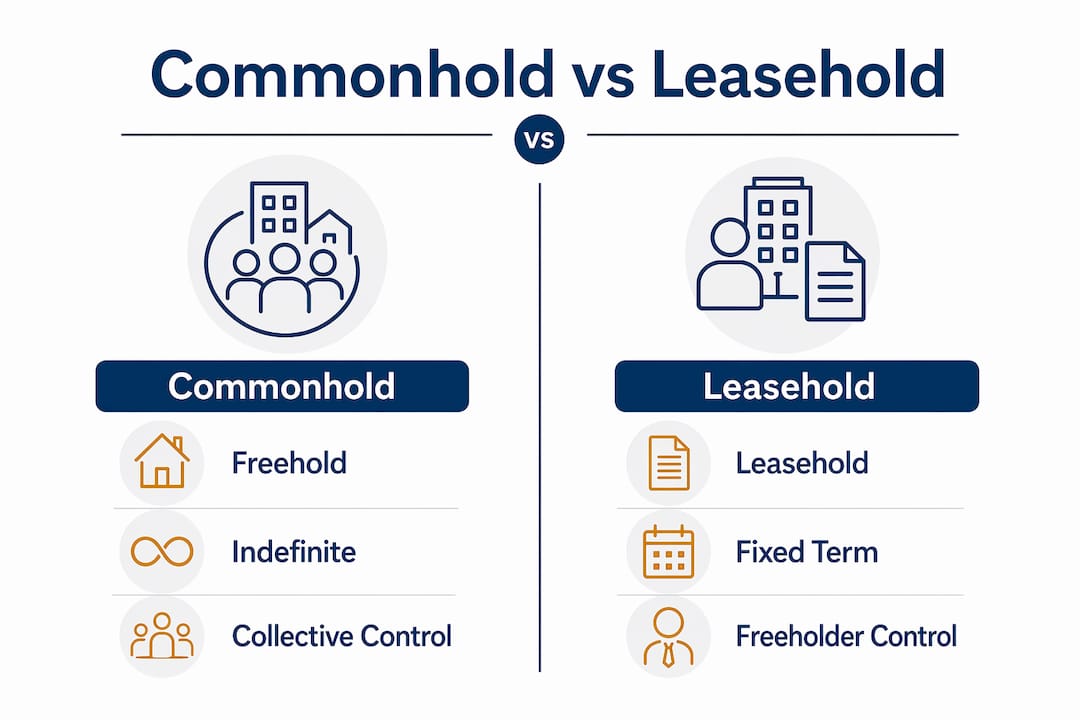
Commonhold is a freehold ownership model. You own your flat outright, with no lease term and no end date. All unit holders become members of a commonhold association, a company that collectively owns and manages the building and land. There is no separate freeholder sitting above you.

Leasehold, by contrast, is a time-limited tenure. You hold a lease from the freeholder, typically for 99, 125, or 999 years. The freeholder retains ownership of the building structure and common areas. This is why leasehold ownership issues such as excessive service charges, inflated insurance, and poor maintenance are so common. The freeholder controls the purse strings.
| Feature | Commonhold | Leasehold |
|---|---|---|
| Ownership type | Freehold, indefinite | Leasehold, fixed term |
| Who owns the building | Commonhold association | Freeholder |
| Governance document | Commonhold Community Statement | Lease agreement |
| Ground rent | None | Payable to freeholder |
| Management control | Collective, by unit owners | Freeholder or managing agent |
| Lease expiry risk | None | Yes, lease value declines over time |
The Commonhold Community Statement is the legal document that governs how a commonhold building operates. It sets rules on matters such as noise, pet ownership, and alterations. Amending this document requires broad consensus among unit holders, which can make governance slow when residents disagree.
Commonhold also imposes collective responsibilities that leasehold does not. Commonhold associations must produce a 10-year building report and maintain a reserve fund for anticipated works. That promotes proactive maintenance but demands active participation from all owners.
Pro Tip: If you currently own a leasehold flat and want to understand your management rights without buying the freehold, the Right to Manage route under the 2002 Act may be the most practical option available to you right now.
How did the Act reform leasehold rights?
The 2002 Act did not just create commonhold. It also strengthened the position of leaseholders within the existing leasehold system. The leasehold reform measures introduced and built upon by the Act include:
- Lease extension rights. Qualifying leaseholders can extend their lease by 90 years on a flat, reducing the ground rent to a peppercorn.
- Collective enfranchisement. A group of leaseholders can club together to buy the freehold of their building, giving them full ownership.
- Right to Manage (RTM). Leaseholders can take over the management of their building from the freeholder without buying the freehold, provided they meet eligibility criteria.
- Service charge protections. The Act introduced requirements for service charges to be reasonable and for leaseholders to be consulted on major works.
- Ground rent restrictions. Subsequent reforms have capped and then banned ground rents on new leases.
The Right to Manage is particularly significant. It gives leaseholders a legal route to remove a poor managing agent and appoint their own, without needing the freeholder's agreement. You can read more about enfranchisement versus RTM to understand which route suits your situation.
Pro Tip: The Right to Manage process requires at least 50% of qualifying leaseholders in a building to participate. Check your building's eligibility before starting the process, as commercial space and certain building types affect qualification.
Why has commonhold seen so little uptake?
Twenty years after the Act came into force, only around 20 commonhold developments exist in England and Wales. That figure is striking. It reveals that creating a legal framework for commonhold was not enough to make it work in practice.
Several barriers explain the low adoption:
- Unanimous consent requirement. Converting a leasehold block to commonhold requires agreement from the freeholder, every single leaseholder, and all mortgage lenders. In a block of 20 flats, one dissenting owner or lender blocks the entire conversion.
- Mortgage lender reluctance. Lenders have historically been cautious about financing commonhold properties because the model lacks the conventional landlord-tenant structure they are accustomed to assessing. That limits buyers' ability to get a mortgage on a commonhold unit.
- Developer preference for leasehold. Developers have traditionally favoured leasehold because ground rent income and management fees generate long-term revenue. Commonhold removes that income stream entirely.
- Governance complexity. Amending the Commonhold Community Statement demands broad agreement. In practice, disputes among residents can make even routine rule changes difficult.
- Law Commission proposals not yet law. The Law Commission has proposed easier conversion routes to commonhold, but those proposals remain unenacted, leaving the unanimous consent barrier firmly in place.
The result is a legal structure that exists on paper but has barely been used. Most leaseholders in England and Wales remain in the traditional leasehold system, relying on the rights reforms rather than the commonhold alternative.
What are the government's plans to reform leasehold and expand commonhold?
The UK Government has signalled a clear direction of travel. The 2025 Commonhold White Paper sets out plans to make commonhold the default tenure for new flat developments and to give existing leaseholders a clearer path to convert. The policy shift is substantial.
Housing Minister Matthew Pennycook confirmed in 2024 that abolishing leasehold will be gradual, with the government focused on empowering leaseholders through escape routes and stopping future leasehold use rather than attempting an overnight switch. That phased approach reflects the scale of the challenge. There are an estimated 4 to 5 million leasehold flats in England alone.
The proposed reforms include:
- Banning the sale of new leasehold flats, making commonhold the default for future developments.
- Capping and eventually abolishing ground rents on existing leases.
- Simplifying the conversion process so that unanimous consent is no longer required.
- Strengthening leaseholder rights to challenge service charges and management decisions.
"The government's focus is on empowering leaseholders to control their buildings and shutting the door on future leasehold arrangements methodically." — Housing Minister Matthew Pennycook, 2024
These changes will not happen immediately. Legislation takes time, and the transition from leasehold to commonhold affects millions of properties, hundreds of mortgage lenders, and decades of established legal practice. For leaseholders living with poor management today, the Right to Manage remains the most accessible tool available under the existing law.
Key takeaways
The Commonhold and Leasehold Reform Act 2002 created commonhold ownership and strengthened leaseholder rights, but practical barriers have kept commonhold rare while government reform plans now aim to make it the default tenure for new flats.
| Point | Details |
|---|---|
| What the Act introduced | Commonhold as a freehold alternative for flats and stronger rights for existing leaseholders. |
| Commonhold vs leasehold | Commonhold owners hold their unit indefinitely with no freeholder; leasehold is time-limited with a freeholder above. |
| Why commonhold is rare | Unanimous consent for conversion and mortgage lender reluctance have kept adoption to around 20 developments. |
| Leaseholder rights under the Act | RTM, lease extension, collective enfranchisement, and service charge protections are all available now. |
| Government direction | The 2025 Commonhold White Paper plans to ban new leasehold flats and simplify conversion to commonhold. |
The reform is real, but the wait is long
I have spent years working with leaseholders who are frustrated, and the pattern is always the same. They discover their rights under the 2002 Act far too late. They have been paying inflated service charges or dealing with a managing agent who ignores maintenance requests for years before anyone tells them that the Right to Manage exists.
The 2002 Act gave leaseholders genuine tools. The problem is that most people do not know they have them. Commonhold sounds like the ideal solution, and in theory it is. But with only around 20 developments in existence after two decades, it is not a practical option for the vast majority of leaseholders today. The government's 2025 White Paper is encouraging, but legislation moves slowly.
My honest view is this: do not wait for commonhold reform to fix your situation. If your building has a poor managing agent, inflated insurance, or unexplained service charges, the Right to Manage process is available to you right now. It does not require you to buy the freehold. It does not require unanimous agreement. It requires organisation, the right legal steps, and enough qualifying leaseholders to participate.
Commonhold is the right long-term direction. But the RTM is the right tool for today.
— Paul
How Righttomanage can help you act on your rights
Leaseholders who understand the 2002 Act often reach the same conclusion: knowing your rights is one thing, but exercising them is another.
Righttomanage manages the entire Right to Manage process from start to finish. That includes eligibility checks, RTM company setup, Section 78 and Section 79 notices, counter-notice review, and acquisition-date preparation. If you are dealing with a poor managing agent, excessive service charges, or a freeholder who ignores your concerns, the RTM process timeline sets out exactly what to expect and when. Righttomanage exists for leaseholders who are ready to stop tolerating poor management and start doing something about it.
FAQ
What did the Commonhold and Leasehold Reform Act 2002 introduce?
The Act introduced commonhold as a new freehold ownership model for flats and reformed leasehold law by strengthening leaseholder rights to extend leases, buy the freehold, and take over building management. It received Royal Assent on 1 may 2002 and came into force on 27 september 2004.
What is the difference between commonhold and leasehold?
Commonhold gives flat owners indefinite freehold ownership through a collective association with no freeholder above them. Leasehold is a time-limited tenure where a freeholder owns the building and leaseholders pay ground rent and service charges.
Why is commonhold so rare in England and Wales?
Converting an existing leasehold block to commonhold requires unanimous agreement from the freeholder, all leaseholders, and all mortgage lenders, making conversion practically impossible for most buildings. Only around 20 commonhold developments exist in England and Wales more than 20 years after the Act came into force.
What is the Right to Manage under the 2002 Act?
The Right to Manage allows qualifying leaseholders to take over the management of their building from the freeholder without buying the freehold or proving the freeholder is at fault. At least 50% of qualifying leaseholders must participate, and the building must meet specific eligibility criteria.
What are the government's current plans for leasehold reform?
The UK Government's 2025 Commonhold White Paper plans to make commonhold the default tenure for new flat developments and to simplify conversion for existing leaseholders. Housing Minister Matthew Pennycook confirmed in 2024 that the abolition of leasehold will be phased rather than immediate.