
Leasehold enfranchisement is the legal process by which qualifying leaseholders collectively purchase the freehold of their building, whereas Right to Manage (RTM) is the statutory right for leaseholders to assume management of their building without buying the freehold. Both rights exist under separate pieces of legislation in England and Wales, and both have been significantly strengthened by reforms introduced in 2025 and 2026. Understanding what is leasehold enfranchisement versus RTM conveyancing is the first step to choosing the right path for your building. The two routes serve different goals, carry different costs, and suit different circumstances.
What is leasehold enfranchisement and how does the conveyancing process work?
Leasehold enfranchisement allows qualifying leaseholders to collectively buy the freehold of their building, transferring ownership to a nominee company controlled by leaseholders. Ownership is the defining outcome. Once leaseholders own the freehold, they control ground rents, service charges, building insurance, and major works decisions permanently.
Eligibility criteria
Eligibility for collective enfranchisement is governed by the Leasehold Reform, Housing and Urban Development Act 1993 (LRHUDA 1993). The building must be a self-contained block or part of a block. At least two thirds of the flats must be held on qualifying leases, and at least half of all qualifying leaseholders must participate in the claim. Qualifying tenants thresholds and participation percentages are critical. In some cases, leaseholders need to extend their leases first to meet the qualifying interest requirements.
Since january 2025, leaseholders no longer need to have owned their lease for two years before initiating a freehold purchase claim. That change removes a significant barrier for recent buyers who previously had to wait before acting.
The conveyancing process step by step
- Confirm eligibility. Check building type, lease lengths, and participation numbers before spending on valuers or solicitors.
- Instruct a specialist solicitor and valuer. Enfranchisement conveyancing requires a solicitor experienced in LRHUDA 1993 and a surveyor to calculate the freehold premium.
- Serve the Section 13 initial notice. This statutory notice is served on the landlord and triggers the legal process under LRHUDA 1993 with strict timelines attached.
- Receive the counter-notice. The landlord must respond within two months, either admitting or disputing the claim.
- Negotiate the premium. Leaseholders and the landlord negotiate the purchase price. If no agreement is reached, the First-tier Tribunal (Property Chamber) determines the premium.
- Complete the conveyance. Once the price is agreed or determined, the freehold transfers to the nominee purchaser company.
Pro Tip: Map every statutory deadline from the date you serve the Section 13 notice. Timetable risk is the most common reason enfranchisement claims fail, even when the landlord has admitted parts of the claim.
The premium paid for the freehold reflects the value of ground rents, the length of unexpired leases, and the marriage value where leases are below 80 years. Valuation disputes are common, so appointing a surveyor with tribunal experience is worth the additional cost.
What is Right to Manage (RTM) conveyancing and what are the key steps involved?
Right to Manage enables qualifying leaseholders to take over the management of their building without buying the freehold, by forming an RTM company. The statutory basis is the Commonhold and Leasehold Reform Act 2002 (CLRA 2002), Part 2. RTM transfers management functions from the landlord to the RTM company. Leaseholders do not need to prove fault with the current management to make a claim.

Eligibility for RTM
The building must be a self-contained block containing at least two flats. At least two thirds of the flats must be held on long leases. The RTM company must have the participation of leaseholders holding at least half of the total number of flats. From march 2025, the non-residential limit was raised to 50%, meaning many mixed-use buildings with ground-floor commercial space now qualify where they previously did not.
The RTM conveyancing process step by step
- Form the RTM company. Leaseholders incorporate a company limited by guarantee with Articles of Association that comply with the CLRA 2002 requirements. Righttomanage handles RTM company setup from incorporation through to acquisition.
- Serve the Notice of Participation (Section 78). This notice invites other leaseholders to join the RTM company. A minimum of 14 days must pass before the next step.
- Serve the Notice of Claim (Section 79). The formal claim notice is served on the landlord and any third parties with management responsibilities.
- Wait for the counter-notice. The landlord has one month to admit or dispute the claim. If the landlord admits, the acquisition date is set. If the landlord disputes, the RTM company may apply to the First-tier Tribunal.
- Acquire management on the acquisition date. Management responsibilities transfer to the RTM company on the agreed date.
- Manage the building. The RTM company is responsible for managing the building under the terms of the lease after acquiring RTM rights.
Pro Tip: RTM companies often appoint a professional managing agent after acquisition, but they are not legally required to do so. Choose carefully. The RTM company faces the same legal obligations as the original landlord, so poor agent selection simply recreates the problem you set out to fix.
From march 2025, RTM reforms mean leaseholders no longer need to pay the freeholder's legal fees in most cases. That change materially reduces the cost of pursuing an RTM claim.
What are the main differences between leasehold enfranchisement and RTM conveyancing?
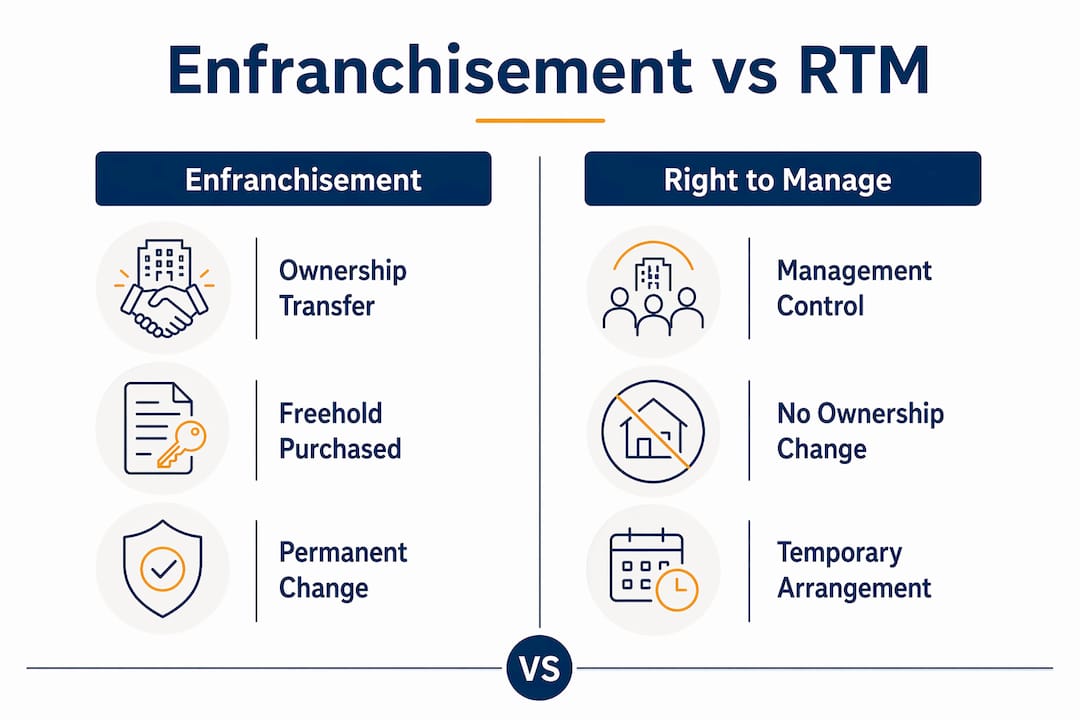
The core difference is ownership versus management. Enfranchisement transfers freehold ownership permanently. RTM transfers management functions only, leaving the freehold with the landlord. Each route has distinct advantages depending on what leaseholders actually want.
| Factor | Leasehold enfranchisement | Right to Manage (RTM) |
|---|---|---|
| Outcome | Freehold ownership transfers to leaseholders | Management transfers; freehold stays with landlord |
| Legislation | LRHUDA 1993 | CLRA 2002, Part 2 |
| Cost | Premium payable for freehold plus legal and valuation fees | No premium; legal fees only (freeholder fees largely removed from 2025) |
| Proof of fault required | No | No |
| Participation threshold | At least 50% of qualifying leaseholders | At least 50% of total flats |
| Complexity | High; valuation and negotiation required | Moderate; notice procedure is more straightforward |
| Long-term control | Permanent and complete | Ongoing but can be challenged or lost |
Key practical distinctions beyond the table:
- Enfranchisement gives leaseholders the power to grant lease extensions at nil premium to themselves, which is a major long-term financial benefit.
- RTM does not affect ground rent or the terms of existing leases. The landlord retains those rights.
- Enfranchisement requires a freehold premium, which can be substantial in high-value areas. RTM requires no premium payment.
- RTM can be pursued more quickly in many cases because there is no valuation negotiation stage.
- Legal experts note that enfranchisement and lease extensions have separate qualifying criteria and timelines, making specialist advice essential to navigate statutory steps securely.
How do 2025 and 2026 reforms affect enfranchisement and RTM claims?
Recent legislative changes have shifted the balance firmly in favour of leaseholders. The reforms affect both routes and are worth understanding before deciding which to pursue.
- Two-year ownership rule abolished. Since january 2025, leaseholders can initiate enfranchisement or lease extension claims immediately after purchase. Previously, a two-year wait applied.
- RTM non-residential limit raised. From march 2025, buildings where up to 50% of the floor area is non-residential now qualify for RTM. This opens the route to a large number of mixed-use blocks that were previously excluded.
- Freeholder legal fees removed. RTM claimants no longer pay the freeholder's legal costs in most cases. This was one of the most significant financial deterrents to RTM claims.
- No fault requirement confirmed. RTM reforms confirm that leaseholders do not need to prove mismanagement to make a claim. The right exists regardless of how the building is currently managed.
- Future reforms anticipated. The Leasehold and Freehold Reform Act 2024 signals further changes to valuation methodology for enfranchisement premiums, though full implementation details are still being confirmed. The 2024 conveyancing changes are worth reviewing before committing to a timeline.
The practical implication is clear. Leaseholders who were previously ineligible due to the two-year rule or a mixed-use building should reassess their position now. The cost and access barriers to both routes are lower in 2026 than at any point in the past decade.
What practical considerations should leaseholders weigh when choosing between enfranchisement and RTM?
The right choice depends on what leaseholders want to achieve and what they can realistically organise. Neither route is universally superior.
Situations where enfranchisement is the stronger choice:
- Leaseholders want permanent, complete control over the building and its finances.
- Leases are approaching 80 years, making the marriage value calculation in enfranchisement more favourable than individual lease extensions.
- The group has the financial capacity to fund the freehold premium and associated costs.
- Long-term security and the ability to grant lease extensions at nil premium are priorities.
Situations where RTM is the stronger choice:
- The primary goal is to replace a poor managing agent or reduce excessive service charges.
- Leaseholders cannot raise the capital for a freehold premium.
- The building has a mixed-use element that previously blocked RTM but now qualifies under the 50% non-residential limit.
- Speed matters. RTM avoids the valuation and negotiation stages that can extend enfranchisement by months or years.
Combined use of both rights:
Some leaseholder groups pursue RTM first to gain immediate management control, then proceed to collective enfranchisement once finances and participation are in place. The two rights are not mutually exclusive. RTM can also be used to stabilise a building's management while an enfranchisement claim is being prepared.
Pro Tip: Verify eligibility before spending on legal advice. RTM eligibility depends on building type, lease lengths, and participation numbers. A failed claim wastes time and money, and a second claim may be barred for a period.
Eligibility planning is crucial because RTM requires formation of an RTM company, and successful exercise depends on building qualification and participation thresholds. Getting the numbers wrong at the start is the most avoidable mistake in either process.
Key takeaways
Leasehold enfranchisement transfers freehold ownership permanently, while RTM transfers management only, making them complementary rather than competing rights for leaseholders in England and Wales.
| Point | Details |
|---|---|
| Enfranchisement transfers ownership | Leaseholders collectively buy the freehold, gaining permanent control over the building and its finances. |
| RTM transfers management only | The freehold stays with the landlord; leaseholders control day-to-day management through an RTM company. |
| 2025 reforms lowered barriers | The two-year ownership rule is abolished and RTM freeholder legal fees are removed in most cases. |
| Cost profiles differ significantly | Enfranchisement requires a freehold premium; RTM requires no premium and is now cheaper after 2025 reforms. |
| Eligibility must be verified first | Both routes have strict participation thresholds and building criteria that must be confirmed before serving notices. |
Why I think most leaseholders underestimate RTM
Most leaseholders I speak with assume enfranchisement is the gold standard and RTM is a consolation prize. That view is wrong. RTM is a genuinely powerful right that solves the most common problem leaseholders face: a managing agent who is unaccountable, expensive, and slow. Buying the freehold does not automatically fix poor management. I have seen leaseholder-owned freeholds appoint equally bad agents because the group lacked the time or expertise to manage the building themselves.
The 2025 reforms have made RTM faster, cheaper, and accessible to more buildings than ever before. For leaseholders whose primary frustration is service charges, insurance, or maintenance quality, RTM addresses those issues directly and without the financial burden of a freehold premium.
That said, enfranchisement remains the right choice when lease lengths are falling and long-term security is the goal. The ability to grant lease extensions at nil premium to yourselves is worth real money. The two routes are not rivals. They are tools for different problems, and the best leaseholder groups understand when to use each one.
Engage a solicitor who specialises in leasehold reform before serving any notice. Timetable errors invalidate claims, and a specialist will map every deadline from day one. The reforms are on your side. Use them properly.
— Paul
How Righttomanage can support your RTM or enfranchisement claim
Righttomanage manages the RTM process from start to finish for leaseholders across England and Wales who are frustrated with poor management, excessive service charges, or freeholder control.
The service covers eligibility checks, RTM company formation, Section 78 participation notices, Section 79 claim notices, counter-notice review, and acquisition-date preparation. For leaseholders weighing up both routes, the RTM process timeline page sets out every statutory stage and deadline clearly. If your building has a mixed-use element or you have received a counter-notice from your freeholder, Righttomanage has specific guidance and support for both situations. Start with a free eligibility check at righttomanage.co.uk to confirm whether your building qualifies before committing to any legal costs.
FAQ
What is the main difference between enfranchisement and RTM?
Enfranchisement transfers freehold ownership to leaseholders collectively, while RTM transfers management functions only, leaving the freehold with the landlord. Enfranchisement gives permanent control; RTM gives management control without a purchase premium.
Do leaseholders need to prove bad management to claim RTM?
No. RTM is a no-fault right under the Commonhold and Leasehold Reform Act 2002. Leaseholders do not need to demonstrate that the current management is poor to make a valid claim.
How long does an RTM claim take from start to finish?
The statutory notice process requires at least 14 days between the Notice of Participation and the Notice of Claim, followed by a one-month period for the landlord's counter-notice. The full process typically takes four to six months from company formation to acquisition date.
Can leaseholders pursue RTM and enfranchisement at the same time?
RTM and enfranchisement are separate statutory rights and can be pursued sequentially. Many leaseholder groups use RTM to gain immediate management control, then pursue collective enfranchisement once participation and finances are secured.
Does the two-year ownership rule still apply in 2026?
No. Since january 2025, the two-year ownership requirement for enfranchisement and lease extension claims has been abolished. Leaseholders can initiate claims immediately after purchasing their flat.