
The Building Safety Act 2022 protects qualifying leaseholders in England from paying most costs related to historic building safety defects in higher-rise residential buildings. This is the most significant shift in leasehold property safety law in a generation. The Act places remediation costs on developers and landlords rather than leaseholders, but only where specific criteria are met. Understanding the building safety act leasehold implications is not optional if you own or manage a flat in a qualifying building. The Building Safety Regulator now oversees compliance, and the certification process that triggers your financial protections requires action from you directly. Righttomanage works with leaseholders who need to understand these rights before making any decisions about their building management.
What are the Building Safety Act leasehold implications for your property?
The Act's protections apply only to buildings 11 metres or higher, or those with five or more storeys. That threshold matters enormously. If your building falls below it, the service charge protections in Schedule 8 of the Act do not apply, and normal building regulations leasehold obligations continue as before.
A qualifying leaseholder is someone who held a long lease on the date of 14 february 2022. The lease must have been on a dwelling, and the leaseholder must not own more than three properties in the UK in total. These criteria determine whether you benefit from the Act's financial protections, and they are assessed at a fixed point in time.

The Act also confirmed in a 2025 Upper Tribunal ruling that no time limit applies to cladding remediation protections. That ruling removed the argument that defects installed more than 30 years ago fell outside the Act's reach. It strengthens the position of leaseholders in older high-rise blocks considerably.
To check whether your building and lease qualify, work through these steps:
- Confirm your building's height or storey count with your managing agent or freeholder
- Check that your lease was granted before 14 february 2022 and has not been materially modified since
- Verify that you do not own more than three UK residential properties
- Confirm the building is in England (Wales has separate legislation)
- Check whether your freeholder or developer is a "relevant landlord" under the Act
Pro Tip: Never extend or vary your lease without taking specialist legal advice first. Lease modifications after 14 february 2022 risk stripping you of qualifying status under the Act, even if the change seems minor.
What is a building safety certificate for leaseholders, and why does it matter?
The certification regime is the legal foundation for cost protections and liability clarity under the Act. Two documents sit at the centre of this process: the Leaseholder Deed of Certificate and the Landlord's Certificate.
The Leaseholder Deed of Certificate
The Leaseholder Deed of Certificate, commonly called the LDoC, is a document you complete and serve on your landlord. It declares that you meet the qualifying leaseholder criteria. Without it, you may not be able to claim the Act's financial protections. Many leaseholders assume their managing agent handles this automatically. They do not. The obligation sits with you.
Failure to serve the LDoC may leave you exposed to the full cost of remediation works through your service charge. The document only needs to be served once, but it is critical. Serve it as soon as you confirm your qualifying status.
The Landlord's Certificate
The Landlord's Certificate is served by your landlord or freeholder. It sets out the landlord's interest in the building, the nature of any relevant defects, and the landlord's liability position. This document determines how much, if any, of the remediation cost can be passed to leaseholders.
Here is the process for obtaining and using both certificates:
- Confirm your qualifying status using the criteria above
- Complete and serve your LDoC on the landlord as soon as possible
- Request the Landlord's Certificate from your freeholder or managing agent in writing
- Review the Landlord's Certificate carefully, ideally with a solicitor, to understand what costs may be passed to you
- If the landlord fails to provide the certificate, take note: non-compliance can legally block the landlord from recovering remediation costs from leaseholders at all
Pro Tip: Request the Landlord's Certificate proactively in writing and keep a dated copy of your request. If the landlord delays or refuses, that failure works in your favour and may prevent any cost recovery claim against you.
What costs are leaseholders still liable for, and how do cost caps work?
The Act shifts historic remediation costs away from leaseholders, but it does not eliminate all service charge responsibilities. Normal maintenance, routine repairs, and costs unrelated to relevant safety defects remain fully recoverable from leaseholders through the service charge. Buildings below the 11-metre or five-storey threshold also fall entirely outside the Act's protections.
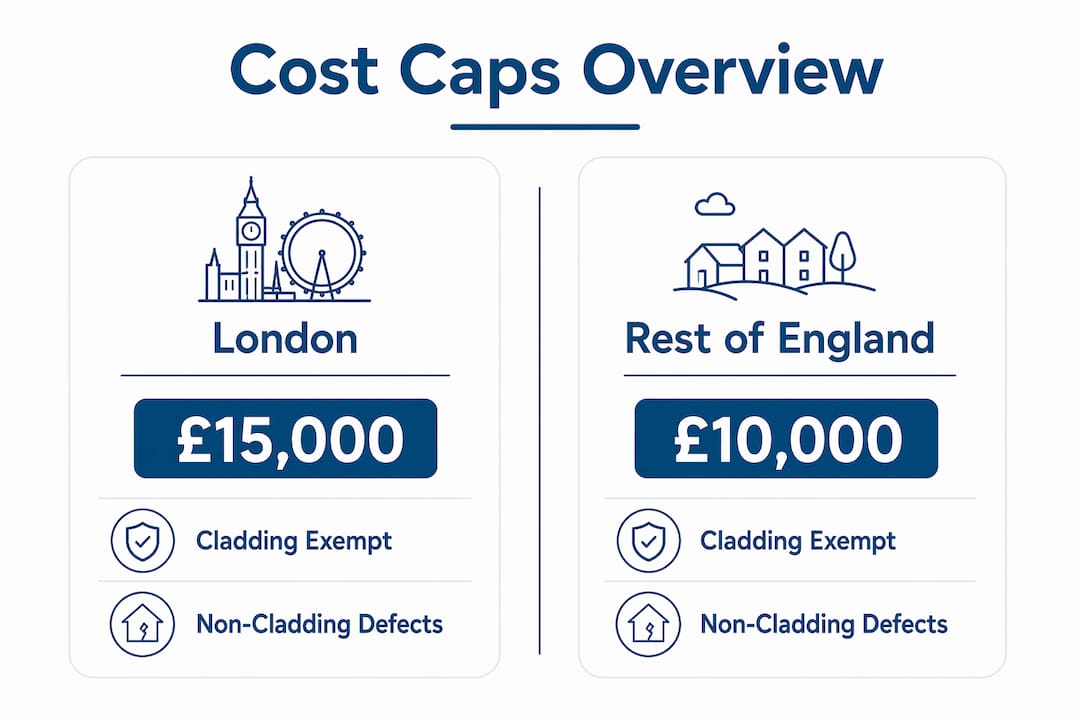
For qualifying leaseholders in qualifying buildings, the Act caps how much can be charged for non-cladding safety defects and interim safety measures. The caps differ by location.
| Cost category | London cap | Rest of England cap |
|---|---|---|
| Non-cladding defect remediation | £15,000 | £10,000 |
| Interim safety measures (e.g. waking watch) | Included within cap | Included within cap |
| Unsafe cladding remediation | £0 | £0 |
| Normal service charges (maintenance, etc.) | No cap | No cap |
Amounts already paid by leaseholders towards relevant defects count towards these caps. That means if you have already paid £8,000 towards non-cladding works in a building outside London, you can only be charged a further £2,000 before the cap is reached. Keep records of every payment you have made.
The Building Safety Levy starts on 1 october 2026. It charges developers based on new residential floorspace and aims to raise £3.4 billion over a decade to fund remediation nationally. The levy does not directly charge leaseholders, but it reflects the government's longer-term commitment to sector-wide safety funding rather than relying on individual building disputes. For leaseholders, the practical implication is that remediation funding will become more structured and less dependent on freeholder solvency over time.
Understanding why cladding affects service charges in detail helps you challenge any service charge demand that appears to breach these caps.
What are the ongoing obligations for leaseholders and property managers?
The Act creates continuing obligations that go beyond the initial certification process. Normal service charges unrelated to safety defects remain the leaseholder's responsibility, and property managers must account for these separately and transparently in their service charge accounts.
Key ongoing obligations include:
- Registration with the Building Safety Regulator: All higher-risk buildings must be registered. Property managers and principal accountable persons must ensure registration is current and accurate.
- Access to safety information: Leaseholders have the right to request the building's safety case report and other key documents. Property managers must not obstruct this access.
- Transparent service charge accounting: Safety-related costs must be clearly separated from routine maintenance costs in service charge demands. Mixing them creates legal exposure for landlords and managing agents.
- Reporting safety concerns: Leaseholders can raise concerns directly with the Building Safety Regulator if they believe their building is not being managed safely. This is a statutory right, not a courtesy.
- Avoiding lease modifications: As noted, lease extensions or variations after 14 february 2022 can inadvertently remove qualifying status. Both leaseholders and property managers should flag this risk before any lease work proceeds.
Property managers also carry responsibility for maintaining the building's safety case and keeping the golden thread of information, the complete record of the building's design, construction, and changes, up to date. This is not a one-off task. It is a continuous obligation under the Act.
For leaseholders considering whether their current management is meeting these standards, understanding your leaseholder rights in England and Wales is the starting point for any challenge or change.
Key takeaways
The Building Safety Act 2022 protects qualifying leaseholders from cladding remediation costs entirely and caps non-cladding defect charges, but only where certification is completed and the building meets height thresholds.
| Point | Details |
|---|---|
| Height threshold is fixed | Only buildings 11 metres or higher, or with five or more storeys, qualify for Act protections. |
| Serve your LDoC without delay | The Leaseholder Deed of Certificate must be served by you, not your managing agent, to trigger financial protections. |
| Cost caps differ by location | Non-cladding defect caps are £15,000 in London and £10,000 in the rest of England; cladding costs are £0. |
| Lease changes carry risk | Any lease modification after 14 february 2022 can remove your qualifying status if not handled by a specialist solicitor. |
| Building Safety Levy starts october 2026 | The levy funds national remediation and signals a shift to sector-wide safety funding rather than individual leaseholder liability. |
What I have learned from watching leaseholders navigate this Act
The single biggest mistake I see is passive assumption. Leaseholders assume their managing agent has served the LDoC on their behalf, or that the Landlord's Certificate will arrive automatically. Neither happens without deliberate action. The Act is structured to reward leaseholders who engage with it and penalise those who do not.
The cost cap figures look reassuring on paper. But I have seen leaseholders discover they have already paid amounts that count towards those caps through historic service charge demands, often without realising it. Reconstructing those payment records after the fact is painful. Keep every service charge demand and receipt from the moment you read this.
The upcoming Building Safety Levy is widely misunderstood. Leaseholders sometimes fear it will add to their bills. It will not, at least not directly. It targets developers of new residential buildings. What it does signal is that the government intends to fund remediation at scale, which is genuinely good news for leaseholders in buildings where the freeholder lacks the resources to remediate without passing costs down.
My strongest advice is this: do not vary your lease without specialist legal advice, serve your LDoC now if you have not already, and request the Landlord's Certificate in writing. These three steps cost very little and protect a great deal. The Act gives leaseholders real power. Using it requires knowing the process.
— Paul
How Righttomanage supports leaseholders dealing with building safety challenges
Leaseholders in qualifying buildings often discover that poor management compounds the complexity of Building Safety Act compliance. Freeholders who delay certificates, managing agents who obscure service charge accounts, and landlords who resist transparency all make an already difficult situation worse.
Righttomanage helps leaseholders take legal control of their building management without buying the freehold. The RTM process gives qualifying leaseholders the right to appoint their own managing agent, oversee service charge accounts directly, and hold safety compliance to a higher standard. If your building is affected by safety defects and your current management is falling short, checking your RTM eligibility is a practical first step. Righttomanage manages the entire process from eligibility check through to acquisition date.
FAQ
What buildings qualify for Building Safety Act protections?
Buildings must be at least 11 metres in height or have five or more storeys. Smaller buildings are excluded from the Act's service charge protections.
What is the Building Safety Levy for leaseholders?
The Building Safety Levy is not charged to leaseholders directly. It targets developers of new residential buildings and aims to raise £3.4 billion over ten years starting october 2026 to fund national remediation.
What is a Leaseholder Deed of Certificate?
The Leaseholder Deed of Certificate is a document you serve on your landlord to confirm your qualifying status under the Act. Without it, you risk losing the financial protections the Act provides.
Can a lease extension affect my Building Safety Act protections?
Yes. Lease modifications after 14 february 2022 can remove your qualifying leaseholder status. Always take specialist legal advice before extending or varying your lease.
What happens if my landlord does not provide the Landlord's Certificate?
If your landlord fails to serve the Landlord's Certificate, they may be legally prevented from recovering relevant remediation costs from you through the service charge. This non-compliance works in the leaseholder's favour.