
RTM company membership gives qualifying leaseholders in England and Wales the collective legal right to control their building's management without buying the freehold. Under the Commonhold and Leasehold Reform Act 2002, RTM is a no-fault right: you do not need to prove landlord wrongdoing or pay compensation to exercise it. With RTM company member rights explained clearly, you can vote on key decisions, appoint directors, access financial records, and hold the board accountable. Righttomanage helps leaseholders exercise these rights from the eligibility check through to acquisition day.
What are RTM company member rights?
RTM company member rights are the legally defined powers that qualifying leaseholders hold within a Right to Manage company. These rights are not informal arrangements. They are set out in the RTM Companies (Model Articles) Regulations 2003 and reinforced by the Companies Act 2006.
As a member, you sit at the top of the governance structure. Members act as owners making constitutional decisions, while directors run the day-to-day operations. That distinction matters enormously. You are not expected to manage contractors or chase repair quotes. Your role is to set direction, approve budgets, and hold the board to account.

The primary advantage of RTM membership is regaining control over building management without needing landlord consent. That control flows directly from your membership rights, which include voting on resolutions, electing directors, and scrutinising company finances. Understanding those rights is the foundation of effective governance.
What voting and decision-making rights do RTM members have?
Members hold the power to shape every major decision the RTM company makes. That power is exercised through formal votes, either at general meetings or by written resolution.
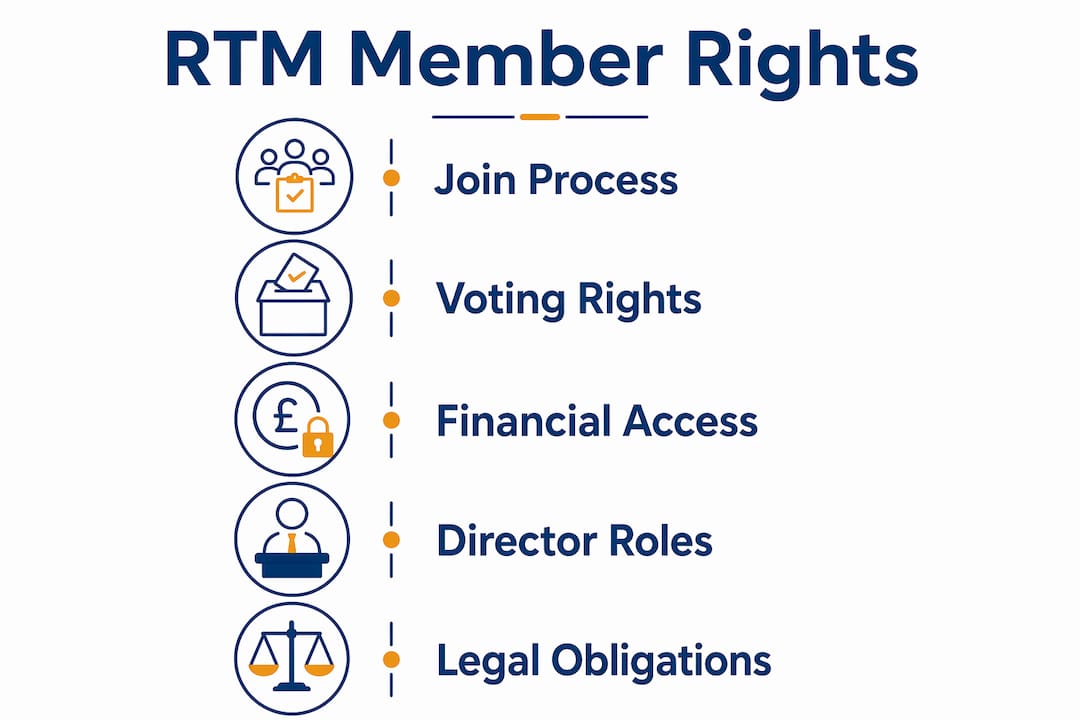
Your core voting rights as a member include:
- Approving service charge budgets and major expenditure above agreed thresholds
- Electing and removing directors who run the company on your behalf
- Passing ordinary and special resolutions to change company rules or approve significant contracts
- Calling general meetings when a sufficient proportion of members request one
- Approving changes to the model articles, which requires a special resolution with a 75% majority
Active member participation and informed voting are critical to holding directors accountable and maintaining good building management. A poorly attended meeting can allow a small group to push through decisions that affect everyone's service charges and living conditions.
Decisions require majority support, so collective action is not optional. If members disengage, governance weakens. The board then operates with little oversight, which is precisely the situation many leaseholders joined RTM to escape.
Pro Tip: Keep a written record of every vote and resolution. Company law requires minutes to be retained for at least ten years, and those records protect you if a decision is ever challenged.
How do RTM member rights differ from director responsibilities?
Members and directors are distinct roles with different legal duties. Confusing the two is one of the most common mistakes in newly formed RTM companies.
The clearest way to understand the split is through a numbered breakdown of each role:
- Members set policy. You approve budgets, elect the board, and vote on major contracts. You do not manage contractors or respond to repair requests.
- Directors administer daily operations. They instruct managing agents, handle maintenance, and comply with health and safety law on behalf of the company.
- Directors serve without pay. An RTM company must be a private company limited by guarantee governed by prescribed articles that forbid directors from receiving remuneration without member approval. Expenses can be reimbursed, but salaries require a formal member vote.
- Directors carry fiduciary duties. They must act in the company's best interests, avoid conflicts of interest, and comply with the Companies Act 2006. Members do not carry these duties individually.
- Members can remove directors. If the board performs poorly, members can pass an ordinary resolution to remove a director. That power is the ultimate check on director behaviour.
Members should understand they are not required to manage daily operations themselves. Their job is to appoint competent directors and supervise them through the governance process. Choosing the right board is therefore the single most consequential decision members make.
What legal obligations do you take on as an RTM member?
Joining an RTM company is a long-term legal commitment, not a trial arrangement. Once the Section 79 claim notice is served, members cannot withdraw. That point is fixed in law and has no exceptions.
The key obligations you accept as a member include:
- Guarantee liability, typically limited to £1, which covers the company's debts if it is wound up
- Ongoing service charge contributions to fund the company's management activities
- Participation in governance, including attending or voting at general meetings
- Compliance with the model articles, which govern how the company operates
The 50% participation threshold is the minimum required before the formal claim can be served. That means at least half of all qualifying leaseholders in the building must join the RTM company. Falling short of that threshold invalidates the claim entirely.
The Section 78 notice is the formal invitation sent to all qualifying leaseholders before the claim is made. It gives every leaseholder the opportunity to join before the threshold is tested. Leaseholders who do not join at this stage can still become members after acquisition, but they lose the right to participate in the original claim.
Pro Tip: Do not serve the Section 79 claim notice until you are confident the 50% threshold is met and verified. A premature notice can be challenged by the freeholder and set the entire process back by months.
The RTM company lasts indefinitely once formed. There is no sunset clause or fixed term. Members must therefore treat their commitment as permanent, not temporary.
What rights do RTM members have to financial information?
Financial transparency is one of the most practical benefits of RTM membership. Members have statutory rights to access company accounts, inspect service charge budgets, and monitor contracts.
| Right | What it covers |
|---|---|
| Company accounts | Annual accounts filed at Companies House and available to all members |
| Service charge budgets | Estimates and actuals for maintenance, insurance, and management fees |
| Management agreements | Contracts with any appointed managing agent, including fee structures |
| Major works approvals | Section 20 consultation documents for qualifying works above £250 per leaseholder |
| Insurance policies | Policy terms, premiums, and the basis on which cover was arranged |
These rights are not passive. Members can use them to challenge expenditure, question contractor selection, and demand explanations for cost overruns. That scrutiny is what separates a well-run RTM company from one that simply replicates the poor management it replaced.
RTM companies often face financial challenges as they rely solely on service charges and cannot raise mortgages or external capital. That constraint makes member oversight of finances especially important. If the company lacks reserves, urgent repairs may require lease variations or First-tier Tribunal approval to fund. Members who understand the accounts can anticipate these situations before they become crises.
How can members exercise their rights effectively?
Exercising your rights as an RTM member requires active engagement, not passive membership. The governance structure only works when members show up, ask questions, and vote.
The most common pitfalls members encounter are:
- Assuming membership is passive. Members who do not attend meetings lose their voice on decisions that affect their service charges and building condition.
- Misunderstanding the binding commitment. Some leaseholders join the RTM company without realising they cannot leave once the claim notice is served.
- Electing directors without scrutiny. Successful RTM companies rely heavily on competent member-elected boards and clear legal compliance. Electing a director who lacks time or expertise creates management failures.
- Neglecting financial oversight. Members who do not review service charge budgets cannot identify overcharging or mismanagement.
- Failing to seek professional advice. Complex issues, such as lease variations or disputed service charges, require specialist legal or surveying input.
Pro Tip: Appoint a professional managing agent after acquisition if the board lacks property management experience. Members retain full oversight and can remove the agent at any time, so professional support does not mean surrendering control.
Collective action remains the foundation of effective RTM governance. You can check your qualifying leaseholder status before committing, and the RTM company structure has specific conveyancing implications worth understanding before you proceed.
Key takeaways
RTM company members hold legally defined rights to vote, access financial information, and appoint directors, but those rights come with binding long-term obligations that cannot be reversed once the Section 79 claim notice is served.
| Point | Details |
|---|---|
| Members govern, directors manage | Members vote on major decisions; directors handle daily operations under member oversight. |
| 50% threshold is mandatory | At least half of qualifying leaseholders must join before the formal claim notice is valid. |
| Membership is permanent | Once the Section 79 notice is served, members cannot withdraw from the company. |
| Financial access is a legal right | Members can inspect accounts, budgets, and contracts to hold directors accountable. |
| Active participation is non-negotiable | Disengaged members weaken governance and risk replicating the poor management they sought to escape. |
Why understanding your role as a member matters more than people realise
People often assume that winning the RTM claim is the hard part. In my experience, it is the governance that follows which determines whether the whole exercise was worth it.
I have seen RTM companies formed by motivated leaseholders who then disengaged the moment acquisition day passed. Within two years, the same complaints about poor maintenance and opaque service charges had returned, because no one was scrutinising the directors or the managing agent. The legal rights were there. Nobody was using them.
The member-director distinction is the single most misunderstood aspect of RTM governance. Members are not passive investors, and they are not expected to manage the building themselves. They are the governing body. That means showing up to meetings, reading the accounts, and asking hard questions when the numbers do not add up.
The financial constraints facing RTM companies also deserve more attention than they typically receive. A company that cannot fund urgent repairs without tribunal approval is not a failure of RTM as a concept. It is a failure of financial planning. Members who understand the accounts from day one can build reserves methodically and avoid that situation entirely.
RTM gives leaseholders genuine power. That power only produces better buildings when members treat their role seriously, elect competent directors, and stay engaged for the long term.
— Paul
How Righttomanage supports you through the RTM process
Righttomanage guides leaseholders through every stage of the RTM process, from the initial eligibility check through to acquisition day and beyond.
The RTM process timeline covers every legal milestone, including Section 78 notices, the Section 79 claim, and counter-notice responses. If your building has accumulated service charge arrears, the service charge arrears guide explains how to handle existing debts after acquisition. For leaseholders dealing with a poor managing agent, the RTM for poor managing agents page sets out exactly how RTM membership gives you the power to replace them. Righttomanage also offers a free eligibility check at righttomanage.co.uk for leaseholders who want to confirm their building qualifies before committing.
FAQ
Who can become a member of an RTM company?
Any qualifying leaseholder in the building can become a member of the RTM company. A qualifying leaseholder holds a long lease of a flat, typically granted for an original term of more than 21 years.
Can a leaseholder leave the RTM company after joining?
No. Once the Section 79 claim notice is served, membership becomes legally binding and leaseholders cannot withdraw. This commitment lasts for the life of the company.
Do RTM members have to manage the building themselves?
Members are not required to manage daily operations. Their role is to appoint and supervise directors, who in turn may instruct a professional managing agent to handle day-to-day building management.
What financial information can RTM members access?
Members have the right to inspect annual company accounts, service charge budgets, management agreements, and major works consultation documents. These rights exist under company law and the Landlord and Tenant Act 1985.
What happens if fewer than 50% of leaseholders join the RTM company?
The formal claim cannot proceed. The 50% participation threshold is a legal requirement, and a claim served without meeting it can be successfully challenged by the freeholder through a counter-notice.