
An RTM company is a legally prescribed private company limited by guarantee, established under the Commonhold and Leasehold Reform Act 2002 to enable leaseholders to exercise their statutory right to manage their building. The RTM company structure carries direct conveyancing implications that every leaseholder and property solicitor in England and Wales must understand before a sale or purchase completes. Membership ties to leasehold ownership rather than the individual, service charge funds must transfer formally at acquisition, and maintenance contracts do not carry over automatically. Miss any of these steps and a buyer can inherit unexpected liabilities, lose voting rights, or face a management gap from day one.
What are the statutory requirements for forming an RTM company?
The RTM company must be formed before any claim notices are served. That is not a procedural preference. It is a legal requirement under the Commonhold and Leasehold Reform Act 2002, and failure to incorporate first invalidates the entire claim.
The company must be registered at Companies House as a private company limited by guarantee, with its name ending in "RTM Company Limited" or "Right to Manage Company Limited." Each member provides a nominal guarantee of £1. The articles of association must follow the prescribed model set out in SI 2009/2767. These are not optional template articles. They are statutory, and any deviation creates a defective company that cannot lawfully exercise the right to manage.
Conveyancers acting on a purchase of a leasehold flat in an RTM building must verify the following:
- The RTM company was incorporated before the Section 79 claim notice was served.
- The company name complies with the statutory naming convention.
- The articles of association match the prescribed model under SI 2009/2767.
- The register of members is current and reflects the correct leaseholders.
- Director appointments are properly recorded at Companies House.
Membership at formation is restricted to qualifying tenants. The landlord may join after the acquisition date but holds no voting rights. RTM boards typically have 2–3 directors drawn from leaseholder members. That governance structure matters in conveyancing because a buyer stepping into a flat automatically becomes eligible for membership, but eligibility does not equal automatic enrolment.
Pro Tip: Ask the seller's solicitor to provide a copy of the RTM company's certificate of incorporation and the current register of members as standard requisitions. Do not assume these documents will be volunteered.
For a step-by-step breakdown of the legal formation process, Righttomanage's guide to RTM company setup covers the prescribed articles and Companies House registration in detail.
How does RTM acquisition affect service charges and contracts?
The RTM acquisition date is the point at which management of the building transfers from the freeholder or their managing agent to the RTM company. Understanding what happens after the RTM acquisition date is critical for both buyers and sellers in any property transaction involving an RTM building.

The statutory position is clear: uncommitted service charge funds must transfer to the RTM company at acquisition. In practice, this handover is frequently delayed or disputed. Buyers' solicitors should request written evidence that the fund transfer has occurred. Without it, a buyer may face a special levy shortly after completion to cover a shortfall the outgoing manager failed to hand over.
Maintenance and service contracts present a separate problem. Contracts do not auto-assign to the RTM company at acquisition. The RTM company must actively renegotiate or retender each contract. That process takes time, and the gap between acquisition and new contract execution creates real liability risk.
Key conveyancing checks at the RTM acquisition date stage include:
- Confirmation that uncommitted service charge funds have transferred, with bank statements or written confirmation from the outgoing manager.
- A schedule of all current maintenance and service contracts, with their expiry dates and assignment status.
- Evidence that the RTM company has either novated existing contracts or issued new ones.
- Confirmation of any outstanding service charge arrears and how they will be treated post-acquisition. Righttomanage's guidance on service charge arrears explains the statutory position in detail.
- Copies of insurance policies, since the RTM company takes over building insurance responsibility at acquisition.
The RTM acquisition process commonly takes 3–6 months from claim notice to handover. A conveyancer acting on a purchase during that window must establish exactly where in the process the claim sits and whether completion will fall before or after the acquisition date.
Pro Tip: If completion is scheduled close to the RTM acquisition date, build a contractual condition into the sale that requires the seller to confirm the acquisition date and fund transfer status in writing before exchange.
What are the membership and director responsibilities in conveyancing?
RTM company membership is tied to the leasehold interest, not to the individual leaseholder. When a flat is sold, the seller's membership does not transfer automatically. The seller's solicitor must notify the RTM company so the register of members can be updated to reflect the new owner.
Failing to update the register has real consequences. A buyer who is not recorded as a member cannot vote on management decisions, appoint or remove directors, or receive formal notices from the company. That is not a minor administrative oversight. In a block where major works are being planned or a managing agent is being appointed, losing your vote matters.
Directors of RTM companies carry statutory duties under the Companies Act 2006. These include:
- Acting within their powers as set out in the prescribed articles.
- Promoting the success of the company for the benefit of its members.
- Exercising independent judgement on management decisions.
- Avoiding conflicts of interest, particularly where a director is also a contractor.
- Filing annual accounts and confirmation statements at Companies House on time.
Directors can face personal liability for breaches of these duties. A conveyancer advising a buyer who is about to become a director of an RTM company should flag this clearly. Many leaseholders accept a director role without understanding that Companies Act 2006 obligations apply in full.
The RTM company also cannot raise a mortgage or forfeit leases. Its sole income is the service charge. That constraint makes transparent accounting a legal necessity, not a management preference. Buyers should request the last two years of service charge accounts as part of standard conveyancing due diligence.
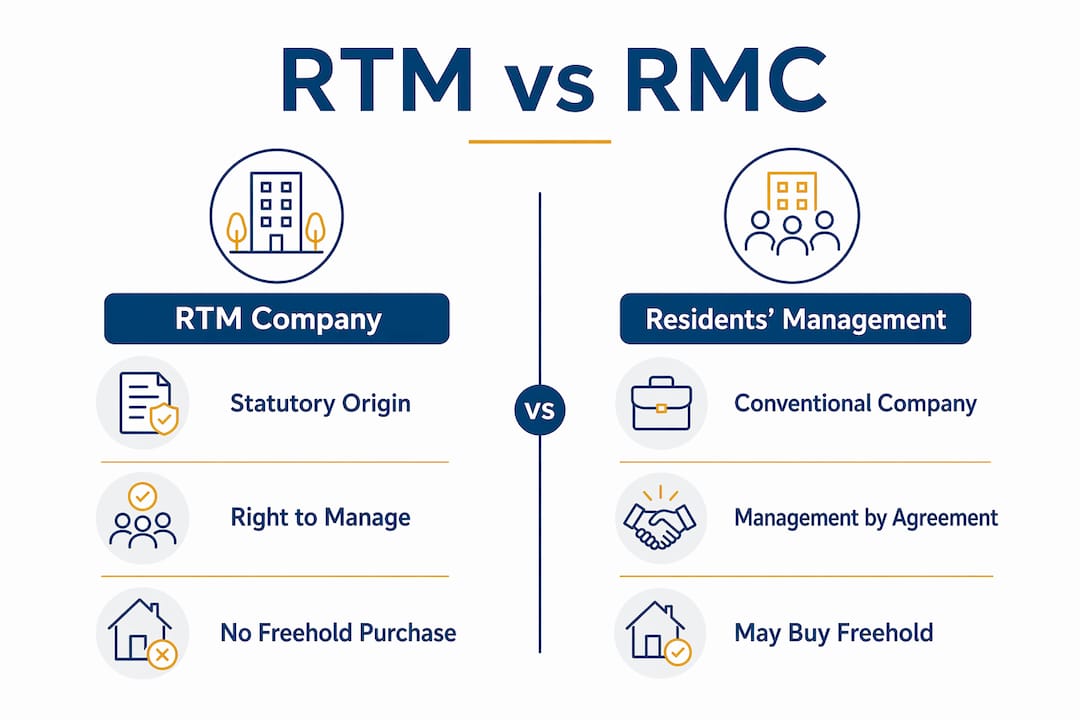
RTM company vs residents' management company: what is the difference?
RTM companies and residents' management companies (RMCs) are frequently confused, and that confusion causes expensive conveyancing errors. The distinction matters because the two structures have different legal origins, different powers, and different implications for leaseholders.
An RTM company is a statutory creation. It exists solely to exercise the right to manage under the Commonhold and Leasehold Reform Act 2002. An RMC, by contrast, is typically a company created by the original developer and embedded in the lease. Its powers derive from the lease itself, not from statute. An RMC may already hold management authority over a building before any RTM claim is considered.
Confusing RTM companies with RMCs leads to procedural errors. A leaseholder group that launches an RTM claim in a building already managed by an RMC may be pursuing an unnecessary and costly process. Solicitors advise confirming whether an RMC exists before any RTM claim is initiated, since an RMC can provide a faster and cheaper route to leaseholder control.
| Feature | RTM company | Residents' management company |
|---|---|---|
| Legal origin | Commonhold and Leasehold Reform Act 2002 | Developer-created, embedded in lease |
| Management powers | Statutory right to manage | Derived from lease terms |
| Membership | Qualifying tenants only (landlord post-acquisition) | Typically all leaseholders per lease |
| Voting rights | Landlord has none post-acquisition | Depends on lease provisions |
| Conveyancing check | Companies House and claim notice history | Lease and Companies House |
| Can it buy the freehold? | No | No (separate vehicle required) |
Conveyancers must check both Companies House and the lease itself to establish which structure governs the building. A building can have both an RTM company and an RMC, which creates a potential conflict over management authority. That conflict needs resolving before completion, not after. For a full comparison of these two structures, Righttomanage's guide on the role of RMC in leasehold sets out the practical differences clearly.
Note also that an RTM company cannot purchase the freehold. Leaseholders who want to acquire the freehold must use a separate vehicle through collective enfranchisement. Righttomanage's comparison of RTM versus buying the freehold explains when each route makes sense.
Key takeaways
RTM company structure conveyancing implications are most effectively managed when solicitors verify formation documents, membership registers, service charge fund transfers, and contract status before exchange.
| Point | Details |
|---|---|
| Company formation must precede claims | The RTM company must be incorporated at Companies House before any Section 79 claim notice is served. |
| Membership does not transfer automatically | Sellers' solicitors must notify the RTM company of ownership changes to protect buyers' voting rights. |
| Service charge funds require formal handover | Buyers should request written evidence of uncommitted fund transfer to avoid post-completion levies. |
| Contracts need active renegotiation | Maintenance and service contracts do not assign automatically; the RTM company must retender or novate each one. |
| RTM and RMC are legally distinct | Conveyancers must check both the lease and Companies House to confirm which structure governs the building. |
Why RTM conveyancing catches people off guard
The RTM process looks straightforward on paper. In practice, the conveyancing stage is where most problems surface, and they surface because neither the buyer nor their solicitor knew what questions to ask.
The most common oversight I see is the membership register. A leaseholder sells their flat, the RTM company is never notified, and the buyer completes without being added to the register. Six months later, there is a vote on a major works contract worth tens of thousands of pounds, and the buyer has no standing to participate. That is not a theoretical risk. It happens regularly, and it is entirely preventable.
The second issue is service charge fund transfers. Outgoing managing agents do not always release uncommitted funds promptly. A buyer who does not insist on written confirmation of the transfer before exchange can face a special levy within months of moving in. The RTM company's financial transparency obligations are clear in law, but enforcement takes time and money.
My advice to any leaseholder going through a sale or purchase in an RTM building is to treat the RTM company like a second legal entity in the transaction, because that is exactly what it is. Check its formation documents, its accounts, its register of members, and its contract schedule. Do not leave it to the managing agent to confirm these details. Go directly to the RTM company directors.
The RTM structure, when properly managed, gives leaseholders genuine control over their building. The conveyancing process is the moment to confirm that control is real and properly documented.
— Paul
How Righttomanage supports leaseholders through RTM conveyancing
Righttomanage manages the RTM process from eligibility check through to acquisition date preparation, including RTM company formation with prescribed articles, Companies House registration, and service charge handover guidance.
If you are buying or selling a leasehold flat in an RTM building, or you are ready to start an RTM claim, Righttomanage provides a free RTM eligibility check to confirm whether your building qualifies. The service covers Section 78 and Section 79 notices, counter-notice review, and full support through the acquisition date process. Leaseholders frustrated with poor managing agents, inflated service charges, or lack of transparency can find out exactly where they stand without any upfront cost.
FAQ
What is an RTM company in conveyancing?
An RTM company is a private company limited by guarantee, incorporated under the Commonhold and Leasehold Reform Act 2002, which holds the statutory right to manage a residential block. In conveyancing, it functions as a second legal entity whose membership, accounts, and contracts must be verified before exchange.
What does the RTM acquisition date mean for buyers?
The RTM acquisition date is when management of the building formally transfers to the RTM company. Buyers completing near this date must confirm that service charge funds have transferred and that maintenance contracts have been renegotiated, as neither happens automatically.
Does RTM company membership transfer when a flat is sold?
No. Membership does not transfer automatically. The seller's solicitor must notify the RTM company of the ownership change so the register of members is updated and the buyer can exercise voting rights.
What is the difference between an RTM company and an RMC?
An RTM company is a statutory creation under the 2002 Act, formed specifically to exercise the right to manage. A residents' management company is typically created by the developer and derives its powers from the lease. Checking both before launching an RTM claim avoids costly duplication.
Can an RTM company buy the freehold?
No. An RTM company cannot purchase the freehold. Leaseholders who want to acquire the freehold must use a separate collective enfranchisement vehicle, which is a legally distinct process from the right to manage.